


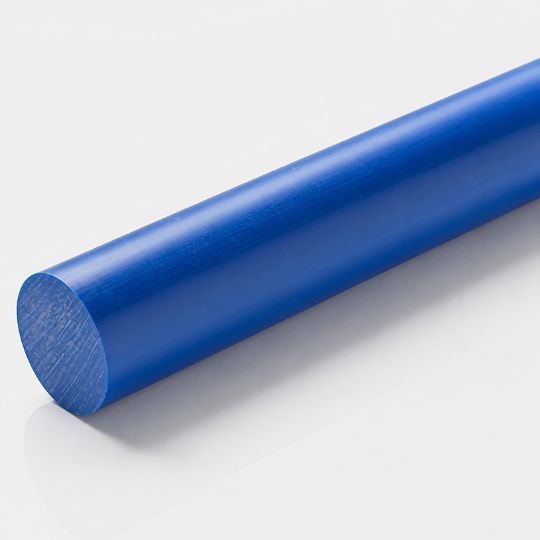
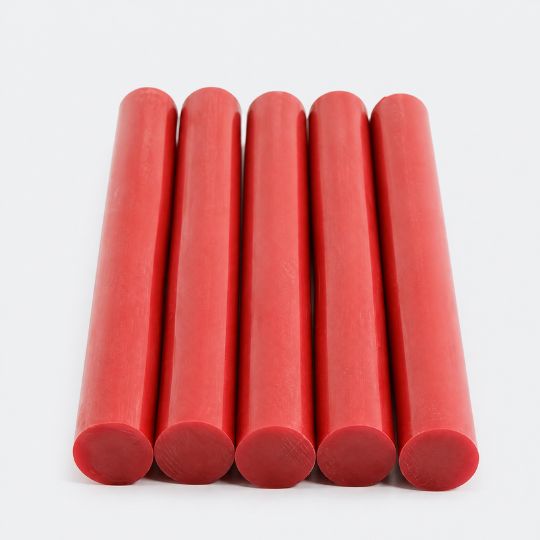
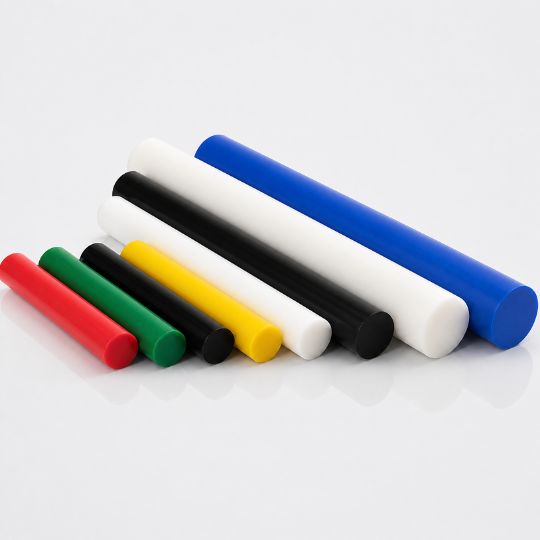
Why engineers specify HANSA for POM rod
- HANSA confirms grade and diameter in one reply.
- Your cut list is quoted as a cut list.
- HANSA supplies both grades across the full diameter range.
- You get the diameter tolerance before you order.
- HANSA quotes custom colour as its own run.
- Your lead time is quoted with the price.
About HANSA POM rod
POM rod, acetal rod, polyacetal rod and pom delrin all name the same material. Chemically it is polyoxymethylene — a semi-crystalline thermoplastic built on a repeating -CH2-O- chain — and that chain is why the material is stiff, slippery and dimensionally calm at the same time.
Delrin® is DuPont’s brand name for the homopolymer, so an acetal vs delrin comparison compares a generic name with one manufacturer’s trade name for the same base polymer, not two materials.
What arrives is a machinable round bar in the unfilled grade, produced in our own plant and supplied cut to your length.
POM rod types you can order from HANSA
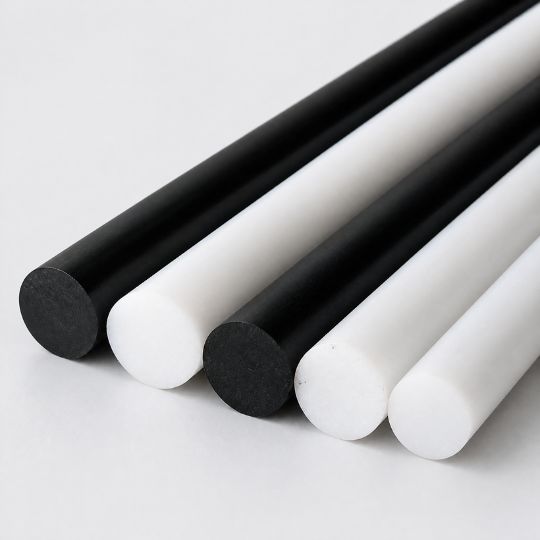
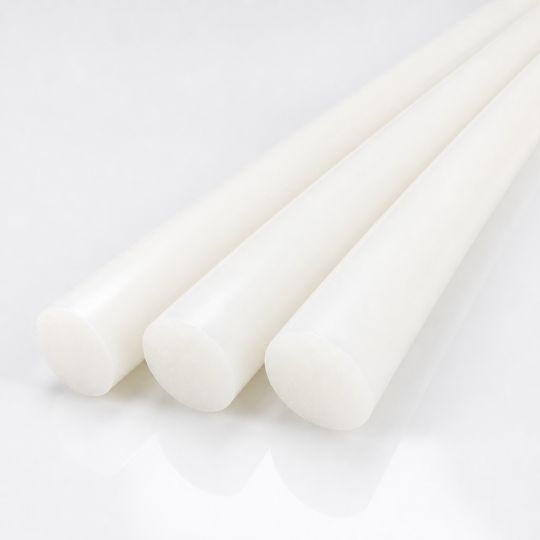
The bar machinists call acetal rod is polyoxymethylene, not cellulose acetate; HANSA supplies it unfilled, ready for the spindle.
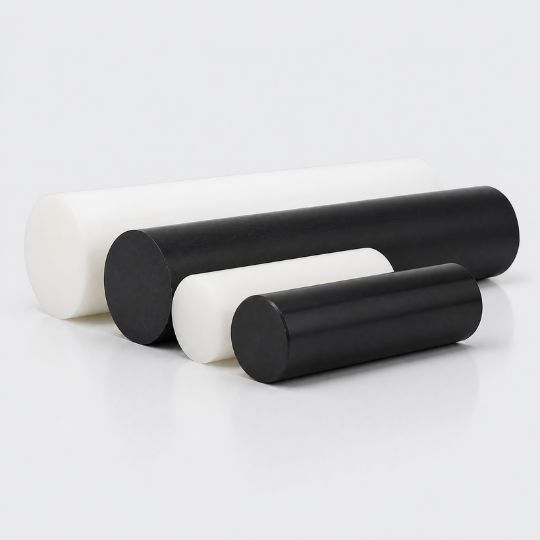
HANSA cuts POM rod from 1000 mm and 2000 mm stock, so you buy the length your part needs rather than a full bar.
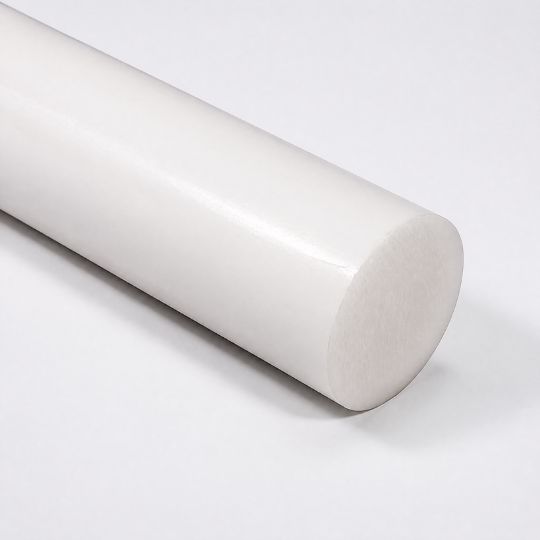
Acetal copolymer rod holds dimension in humid air and resists hydrolysis, so HANSA supplies it for wet service and chemical exposure.
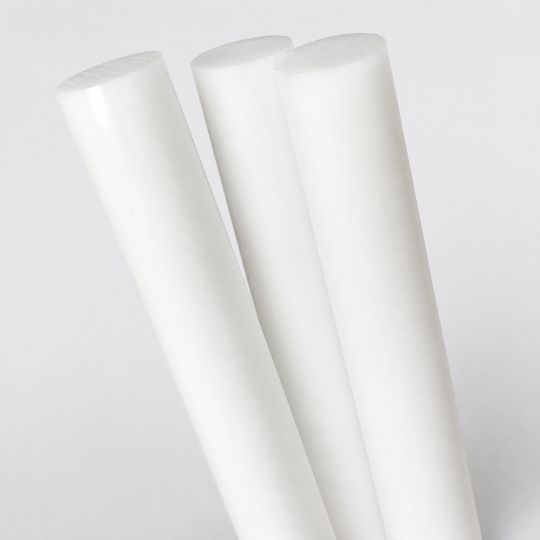
The stiffer, harder-wearing grade of the two — HANSA suggests acetal homopolymer rod for loaded gears and transmission parts.
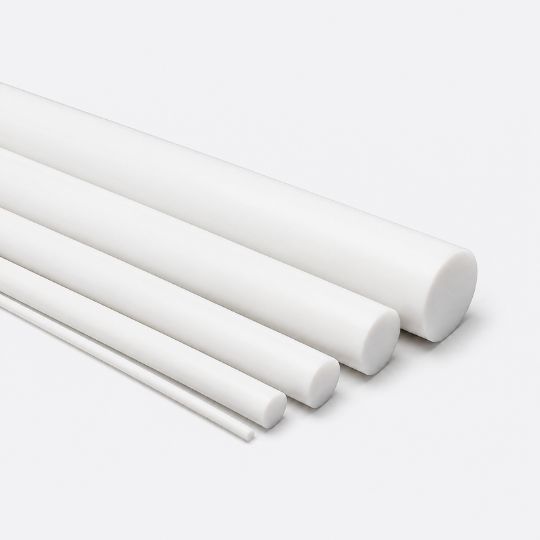
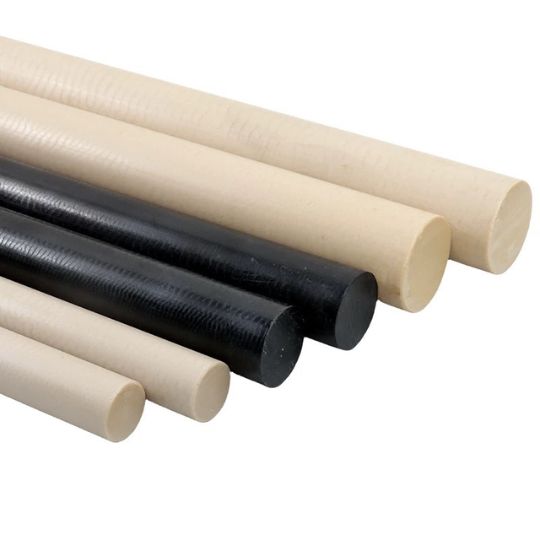
Natural acetal rod is unpigmented, so you see the material rather than a colour, and HANSA holds it across the full range.
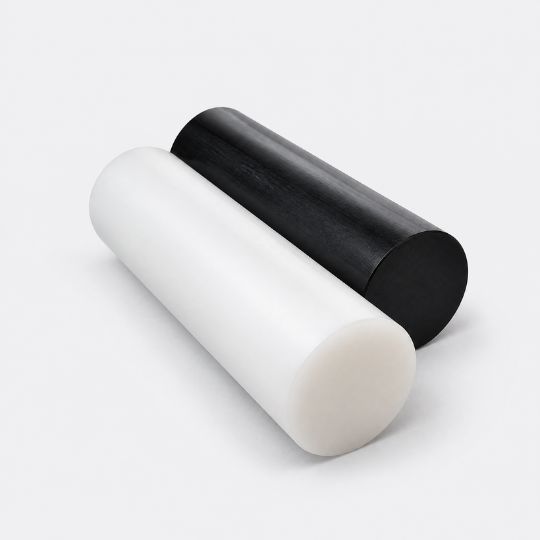
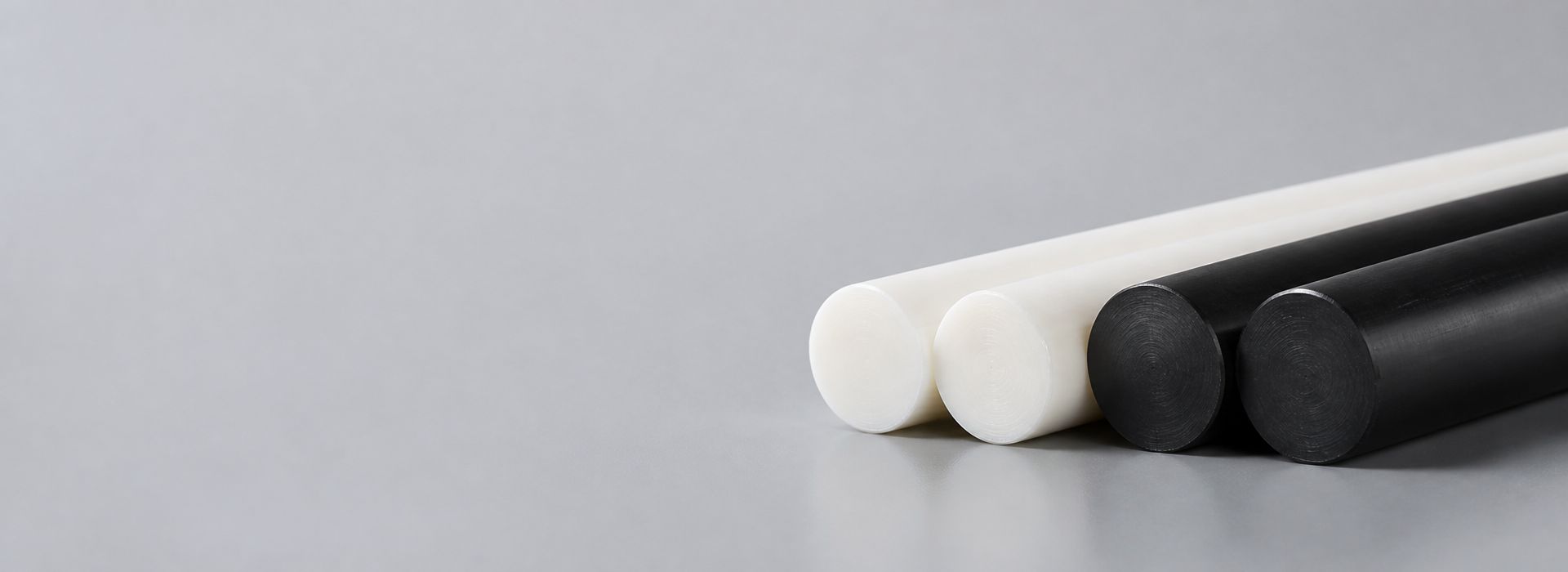
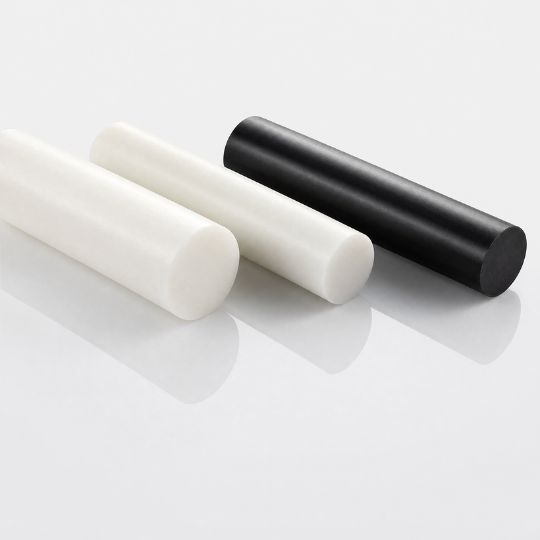
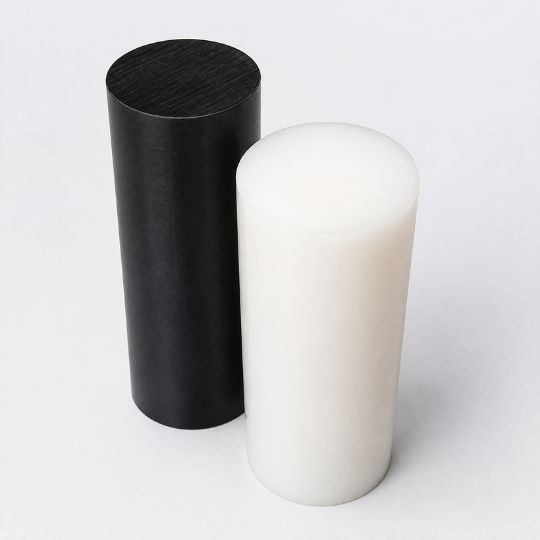
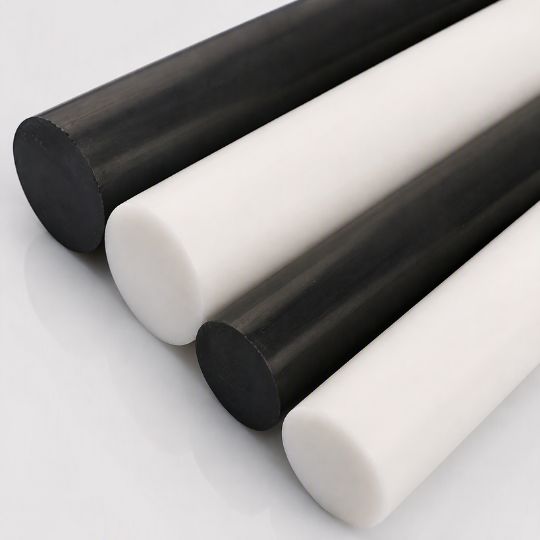
Black acetal rod and white acetal rod both ship from HANSA stock; white is the usual choice where a food-contact surface is inspected.
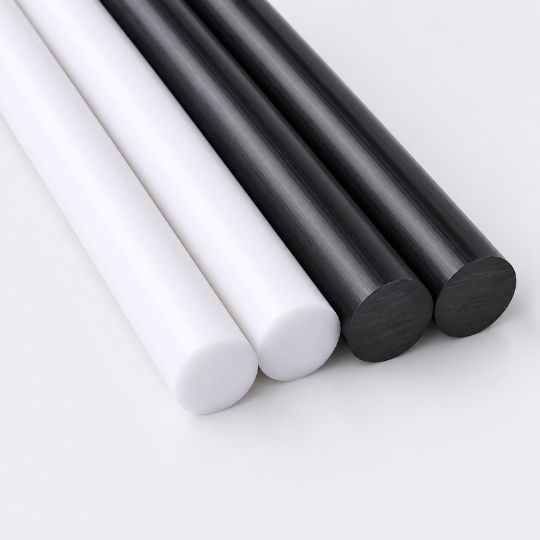
A delrin rod and a POM rod are the same rigid unfilled bar; Delrin® is DuPont’s brand, and HANSA supplies the equivalent grades.
More About HANSA POM Rod
- تحديد
- ملكيات
|
Diameter (mm) |
Theoretical unit weight (kg/m) | Diameter (mm) |
Theoretical unit weight (kg/m) |
| 6 | 0.048 | 80 | 7.58 |
| 8 | 0.076 | 85 | 8.6 |
| 10 | 0.117 | 90 | 9.5 |
| 12 | 0.178 | 95 | 10.7 |
| 14.8 | 0.248 | 100 | 12 |
| 15 | 0.31 | 110 | 14.4 |
| 18 | 0.368 | 120 | 16.7 |
| 20 | 0.5 | 130 | 19.8 |
| 22 | 0.6 | 140 | 22.8 |
| 25 | 0.76 | 150 | 26.4 |
| 30 | 1.1 | 160 | 29.6 |
| 32 | 1.25 | 170 | 34.2 |
| 35 | 1.48 | 180 | 38.2 |
| 40 | 1.9 | 190 | 43 |
| 45 | 2.44 | 200 | 48.5 |
| 47 | 2.5 | 210 | 55.6 |
| 50 | 2.97 | 220 | on request |
| 55 | 3.6 | 230 | 62.5 |
| 60 | 4.25 | 240 | 68.6 |
| 65 | 4.8 | 250 | 72.4 |
| 70 | 5.8 | 280 | 94.8 |
| 75 | 6.5 | 300 | 108 |
|
ملكية |
POM-H |
POM-C |
| كثافة | 1.41-1.43 g/cm³ | 1.38-1.41 g/cm³ |
| Water absorption, 24 h | 0.2-0.4 % | 0.2-0.4 % |
| قوة الشد | 60-70 MPa | 50-62 MPa |
| الاستطالة عند الانكسار | 20-30 % | 25-40 % |
| Notched impact | 6-10 kJ/m² | 7-12 kJ/m² |
| نقطة الانصهار | 165-175 °C (329-347 °F) | 165-175 °C (329-347 °F) |
| Continuous service temperature | -40 to 100 °C (-40 to 212 °F) | -40 to 100 °C (-40 to 212 °F) |
| القوة العازلة | 18-20 kV/mm | 18-20 kV/mm |
There is no minimum on standard specifications, because those ship from stock. Custom sizes and custom colours carry a 100 kg minimum.
Standard sizes ship from stock in 1 to 3 days. Bulk orders and custom specifications run 7 to 15 days, confirmed with your quote.
Yes. Stock comes in 1000 mm and 2000 mm, and we cut to your list, so you order the length your part needs.
+/-0.2 mm (+/-0.008 in). It is confirmed against your drawing before production, and because POM takes up very little moisture the figure holds after the bar is cut.
Yes. Both grades are supplied from 6 to 300 mm (0.24 to 11.8 in), so a grade change does not change your diameter.
No. A POM welding rod is a filler rod for plastic welding, not a solid bar. HANSA supplies solid round bar for machining, by diameter and cut length.
Yes, in the black and white material, which is held to FDA food-contact requirements. Tell us the application when you enquire.

What Changes When You Machine POM Rod Instead of Metal
POM rod cuts like brass and behaves like neither metal nor a soft plastic. The chips come off clean, the surface finishes well, and the tool load stays low — which is why a shop that has never run acetal will usually get a good first part. What surprises them is everything downstream of the cut.
The difference is heat. POM conducts heat poorly, so the heat your tool generates stays at the cutting edge instead of spreading into the bar. Push a dull tool or a heavy feed and the surface of a POM rod can soften, smear and tear while the part still measures correctly. The practical answer is a sharp, polished cutter with a positive rake, a generous clearance angle, and air rather than coolant to clear the chip.
Clamping is the second difference. A POM rod between centres will spring under a chuck pressure that a steel bar would shrug off, and a thin wall will ovalise before the tool touches it. If your part has a bore, rough it, let the bar come back to room temperature, then finish. HANSA supplies every POM rod oversize enough that you can take that second pass without losing the finished diameter.
Stiffness and Strength Under Load
For a thermoplastic, POM rod is stiff. It holds its shape under load better than most unfilled engineering plastics, and it keeps that stiffness in humid air, which is where nylon starts to lose it. That combination — rigid and dimensionally calm — is the reason a POM rod ends up in fixtures, valve bodies and transmission parts rather than in covers and housings.
Grade changes the number. The homopolymer grade is the stronger and more rigid of the two, and it is the one specified for high-load gears and mechanical transmission components. The copolymer grade gives up a little strength and buys back chemical resistance and processing tolerance. HANSA supplies both in the same diameter range, so a grade change does not force a drawing change.
The limit is time. POM creeps: a part held under continuous load will keep deforming slowly, even at room temperature, and the rate rises with temperature. A static load that looks comfortable against the tensile figure can still walk out of tolerance over a year of service. Design for the load you will actually carry, and if the duty is a permanent one, treat the published strength of any POM rod as an upper bound rather than a working stress.
Low Friction and Wear Without Added Lubricant
POM rod is self-lubricating. Its coefficient of friction against steel is low enough that dry-running sliding parts are a normal application rather than a compromise, and that is what puts POM rod in bushings, wear strips, cam followers, rollers and gear trains where a grease line would be a maintenance item nobody wants.
Wear resistance follows the same logic. The homopolymer grade resists abrasion better than the copolymer, so it is the default for a part that sees continuous sliding contact rather than occasional movement. If the duty is a high-load sliding application instead of a simple bearing surface, filled grades exist for exactly that reason — but they are a different specification. A PTFE rod is the other route when friction has to be lower still and stiffness matters less.
The honest limit is the product of load and speed. Unfilled POM rod, run dry, has a practical ceiling; past it the surface heats faster than it can dissipate and wear stops being gradual. If your application sits near that ceiling, tell HANSA the load, the speed and the duty cycle when you enquire, because the right answer may be a different material rather than a different grade.
Moisture, Dimensional Stability, and What It Means at Your Machine
This is the property that separates POM rod from the nylon it often replaces. POM absorbs very little moisture, so a bar does not grow between the storeroom and the machine, and a part does not change size after it has been cut. For a shop holding a tolerance, that predictability is worth more than a higher strength figure.
It also makes the diameter tolerance mean something. HANSA holds POM rod to +/-0.2 mm (+/-0.008 in) on diameter, and because the material is not quietly swelling or shrinking underneath that number, the tolerance you buy is close to the tolerance you keep. With a moisture-sensitive plastic the same printed tolerance can be true at despatch and false a week later.
POM is not immune. It still takes up a small amount of moisture, and the copolymer grade resists hydrolysis in hot wet service noticeably better than the homopolymer. If the part lives in hot water, steam or a humid enclosure above room temperature, that difference decides the grade before strength does.
How POM Rod Behaves at Temperature
The published continuous service range for POM rod is -40 to 100 °C (-40 to 212 °F), and that range is a starting point rather than a guarantee for your part. The ceiling that matters is set by three things at once: the grade, the load the part carries, and how long it carries it. A lightly loaded part can sit near the top of the range for years; the same part under continuous load will creep there in months.
Two behaviours matter in service. POM has a sharp melting point for a thermoplastic, so it does not soften gradually on the way to failure — there is little warning between “fine” and “flowing”. And it is not a UV-stable material, so an outdoor part needs either a stabilised grade or a design that keeps the sun off it.
If your service temperature is above the range, or if the part is expected to hold a dimension at the top of it, say so when you ask HANSA for a quote. The grade recommendation changes, and so does the answer — a PEEK rod or a PVDF rod is the usual next step when the ceiling is the constraint.
Where POM Rod Fits, and Where It Does Not
POM rod fits where you need stiffness, low friction and dimensional calm at the same time: gears, sprockets, bushings, wear pads, rollers, cam plates, valve components, pump parts, conveyor guides, and food-contact machinery parts. It fits especially well where the part replaced a bronze or steel component and the lubrication point was the thing you wanted to remove.
It does not fit everywhere, and the list is short but real. POM rod is not the right choice for continuous service above its temperature range. It is not the right choice for strong acids and oxidising agents. It is not UV-stable outdoors without protection. It creeps under sustained load, so a part that must hold a preload indefinitely needs a different answer. And unfilled POM run dry has a load-and-speed ceiling that a filled grade or a different polymer will beat — a UHMW-PE rod is often the cheaper answer where impact and abrasion dominate.
Being straight about those limits is part of the quote. If you describe the duty and HANSA thinks POM rod is the wrong material, you will hear that before you place an order rather than after the parts fail.
POM-C, POM-H, Nylon and Bronze Side by Side
The right column depends on your duty:
If the part runs dry and must hold a dimension, acetal is usually the shortest route. If it runs hot and wet, the copolymer column is the one to take. If it carries a shock load and moisture does not matter, nylon earns its place.
How to Specify a POM Rod Order
Six things fix a quote for a POM rod: diameter, length, grade, colour, quantity, and the duty the part will see. Diameter runs from 6 to 300 mm (0.24 to 11.8 in). Standard lengths are 1000 mm and 2000 mm (39.4 in and 78.7 in), and HANSA cuts to your length, so a cut list on a POM rod order is as usable as a stock length. Grade is POM-C or POM-H, both held across the same diameter range. Colour is black or white from stock, natural is also available, and any other colour is a custom run.
Lead time follows stock. Standard sizes ship from stock in 1 to 3 days, and bulk orders or custom specifications run 7 to 15 days. There is no minimum order quantity on standard specifications, because those ship from stock; custom sizes and colours carry a 100 kg minimum. The relevant quality certifications are held for the POM line.
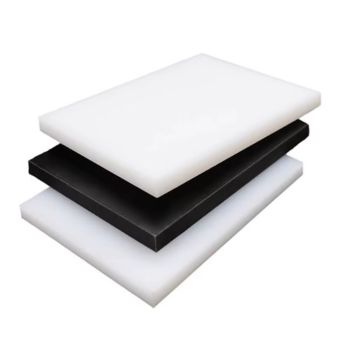
If you send the diameter, the cut length and the quantity, HANSA will come back with the price and the lead time together, and will tell you if the duty suggests a different grade than the one you asked for. A POM sheet runs on the same stock and the same lead time if your part starts as plate rather than bar, and the plastic rod index covers the other materials in the same format.

 Arabic
 English
 Tibetan
 German
 Spanish
 French
 Hindi
 Indonesian
 Italian
 Japanese
 Korean
 Dutch
 Portuguese
 Thai
 Russian
 Swedish
 Chinese