



Why Engineers Specify HANSA for PCTFE Rod
- PCTFE resin supply you can rely on for repeat orders.
- HANSA books monthly capacity against your build schedule.
- Lead times for OEM customers are fixed by HANSA on every release.
- Batch stability is tracked across long-term projects.
- Grade data you can sign a drawing against comes with your quote.
- HANSA confirms your document set with the price.
About HANSA PCTFE Rod
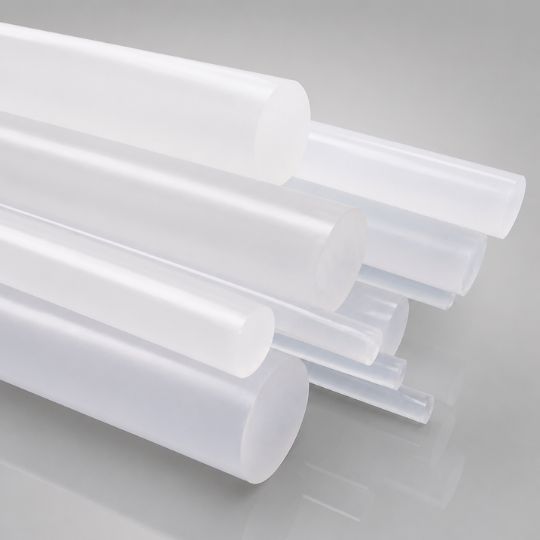
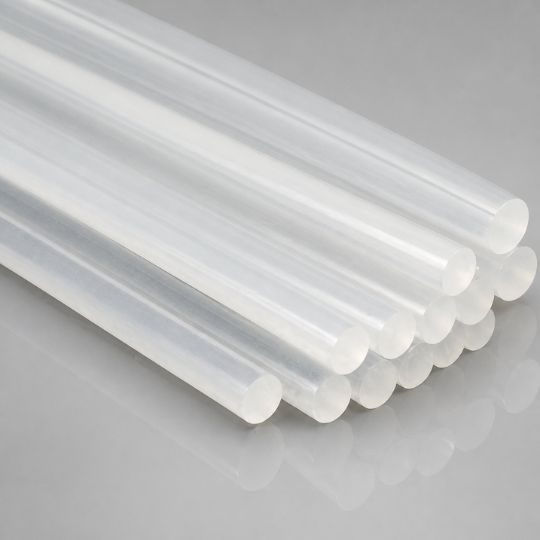
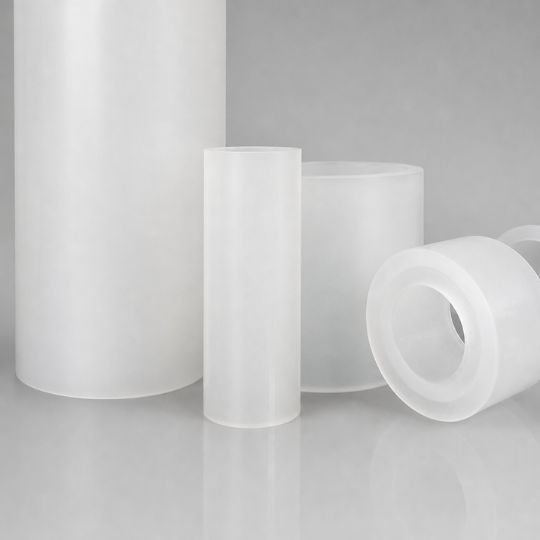
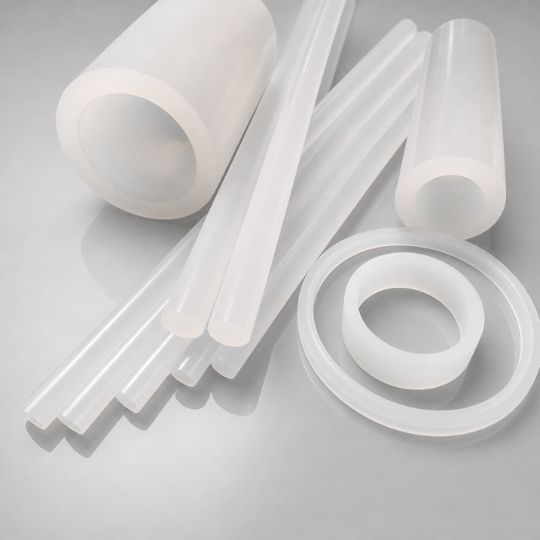
HANSA is a PCTFE rod manufacturer based in China, supplying unfilled polychlorotrifluoroethylene round bar in diameters from 10 to 100 mm (0.39 to 3.94 in) in one-metre lengths, with cut lengths and machined components available on request. PCTFE (also known as Kel-F®) is specified for its rigidity and dimensional stability under load, its very low water-vapour and gas transmission, its low outgassing, its electrical insulation and its resistance to radiation. HANSA has manufactured engineering plastics since 1995 and exported since 2005, and quotes PCTFE rod against the diameter, length, quantity and duty you send.
Contact us to request samples, datasheets, or custom diameters.
PCTFE Rod Types You Can Order From HANSA
PCTFE is a rigid, low-permeability fluoropolymer: stiffer than PTFE and far lower in moisture and gas transmission, with a continuous service range from -240 to 150 °C (-400 to 302 °F). HANSA supplies it as unfilled round bar, and these are the six ways buyers specify it.
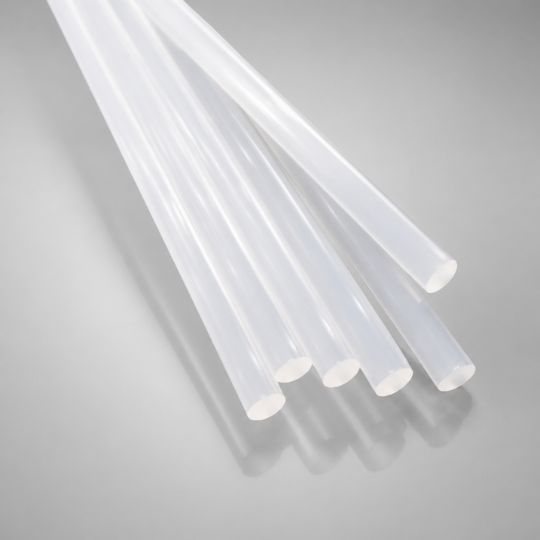
PCTFE and Kel-F® are the same polymer, so a Kel-F rod and a PCTFE rod are the same rigid unfilled bar: 10 to 100 mm, supplied by the metre.
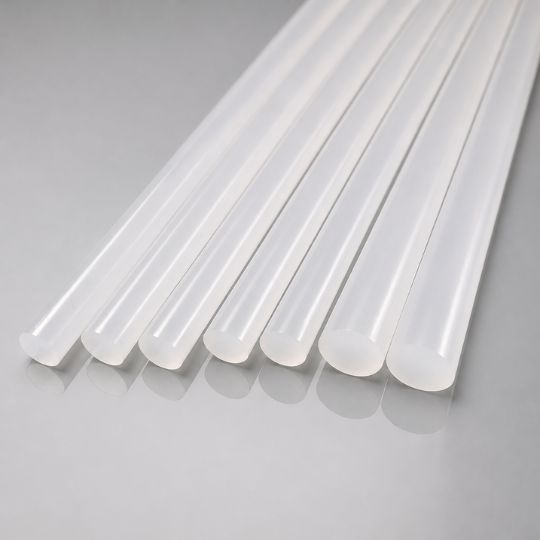
PCTFE cryogenic service needs a part that stays hard and keeps its dimensions as the temperature falls – the behaviour that puts it into cold-box seals and liquid-gas valve seats.
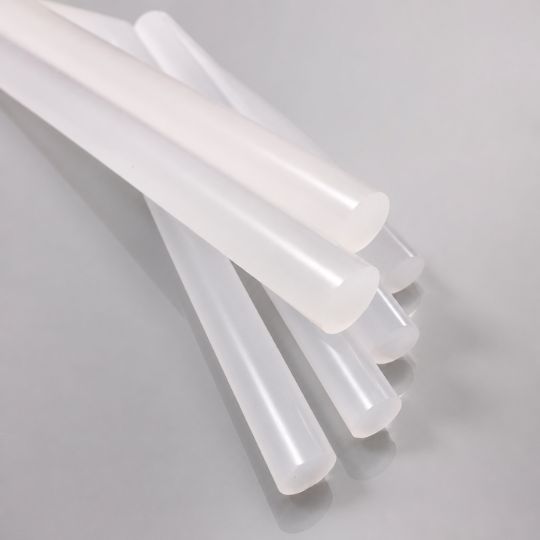
PCTFE’s rigidity resists the cold flow that lets a seat lose its interference, so a PCTFE seal machined from PCTFE rod holds under sustained load.
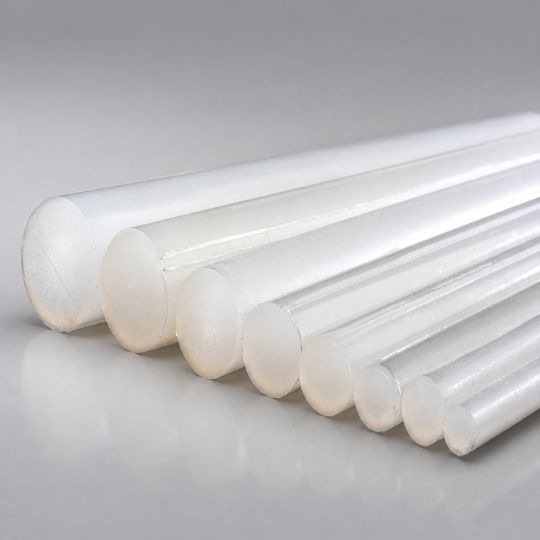
PCTFE chemical resistance covers acids, bases, oxidisers, hydrocarbons and solvents, and water absorption stays below 0.01%, so the part does not swell out of tolerance.
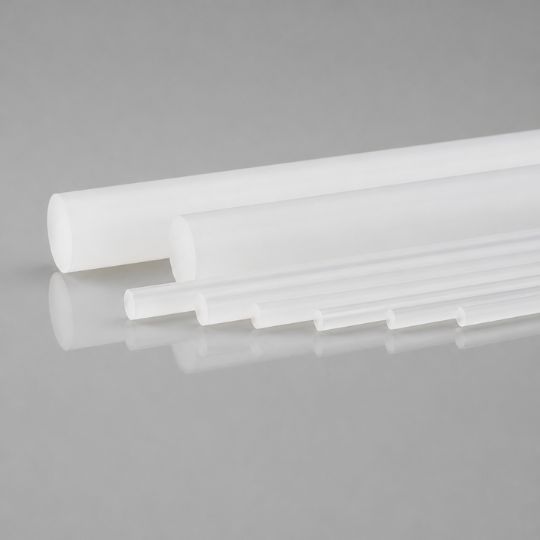
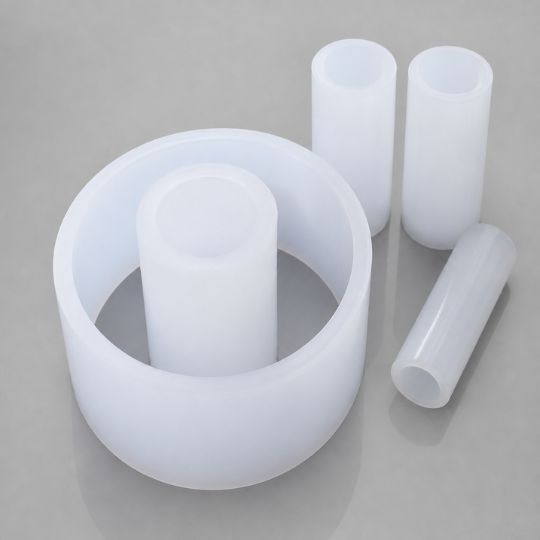
Custom PCTFE rod suits short runs and spares: cut to your drawing, so a worn seat is replaced without buying or storing a full metre.
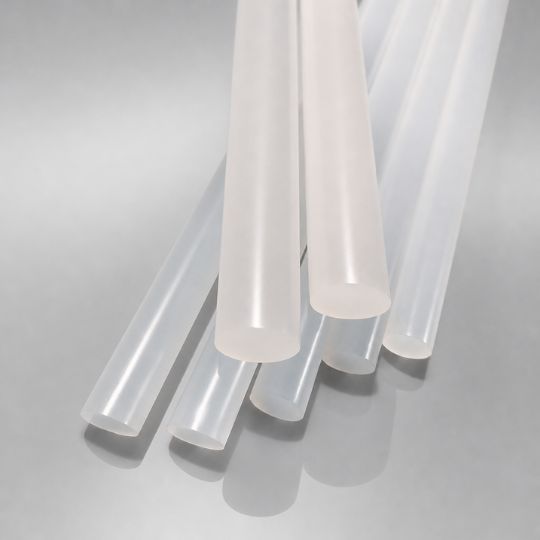
HANSA is the PCTFE rod supplier and manufacturer behind every diameter, working from its own plant in China, so bar, tolerance and paperwork come from one source.
PCTFE Rod Sizes and Supply Form
Stocked nominal diameters run from 10 to 100 mm (0.39 to 3.94 in). Standard supply is by the metre, in 1000, 2000 and 3000 mm lengths; cut lengths are agreed against your cutting list.
- Sizes
| Nominal diameter (mm) | Nominal diameter (in) | Standard supply |
| 4 | 0.16 | 1000 / 2000 / 3000 mm |
| 5 | 0.2 | 1000 / 2000 / 3000 mm |
| 6 | 0.24 | 1000 / 2000 / 3000 mm |
| 7 | 0.28 | 1000 / 2000 / 3000 mm |
| 8 | 0.31 | 1000 / 2000 / 3000 mm |
| 9 | 0.35 | 1000 / 2000 / 3000 mm |
| 10 | 0.39 | 1000 / 2000 / 3000 mm |
| 11 | 0.43 | 1000 / 2000 / 3000 mm |
| 12 | 0.47 | 1000 / 2000 / 3000 mm |
| 13 | 0.51 | 1000 / 2000 / 3000 mm |
| 15 | 0.59 | 1000 / 2000 / 3000 mm |
| 18 | 0.71 | 1000 / 2000 / 3000 mm |
| 20 | 0.79 | 1000 / 2000 / 3000 mm |
| 25 | 0.98 | 1000 / 2000 / 3000 mm |
| 30 | 1.18 | 1000 / 2000 / 3000 mm |
| 35 | 1.38 | 1000 / 2000 / 3000 mm |
| 40 | 1.57 | 1000 / 2000 / 3000 mm |
| 45 | 1.77 | 1000 / 2000 / 3000 mm |
| 50 | 1.97 | 1000 / 2000 / 3000 mm |
| 55 | 2.17 | 1000 / 2000 / 3000 mm |
| 60 | 2.36 | 1000 / 2000 / 3000 mm |
| 65 | 2.56 | 1000 / 2000 / 3000 mm |
| 70 | 2.76 | 1000 / 2000 / 3000 mm |
| 75 | 2.95 | 1000 / 2000 / 3000 mm |
| 80 | 3.15 | 1000 / 2000 / 3000 mm |
| 85 | 3.35 | 1000 / 2000 / 3000 mm |
| 90 | 3.54 | 1000 / 2000 / 3000 mm |
| 100 | 3.94 | 1000 / 2000 / 3000 mm |
Yes in practice. Kel-F® was the original brand name for PCTFE; the trademark was used by 3M and the material has since been produced under other names, including Neoflon®. “PCTFE”, “Kel-F” and “polychlorotrifluoroethylene” all name the same polymer, so a Kel F rod and a Kel-F rod are the same unfilled bar, and HANSA quotes it as PCTFE rod.
HANSA manufactures and machines the bar, and has manufactured engineering plastics since 1995 and exported since 2005.
It is quoted per order. Tell us the diameters, the lengths and the quantities you need and the minimum ships with the quotation.
HANSA prices per order against the diameter, the cut length and the quantity, and confirms the price alongside the tolerance. Send the diameter and the length you need and the quotation covers the exact bar rather than a list figure.
It is confirmed per order against the diameter and quantity, and quoted together with your price. Stocked diameters move fastest; non-standard diameters and machined components are scheduled with the order. If you run a long-term OEM programme, monthly capacity is booked in advance, so the date is held on each release instead of being re-negotiated at every purchase order.
Yes. Standard supply is by the metre in 1000, 2000 and 3000 mm lengths, and cut lengths are agreed against your cutting list.
Send the drawing. HANSA machines and inspects in-house, so you can order bar stock or finished components from the same supplier.
Related Products You May Need
What Is PCTFE, and What the Chlorine Atom Changes
PCTFE rod is solid round bar machined from polychlorotrifluoroethylene. If you already work with fluoropolymers you know the family; PCTFE is the member of it that trades some chemical inertness for rigidity, and that trade is why it turns up in sealing faces, barrier components and electrical parts where PTFE would move too much. HANSA supplies unfilled PCTFE round bar in diameters of 10 to 100 mm (0.39 to 3.94 in) and in 1000, 2000 and 3000 mm (3.28, 6.56 and 9.84 ft) lengths, for engineers who then machine your PCTFE rod to their own drawing.
What the Chlorine Atom Actually Changes
The whole material follows from one substitution. PTFE’s chain carries carbon and fluorine only. PCTFE carries a chlorine atom on every repeat unit, and the chlorine is bulkier than fluorine. That extra bulk pulls the polymer chain into a tighter, more ordered packing, which raises stiffness and hardness and makes the material far less willing to creep under a sustained load.
Three of PCTFE’s headline behaviours come from the same cause. The tighter packing leaves less free volume for water or gas molecules to travel through, which is why its water-vapour and gas transmission is lower than PTFE’s and among the lowest of any thermoplastic. The same dense packing limits how much the polymer moves when the temperature changes or when humidity does, so the dimensions on the PCTFE rod you machine tend to still be there at inspection. And because the chlorine increases intermolecular forces, the material resists deformation under load rather than slowly flowing out of shape the way PTFE does. Unfilled PCTFE runs at a density of 2.10 to 2.20 g/cm³, which is the range to design weight and machined-part mass against.
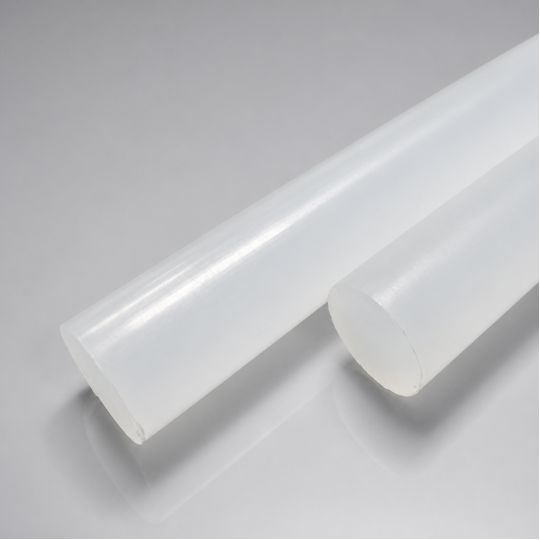
You can also see the polymer in the bar itself: unfilled PCTFE is translucent and can be supplied clear in thin sections, where PTFE is opaque and waxy to the touch.
PCTFE Rod vs PTFE Rod: Where the Two Diverge
Buyers often arrive at PCTFE expecting a straight upgrade. It is not. The two materials fail in different ways, and the decision is usually about whether your part must resist deformation or resist chemistry.
| What you are comparing | PCTFE rod | PTFE rod |
| Polymer chain | Carbon, fluorine and chlorine | Carbon and fluorine |
| Stiffness and rigidity | Higher – a stiff, hard bar | Lower – soft and compliant |
| Deformation under sustained load | Resists it; a sealing face stays put | Creeps more readily |
| Water-vapour and gas transmission | Lower – the barrier property | Higher |
| Chemical inertness | Broad, narrower than PTFE | The widest in the family |
| Lowest friction | Good, not the family’s lowest | The lowest of any solid polymer |
| Optical clarity | Translucent, clear in thin sections | Opaque |
| Relative cost | Higher | Lower |
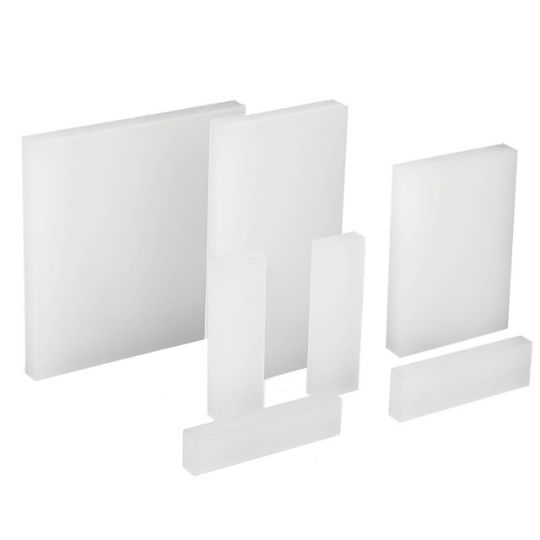
Read that table as trade-offs, not a ranking. Specify PCTFE rod when the part has to keep its shape and keep a gas or vapour out. Specify PTFE when the duty is maximum chemical inertness or the lowest possible friction, and read PTFE rod for that side of the comparison. For the chemistry itself, the mechanism is set out in PCTFE vs PTFE. If your part starts from flat stock rather than bar, the same reasoning governs PCTFE sheet.
Rigidity, Cold Flow and Dimensional Stability
Cold flow is the quiet failure mode in fluoropolymer parts. A PTFE gasket or seat that was correct at installation continues to deform under a bolted load, the sealing stress relaxes, and the joint weeps months later without anything having visibly broken. If you have chased that leak, you already understand why PCTFE rod exists in so many seal and seat designs.
Because PCTFE resists creep, a machined seat or washer holds the interference you designed into it. That makes the material attractive for a joint that must stay tight under a constant load, and for a part whose dimensions must survive both a load and a temperature excursion. HANSA machines and supplies this material for exactly those duties, and the rigidity you get is the reason a PCTFE rod can be machined to a fine surface finish and hold it.
There is a design consequence worth naming. A stiffer material tolerates less misalignment than a compliant one, so a PCTFE sealing face has less capacity to absorb a distortion in the mating part than PTFE would. The material does not forgive a flange that is out of flat.
Low Temperature and Cryogenic Service
PCTFE rod does not become brittle and useless as the temperature falls the way many thermoplastics do. Its increase in stiffness at low temperature is the useful part: where other polymers turn soft, or the opposite, PCTFE stays rigid and keeps its dimensions, which is why it is specified for cryogenic valves, seats and barrier components in liquefied-gas service.
Two cautions belong with that. Thermal contraction is real, and it changes clearances: a joint that seals at ambient may need a different interference at cryogenic temperature, and that calculation sits on your side of the design. The published continuous service range for HANSA’s unfilled PCTFE rod is -240 to 150 °C (-400 to 302 °F), and within that window the figure you can actually run depends on the grade, the load, the cycle and the medium – so treat the range as the envelope, not as a blanket approval, and confirm your working temperature against the duty. If your application runs near either end, ask for PEEK rod أو polyimide rod to be compared against PCTFE rod in the same review.
Moisture, Gas Permeability and Outgassing
This is where the material earns its place. Its water-vapour transmission is lower than PTFE’s and sits among the lowest of any thermoplastic, and its permeability to gases follows the same pattern. If your application involves keeping moisture out of a package, holding a vacuum, or controlling a gas across a barrier, that property is the reason to specify PCTFE rod rather than a nicer finish on something else.
The same low free volume that limits transmission also limits how much the material releases into a clean environment. Low outgassing matters in vacuum chambers and analytical instruments, where a part that sheds volatiles contaminates the system it was meant to protect. Water absorption for the unfilled grade is below 0.01%, which has a second benefit for the machinist: the bar does not swell after you cut it, so a dimension you set on the machine tends to still be there when the part reaches inspection.
How PCTFE Rod Stands Up to Chemicals and Radiation
PCTFE rod resists most acids, bases, oxidisers, hydrocarbons and solvents. It is not PTFE, and the difference matters at the aggressive end: where a medium would attack an elastomer or a commodity plastic, PCTFE usually holds, but PTFE remains the reference when the chemistry is extreme. The wider picture of how fluoropolymers behave against specific media is covered under خصائص PTFE.
Radiation is the other half of this section. PCTFE withstands ionising radiation considerably better than most polymers, which is what puts it into nuclear and radiation-exposed equipment alongside its barrier behaviour. In practice the two properties are often wanted in the same part: an insulator that sees both radiation and moisture.
Electrical Insulation and Optical Clarity
PCTFE rod is a good electrical insulator with low dielectric loss, and it keeps that performance when it gets damp – a combination that many insulating plastics do not offer. For a component that has to insulate in humid or condensing conditions, or where the surface resistance must stay stable, the material is a sound starting point, and its stiffness means the part can be thin without losing shape. HANSA machines insulating components from this bar for electronics and semiconductor work, where both the electrical behaviour and the low outgassing are wanted.
Unfilled PCTFE is translucent, and in thin sections it can be supplied clear. For a sight part, a window insert or a component where you want to see the medium, that is a rare combination in a material that also insulates and resists chemicals.
What PCTFE Rod Cannot Do
A page that only lists advantages is not much use to an engineer, so here is where this material is the wrong answer.
PCTFE rod is not a low-friction material in the way PTFE is. If the job is the lowest possible coefficient of friction, or chemical inertness against the widest range of media, PTFE wins and you should specify it. PCTFE is also not a high-temperature polymer in PEEK’s class; if the service temperature is the governing constraint, PEEK or polyimide is the family to look at. From HANSA, unfilled PCTFE rod is the grade we supply today, so if your design assumes a filled grade, tell us at enquiry stage rather than after the drawing is released. And the material costs more than the commodity plastics by a wide margin, so it is worth asking whether the application genuinely needs the barrier and the rigidity before you commit to it.
The last honest limit is a commercial one. HANSA does not print a single stock tolerance figure for this material, because the number only means something alongside the condition it is measured in – the diameter, the length, how the bar has been handled and the process you intend to run. It does not follow that a PCTFE rod cannot be held to a tight tolerance. It can, and we agree one with you: send the finished diameter and length you need, and the tolerance and the inspection basis come back with the quotation.
How Do You Order PCTFE Rod from HANSA?
Three things get you a firm answer the same working day.
First, the diameter and the length you want cut from each, with the quantities. Stocked PCTFE rod sizes run from 10 to 100 mm (0.39 to 3.94 in) and standard supply is by the metre in 1000, 2000 and 3000 mm lengths; if your drawing needs a specific cut length, say so and we will confirm what is available.
Second, what the part has to do. The medium it contacts, whether it holds a vacuum or a seal, whether it operates cold, and whether it has to insulate. Those four answers decide whether PCTFE is the right polymer at all, and they are the difference between quoting a bar and quoting a bar that works.
Third, your drawing, if the part will be machined rather than cut. Unfilled PCTFE machines cleanly on standard tooling with sharp edges and good chip clearance, and HANSA runs the machining and the inspection under one roof, so you can order PCTFE rod as bar stock or as finished components from the same supplier.
If you are unsure which fluoropolymer fits, send the duty and let HANSA compare it against PTFE rod, PEEK and بولي فينيل كلوريد before you commit. Quality documentation for your incoming inspection is agreed with the order, and the process behind it is described on our ضمان الجودة و manufacturing capabilities pages.
Send us your sizes, your duty and your drawing. You will have the quote for your PCTFE rod, the confirmed tolerance and the ship date back in one reply.

 Arabic
  English
  Tibetan
  German
  Spanish
  French
  Hindi
Hindi  Indonesian
  Italian
  Japanese
  Korean
  Dutch
Dutch  Portuguese
  Thai
Thai  Russian
  Swedish
  Chinese