


Why Engineers Specify HANSA for PVDF Rod
- HANSA makes PVDF rod in its own plant in China.
- You deal with one engineer from enquiry through shipment.
- Production is planned against your own build schedule.
- HANSA issues batch documentation to match your quality plan.
- Your cut-to-length and finished machining run under one roof.
- HANSA inspects and records every batch before dispatch.
About HANSA PVDF Rod
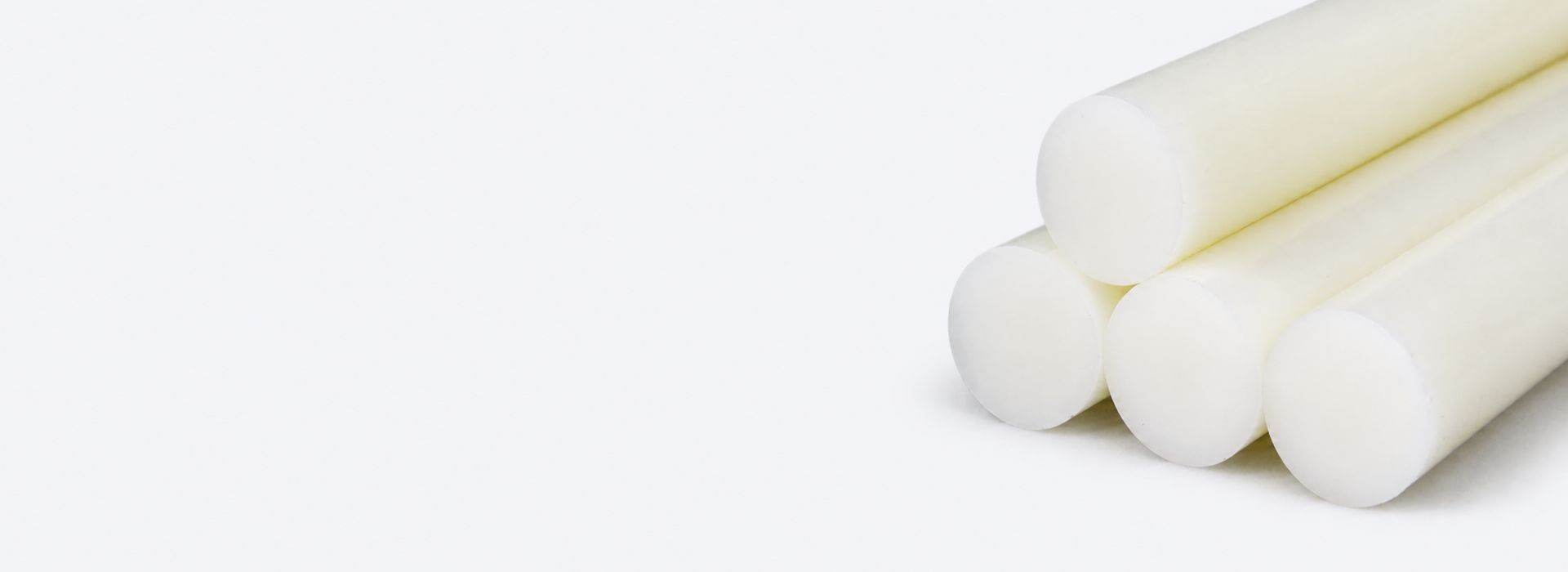
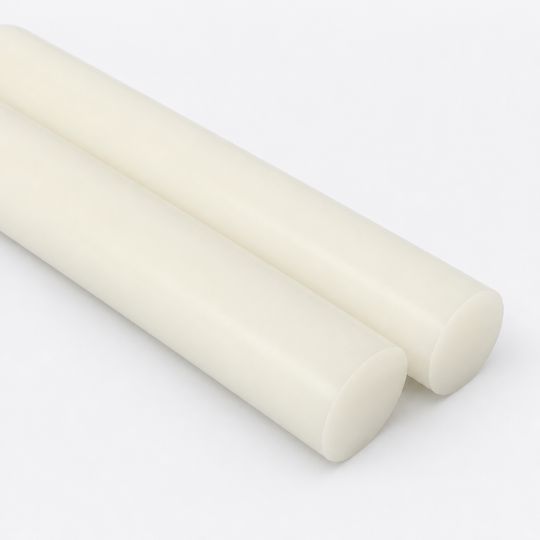
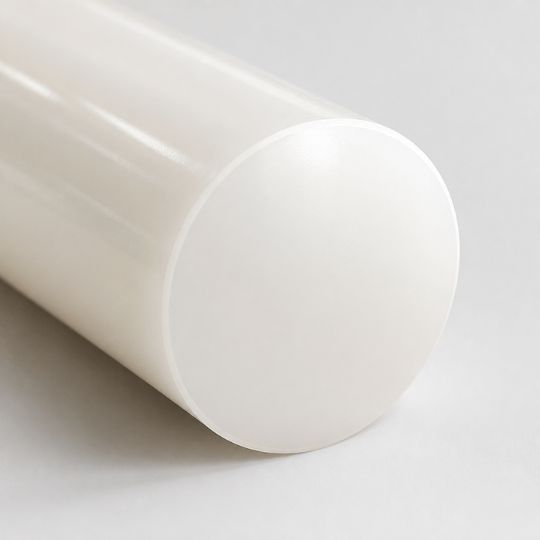
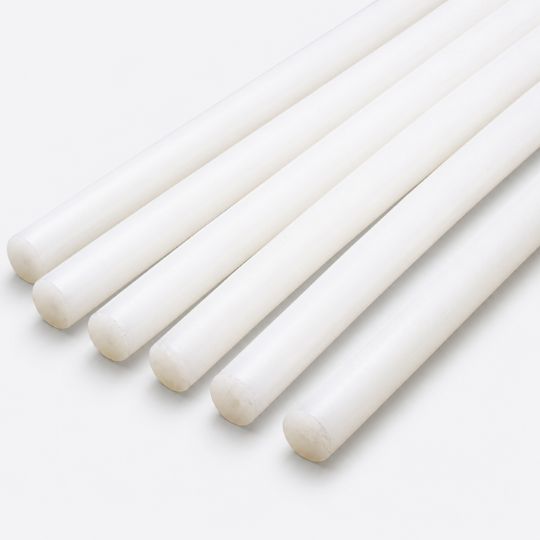
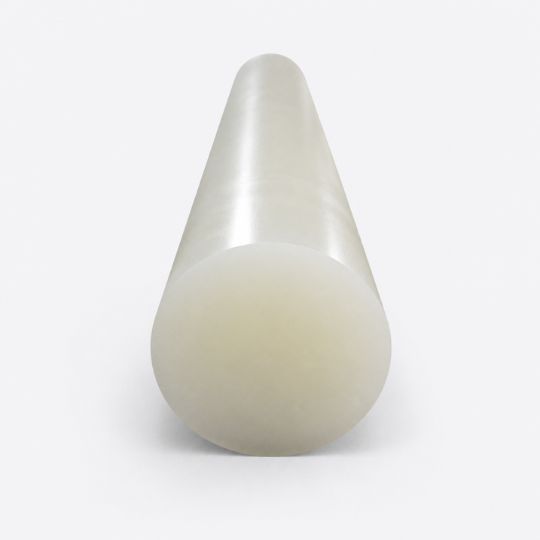
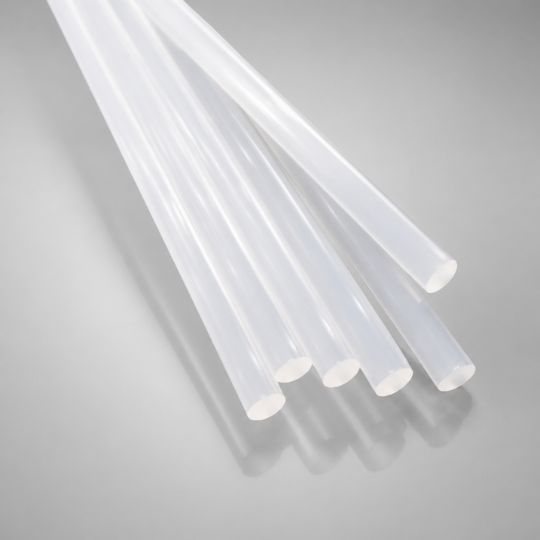
A PVDF rod is a solid round bar of polyvinylidene fluoride — a semi-crystalline fluoropolymer, and the one that Kynar is a trade name for. Kynar PVDF is a single material under two names, and the bar arrives unfilled, in a natural translucent white, machined from stock rather than moulded to shape.
What separates PVDF plastic from the other fluoropolymers you may already buy is the balance it strikes: it keeps most of the chemical resistance of a fully fluorinated material while gaining the rigidity, the weldability and the outdoor stability that fluoropolymers are usually chosen against. HANSA supplies the bar; the drawing that shapes it is yours.
PVDF Rod Types You Can Order From HANSA
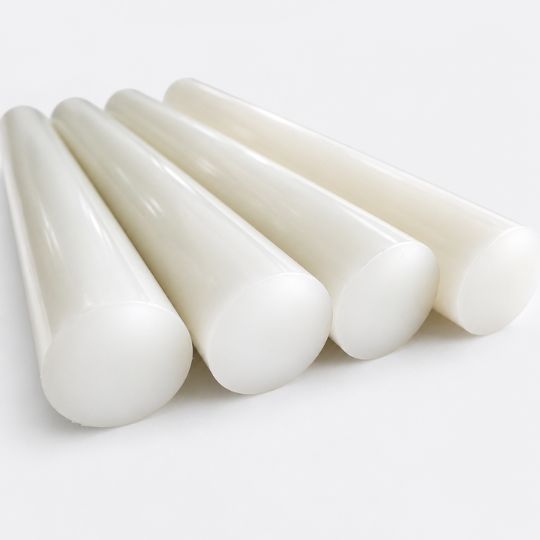
An unfilled fluoropolymer bar with high rigidity and near-zero water uptake, so your PVDF rod holds its dimensions in wet service. HANSA machines and cuts it in-house.
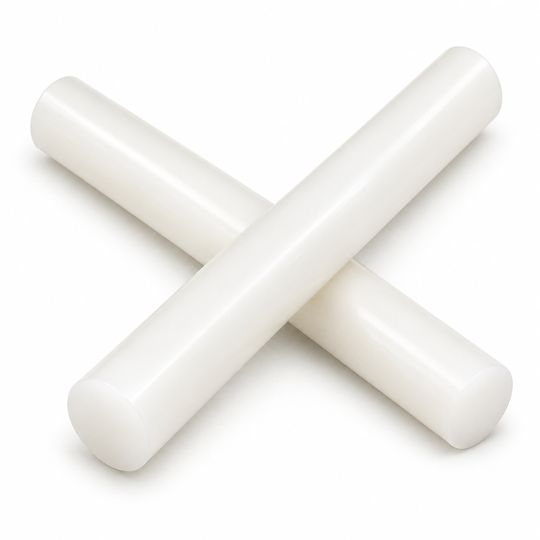
If your drawing says Kynar rod, you have specified Arkema’s trade name for PVDF. HANSA supplies the same unfilled bar, machined the same way.
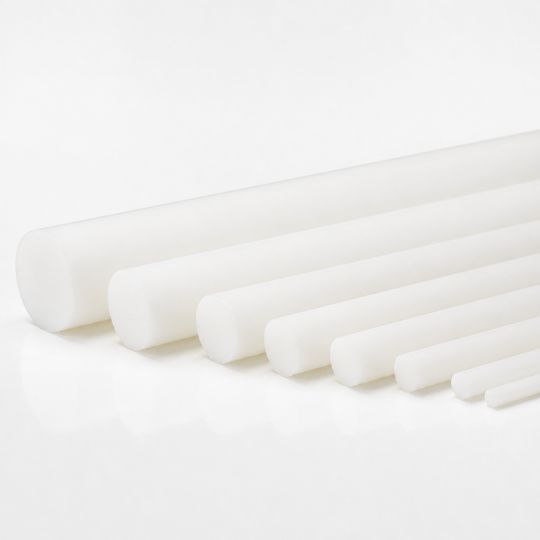
Kynar chemical resistance covers most acids, bases and oxidisers at ambient and elevated temperature. HANSA supplies the bar; your fabricator machines the wetted parts.
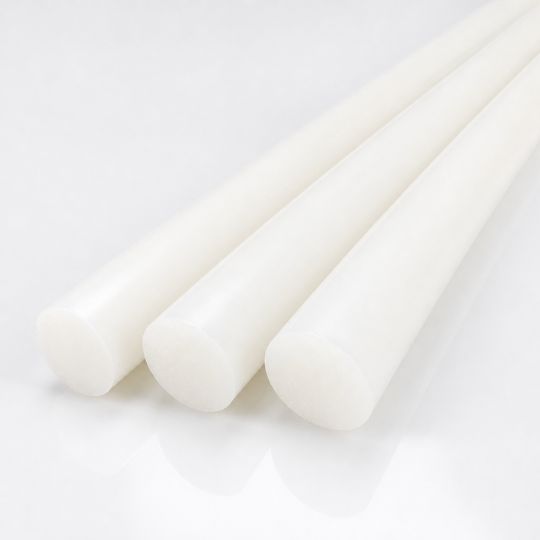
Of all the melt-processable fluoropolymers, PVDF uv resistance is the highest, so HANSA supplies this bar for your outdoor and architectural parts.
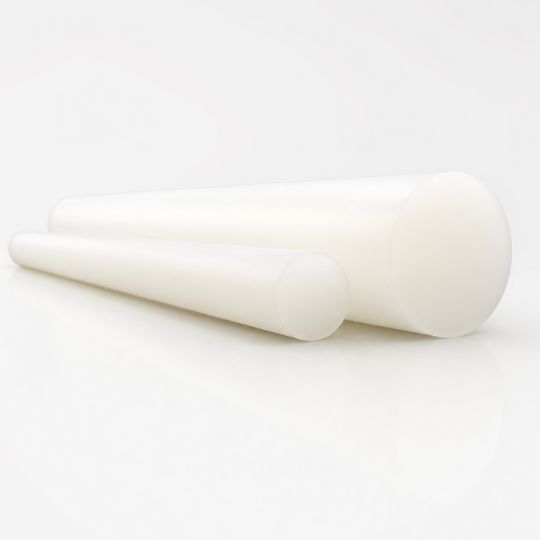
Specifications written for aerospace kynar and aviation kynar usually turn on weight, outgassing and fire behaviour. HANSA machines the bar to your drawing rather than to a general catalogue.
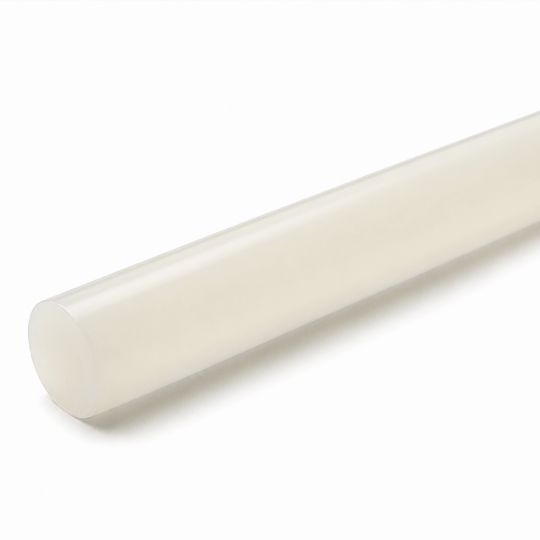
Two names, one polymer: Kynar material is Arkema’s trade name for PVDF, a semi-crystalline fluoropolymer that machines, welds and hot-gas bonds. HANSA supplies it as unfilled bar you can machine.
Made in Our Own Plant
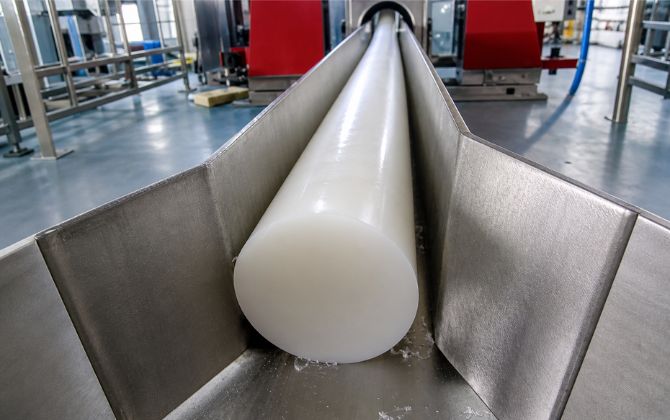
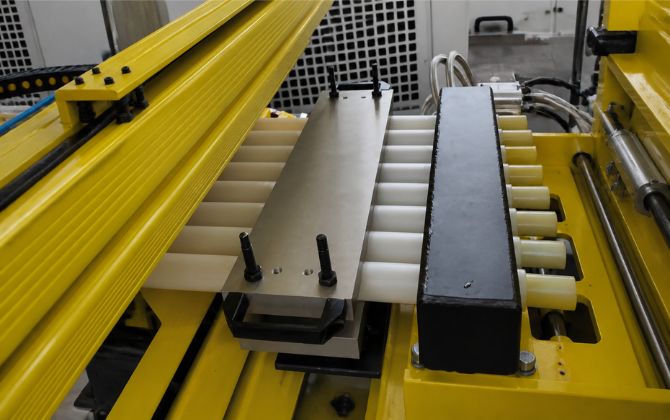
HANSA has made engineering plastics since 1995 and runs the rod, the cutting and the finishing in one plant, so the bar you buy and the part you draw meet the same inspection regime. Laser cutting, milling, turning, CNC machining, bending and bonding are all in-house, and HANSA supports OEM and private-label programmes for buyers who resell under their own part numbers.
Bring the drawing or the cutting list. HANSA quotes from the drawing, agrees the tolerance against the condition the bar is supplied in, and books the production run against your build schedule.
PVDF Rod Sizes and Properties
- Sizes
- Eigenschappen
|
Outside diameter (mm) |
Outside diameter (in) |
Nominal weight at 1000 mm (kg) |
|
10 |
0.39 | 0.15 |
|
15 |
0.59 |
0.36 |
|
20 |
0.79 |
0.60 |
|
25 |
0.98 |
0.90 |
| 30 | 1.18 |
1.40 |
|
35 |
1.38 |
1.80 |
| 40 | 1.57 |
2.40 |
|
45 |
1.77 |
2.90 |
|
50 |
1.97 |
3.60 |
|
55 |
2.17 |
4.30 |
|
60 |
2.36 |
5.30 |
|
65 |
2.56 |
6.20 |
|
70 |
2.76 | 7.10 |
| 75 | 2.95 |
8.30 |
| 80 | 3.15 |
9.20 |
|
85 |
3.35 |
10.30 |
|
90 |
3.54 |
11.80 |
| 95 | 3.74 |
13.10 |
|
100 |
3.94 |
14.50 |
|
110 |
4.33 |
17.80 |
| 120 | 4.72 |
21.50 |
|
130 |
5.12 |
24.20 |
| 140 | 5.51 |
28.30 |
|
150 |
5.91 |
33.80 |
|
160 |
6.30 |
36.20 |
|
170 |
6.69 |
41.30 |
|
180 |
7.09 |
47.00 |
| 200 | 7.87 |
59.00 |
| 220 | 8.66 |
73.30 |
| 230 | 9.06 |
80.60 |
| 250 | 9.84 |
90.00 |
| Eigendom | Eenheid |
Typical value |
|
Smeltpunt |
°C (°F) |
175 (347) |
| Glass transition temperature, Tg | °C (°F) | -35 (-31) |
|
Maximum continuous service temperature |
°C (°F) |
150 (302) |
|
Minimum service temperature |
°C (°F) |
-40 (-40) |
|
Thermal conductivity |
W/cm·K |
0.13 |
|
Hardheid |
Shore D |
75-85 |
|
Treksterkte |
MPa |
40-85 |
|
Druksterkte |
MPa |
13-14 |
|
Rek bij breuk |
% |
30-50 |
|
Dikte |
g/cm³ |
1.76-1.78 |
|
Moulding shrinkage |
% |
1.4 |
|
Diëlektrische constante |
— |
6.43 |
|
Water absorption (24 h) |
% |
≤0.04 |
|
Volume resistivity |
Ω·cm |
≤10^15 |
|
Friction coefficient |
— |
0.4 |
Ø10 mm to Ø250 mm (0.39 in to 9.84 in), 31 standard diameters, in two standard lengths: 1000 mm (39.37 in) and 2000 mm (78.74 in). Any other length is cut to your list.
Yes. HANSA manufactures the rod itself rather than reselling it, so a PVDF rod manufacturer enquiry and a PVDF rod supplier enquiry land in the same place — one engineer, one plant, one quote.
Yes. Kynar is Arkema’s trade name for polyvinylidene fluoride. A Kynar rod and a PVDF rod are the same unfilled bar unless a filled grade is specified by name.
No, and the two are sold to different buyers. A welding rod is a thin filler strip fed into a hot-gas or fusion weld to join PVDF sheet and pipe. The rod on this page is solid round bar, machined into parts.
MOQ is not a single number here — it is quoted per part, because a 150 mm bar machined to a drawing and a 20 mm bar cut to length are different jobs. Send the drawing and HANSA will quote the quantity that makes the run worthwhile.
It depends on whether you need stock cut to length or a finished machined part, and on the quantity. HANSA confirms the date with the quote so you are planning against a committed date, not a range.
Both. HANSA supplies the bar and machines finished parts from it, so the tolerance on the finished part is agreed with the same plant that made the bar.
Gerelateerde producten
What a PVDF Rod Is
A PVDF rod is a solid round bar of polyvinylidene fluoride, supplied unfilled and machined into parts rather than moulded into a finished shape. The long form — polyvinylidene fluoride rod — names the same item. You will also meet it as Kynar, which is a trade name for the polymer rather than a different material.
The chemistry sets the limits. Half of the carbon backbone carries fluorine and the other half carries hydrogen. That single difference from a fully fluorinated polymer is why a PVDF rod is stiffer, weldable and stable outdoors — and it is also why the material is not the most chemically inert fluoropolymer you can buy. If you are designing a part, the useful question is not whether PVDF is better than PTFE, but which of those two properties your duty actually turns on.
Two things this page is not about, and the reason is that the buyers are different. A welding rod is a thin filler strip fed into a hot-gas or fusion weld to join sheet and pipe; the bar described here is stock that gets machined. Printing filament is feedstock for an extruder. All three share a name and nothing else. You are in the right place if what you need is a PVDF rod to machine into a part.
PVDF Rod vs PTFE Rod: Where the Two Diverge
Engineers arrive at this comparison constantly, and the honest answer is that neither material wins. PTFE is the more chemically inert of the two and the better high-temperature choice. A PVDF rod is the more rigid, the more dimensionally stable under sustained load, and the easier to weld and bond. Which one you specify depends on what your part has to survive.
|
Eigendom |
PVDF | PTFE | PVC |
PFA |
|
Chemische bestendigheid |
Very good across acids, bases and oxidisers | The broadest of the four | Good, but solvents attack it |
Very good, close to PTFE |
|
Rigidity and creep |
High — holds a thread and a tolerance | Low — cold-flows under sustained load | High |
Moderate |
|
Maximum continuous service temperature |
Higher than PVC, lower than PTFE and PFA | The highest of the four | The lowest of the four |
High |
|
UV and weathering |
The best of the four | Poor outdoors | Goed |
Goed |
|
Weldable and bondable |
Yes | Very difficult in practice | Yes |
Yes |
|
Melt-processable |
Yes | Nee | Yes |
Yes |
|
Relative cost |
Mid | High | Low |
High |
Read the table by duty, not by column. If your part sits in an aggressive medium at elevated temperature and carries no structural load, PTFE is usually the right answer and HANSA will say so — see PTFE rod for that route. If your part has to hold a thread, keep a bore round, or be welded into an assembly, the rigidity of a PVDF rod is what you are buying. For those duties the PVDF rod is the specification, and HANSA’s size range on this page is the starting point.
PVDF vs PVC and PVDF vs PFA
The two comparisons buyers make least often are also the two where the answer is clearest.
Against PVC, PVDF wins on the two axes that usually decide the job: solvent resistance and service temperature. PVC is cheaper and perfectly adequate for water, dilute acids and indoor ductwork. It is the wrong choice where the part sees ketones, esters or chlorinated solvents, and it is the wrong choice above the modest ceiling PVC tolerates. If your line already runs PVC and you are replacing parts regularly, that replacement frequency is the signal to look at a PVDF rod.
Against PFA, the gap narrows. Both are fluoropolymers with good chemical breadth, and PFA keeps more of the flexibility and the temperature headroom. PVDF is the stiffer of the two and the less expensive, which is why it is the default for machined structural parts that must sit in a chemical environment. Reach for PFA when a hose, a liner or a continuously flexing part is what you actually need, and note that HANSA covers that route on a separate page. The same material in flat form is covered on the PVDF sheet page, which is the one to read if you need a lining rather than a machined bar.
Chemical Resistance of PVDF Rod, and Where It Stops
Chemical compatibility is the property buyers ask about first, and it is also the one most often reduced to a slogan. The useful statement is narrower.
Unfilled PVDF holds up well against most inorganic acids, bases and oxidisers, including the strong mineral acids and the hypochlorite solutions that attack many plastics. It is widely used in chlor-alkali and water-treatment duty for exactly that reason. Resistance to hydrocarbons is good and resistance to most alcohols is good.
Where it stops matters more. Strong bases at high concentration and elevated temperature are the classic failure mode, and polar solvents — ketones, esters, some amines — will attack it. Aromatic solvents are a poor fit. So is any duty where the part is simultaneously hot, highly basic and under stress, because chemical attack and stress cracking compound rather than add.
The rule that keeps you out of trouble is to test the finished part in the actual medium, at the actual temperature, rather than to trust a table with a single tick. HANSA will machine a sample PVDF rod to your drawing so you can run that test before you commit to a production order.
Temperature Capability and Continuous Service
PVDF behaves predictably across its range, and the range has two ends worth knowing.
The maximum continuous service temperature is 150 °C (302 °F), and it is a continuous figure rather than a short-term peak — the material does not need an excursion allowance built into the design. The minimum service temperature is -40 °C (-40 °F). The glass transition temperature sits at -35 °C (-31 °F) and the melting point at 175 °C (347 °F).
Read those two middle numbers together and the behaviour makes sense. Because the glass transition sits below the service floor, the material stays out of its brittle range across the whole working band, which is why a PVDF rod does not become fragile in a cold store. Because the melting point sits only a little above the service ceiling, the material is melt-processable, which is the property that makes it weldable and the reason it can be supplied as a smooth bar.
Those figures describe an unfilled PVDF rod. Load, medium and part geometry all move the practical limit, and packaging a hot part against a cold one moves it too. Tell HANSA the duty and the number can be confirmed for your application rather than left as a table value. If the duty runs colder than this material allows, PCTFE rod is the grade to look at instead, and if it runs hotter, the answer sits in the PEEK rod range.
Strength, Stiffness and Impact
The mechanical case for a PVDF rod is straightforward: it is the strongest of the common fluoropolymers and it holds its shape.
Typical unfilled PVDF sits at a tensile strength of 40 to 85 MPa with a compressive strength of 13 to 14 MPa, an elongation at break of 30 to 50 percent and a hardness of 75 to 85 on the Shore D scale. Density is 1.76 to 1.78 g/cm³, which is lighter than a metal replacement and heavier than most commodity plastics. Moulding shrinkage of 1.4 percent is a processing figure and not a machining one, but it explains why a moulded part and a machined part start from different allowances.
The number that matters most in service is the one that never appears in a datasheet: creep. PVDF resists cold flow far better than a fully fluorinated polymer, so a part under sustained load keeps its dimensions over years rather than weeks. That stability is what a PVDF rod buys you over a fully fluorinated bar, and it is the first thing HANSA asks about when you send a loaded part. That is the property that lets you hold a thread in it, and it is why the material turns up in load-bearing chemical hardware rather than only in linings.
Impact resistance is moderate. A PVDF rod will absorb a knock that would crack an acrylic, but it is not a substitute for a polycarbonate or an ultra-high-molecular-weight polyethylene rod in a genuinely shock-loaded duty. If your application is impact-dominated rather than chemical-dominated, say so and HANSA will point you at the right material in the range.
Standard Length, Diameter Range and Cut Length
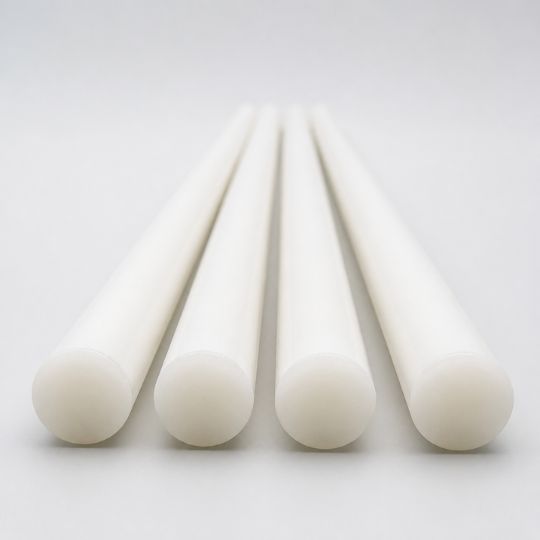
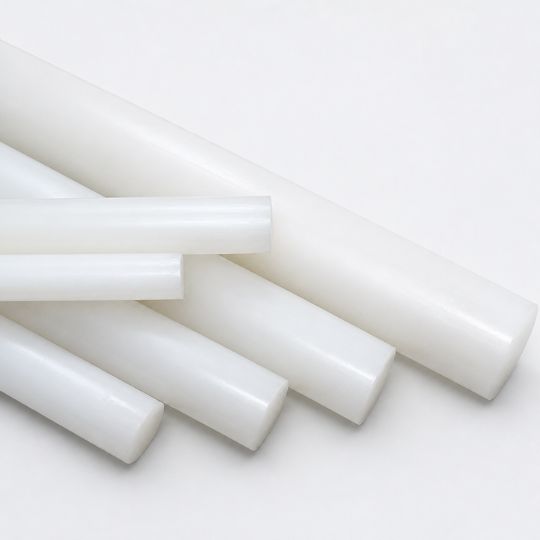
The bar is stocked from Ø10 mm (0.39 in) to Ø250 mm (9.84 in), in two standard lengths: 1000 mm (39.37 in) and 2000 mm (78.74 in).
Thirty-one diameters are held as standard across that range, and the full list with nominal weights sits in the specification table above. Nominal weights are quoted for freight; they are not a theoretical figure derived from the density of the polymer, so do not use them as a material-take-off.
Two practical notes about ordering a PVDF rod. First, diameters that fall between the listed stock sizes are not held as bar — they are machined, so send the finished diameter and the length you actually need rather than the nearest stock size. Second, if you are machining the part yourself, specify the diameter you need to receive, not the finished diameter you have in mind. The bar arrives at nominal diameter, so a finishing allowance has to come out of your drawing.
Machining, Welding and Bonding
A PVDF rod machines like a soft engineering plastic and it behaves far better than a fully fluorinated polymer at the tool.
Turning, milling, drilling and threading all work with sharp, positive-rake tooling and generous clearance, and the material takes a clean thread, which is unusual in this family. Expect the usual thermoplastics discipline: keep the tool moving, keep the chip clear, and let the part cool before you measure it, because a warm machined part will measure undersize. If your shop has not run one before, HANSA will send the speeds and feeds that work on a PVDF rod.
Welding is where the material separates itself from PTFE. Hot-gas welding, butt fusion and socket fusion all work, which is why PVDF appears in welded assemblies such as tank linings, ductwork and wet benches. The welding rod you feed into those joints is a separate product from the bar on this page. So is printing filament, which is a different grade made for a different machine. Bonding also works with a properly prepared surface — abrade it, degrease it, and use a system the adhesive maker recommends for low-surface-energy plastics. Do not expect a solvent cement to hold; it will not.
How to Order PVDF Rod from HANSA
Send HANSA three things and you will get a usable answer rather than a range.
Whether you buy one PVDF rod or a year’s supply, the same three things decide the answer. Send the diameter and the length, whether that is a stock bar cut to length or a finished part machined from the bar. Send the duty — the medium, the temperature and whether the part carries load — because that is what decides whether the standard grade is right or whether a different material in the range is the better answer. Send the quantity and the date you need it, so the quote carries a committed delivery date instead of an estimate.
You will get one reply with the price, the tolerance the part will be held to, and the date. If a value needs confirming on the material rather than on the drawing — a chemical, a continuous temperature, a finished dimension — HANSA will say which one before the order is placed, so nothing on the quote is an assumption.

 Dutch
Dutch  English
  Arabic
  Tibetan
  German
  Spanish
  French
  Hindi
Hindi  Indonesian
  Italian
  Japanese
  Korean
  Portuguese
  Thai
Thai  Russian
  Swedish
  Chinese