


Why Global Engineers Choose HANSA PEEK Tube
- Sizes others do not extrude: 23 mm to 597 mm outside diameter, bores 12 mm to 460 mm, walls to 75 mm
- 328 sizes already tooled: No tooling project, no tooling cost, no month-long lead time
- Tolerance published per size band: OD 0/+1.2 to 0/+8 mm, bore minus-only, roundness 0.5 to 4 mm
- Stock ships the same day: Single-piece orders accepted, no minimum on held sizes
- Multi-stage stress-relief annealing: Dimensions stay stable after you machine the part
- ISO 9001:2015 · RoHS · REACH: Test reports and certificate of conformity with every batch
About HANSA PEEK Tube
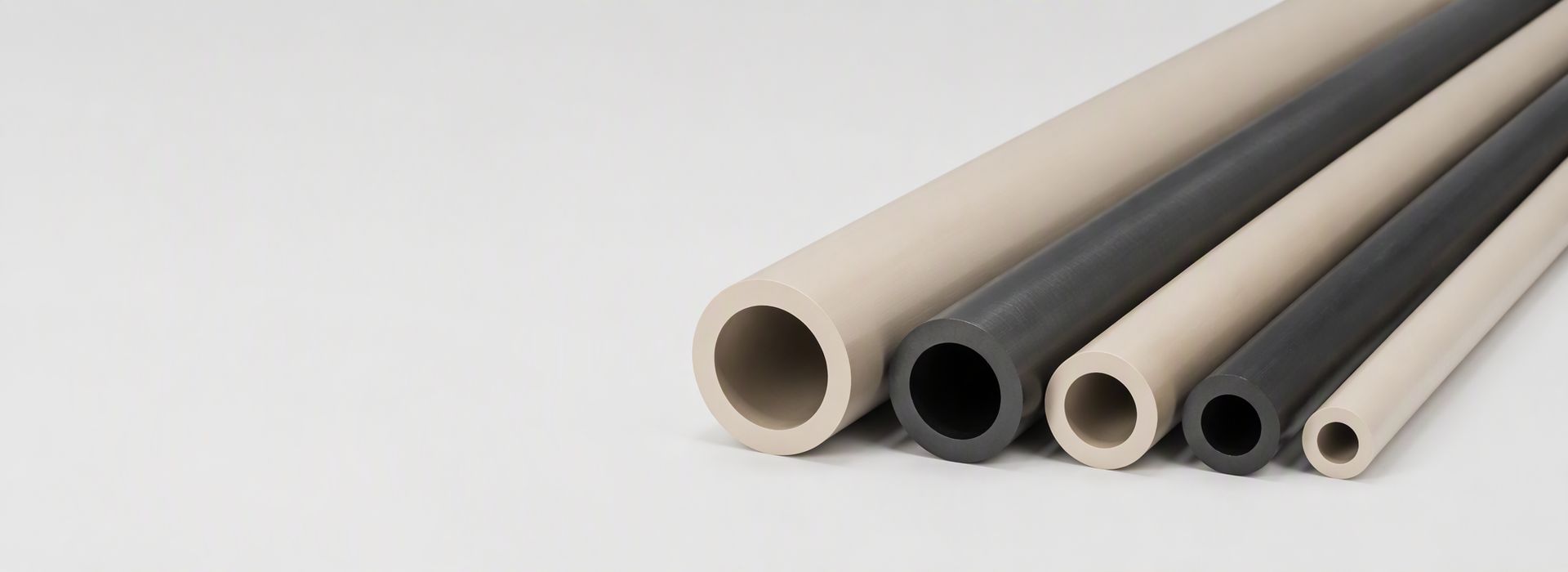
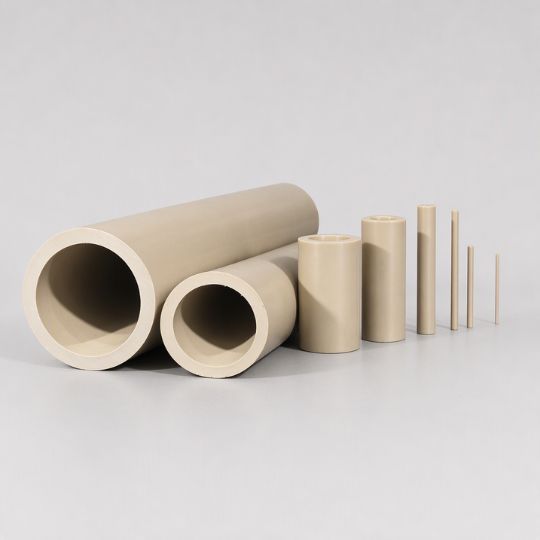
A PEEK tube is a semi-finished extrusion of polyetheretherketone, supplied as a hollow section that is machined into a finished part. HANSA has made engineering plastics since 1995 and exported them since 2005, and this PEEK tube range was built for the work ordinary stock tubing cannot reach: large bore, heavy wall and long lengths cut to order.
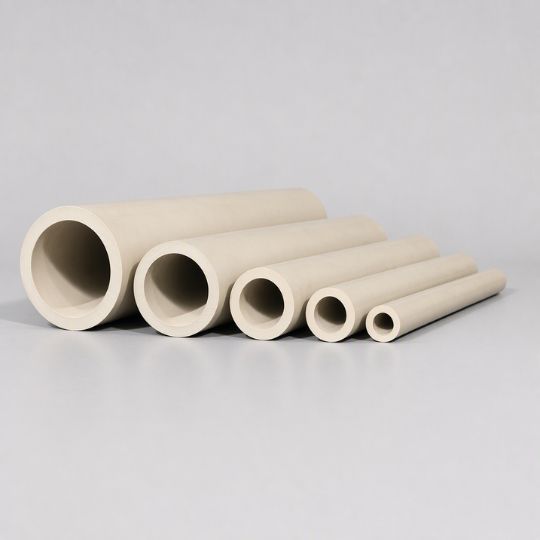
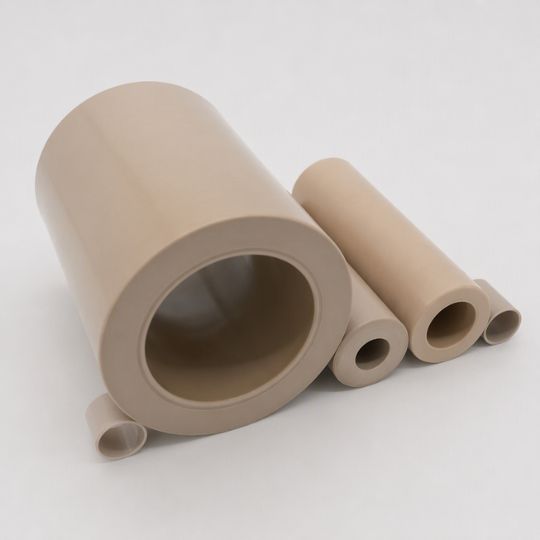
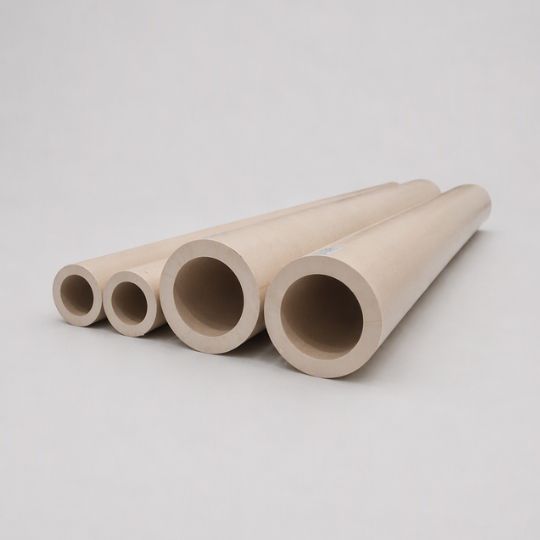
The range carries 328 standard outside-diameter and bore combinations, from 23 mm (0.906 in) outside diameter to 597 mm (23.504 in), with bores from 12 mm (0.472 in) to 460 mm (18.110 in) and wall thickness from 2.5 mm (0.098 in) to 75 mm (2.953 in). Most of it is genuinely large: 258 of the 328 combinations sit at 100 mm (3.937 in) outside diameter or above, and 144 sit at 200 mm or above.
This is not a capillary tubing page. If your drawing calls for a bushing, a liner, a seal carrier or an insulating sleeve in a diameter that starts at a few inches and grows from there, you are in the right place.
PEEK Tube Grades You Can Order From HANSA
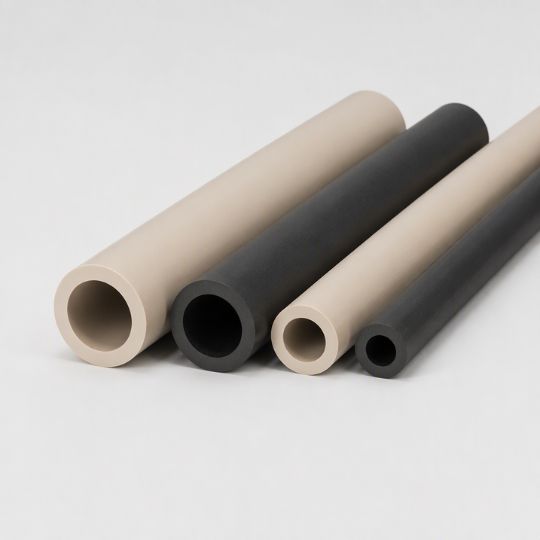
HANSA manufactures all five PEEK tube grades in-house across 328 standard sizes. Below, compare them on colour, strength and electrical behaviour before you send a drawing.
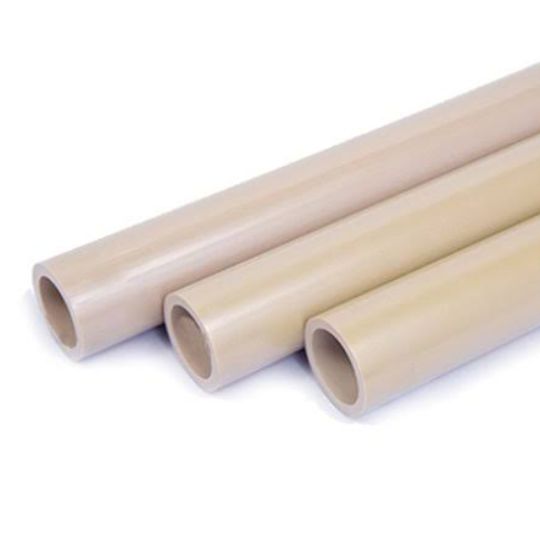
HANSA manufactures this grade across the full standard size range. Choose it when you need base PEEK chemistry with no filler effect on your mating surface.
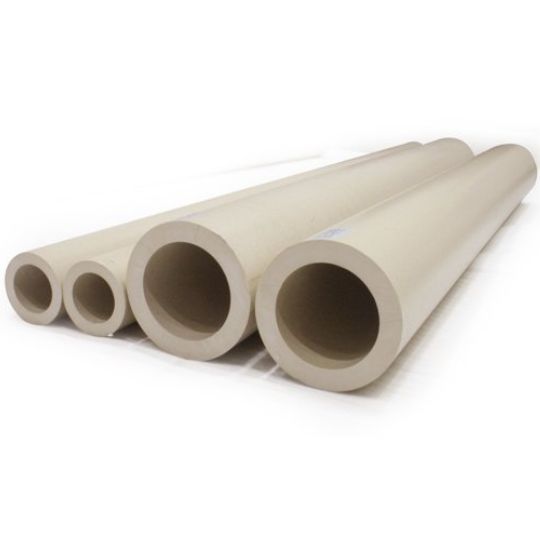
HANSA adds 30% glass fibre for stiffness and creep resistance while keeping the grade electrically insulating. Specify it where you carry high compressive load.
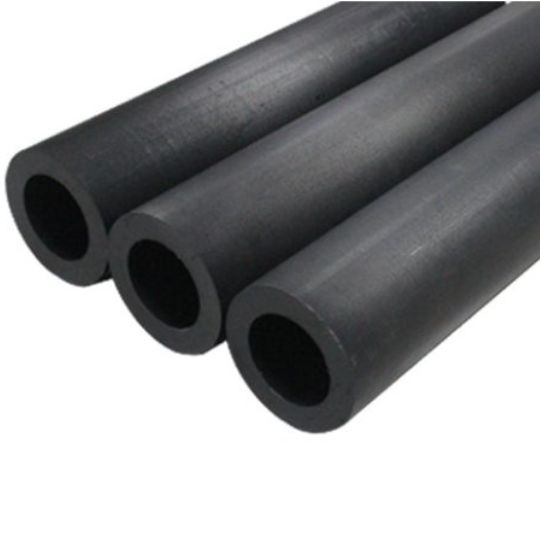
HANSA supplies this carbon PEEK tube in black and on a wholesale basis. It is the strongest and stiffest grade, and antistatic — so you cannot use it as an insulator.
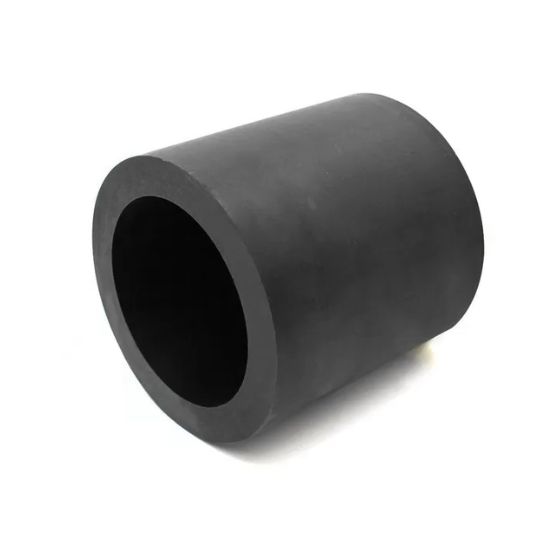
HANSA combines carbon fibre, graphite and PTFE in one grade. It suits low friction and a high pressure-velocity limit, where you need dry-start tolerance.
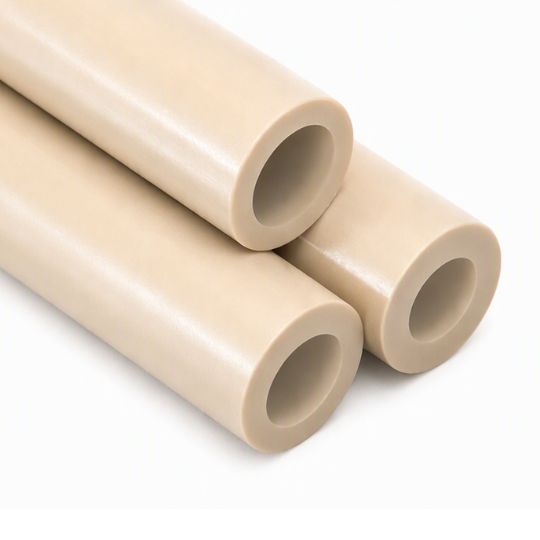
HANSA blends 20% PTFE into this grade for the lowest friction and best chemical resistance of the five. It suits your sealing and low-load sliding parts.
PEEK Tubes from HANSA
- Main Grades and Typical Properties
- 명세서
| 범주 | 재산 | Test Standard / Instrument | 단위 | PEEK5600G
100% PEEK |
PEEK5600GF30
PEEK + 30% glass fiber |
PEEK5600CF30
PEEK + 30% carbon fiber |
PEEK5600LF30
PEEK + 30% (carbon fiber + graphite + PTFE) |
PEEK5600FE20
PEEK + 20% PTFE |
| 기계적 특성 | Tensile Strength (23 °C) | ISO 527 | 엠파 | 95 | 175 | 250 | 145 | 70 |
| Tensile Modulus (23 °C) | ISO 527 | GPa | 3.8 | 11 | 23 | 12.5 | — | |
| Elongation at Break (23 °C) | ISO 527 | % | 35 | 2.0 | 1.5 | 2.2 | — | |
| Flexural Strength (23 °C) | ISO 178 | 엠파 | 155 | 235 | 350 | 220 | 118 | |
| Flexural Modulus (23 °C) | ISO 178 | GPa | 3.5 | 10 | 21 | 11 | — | |
| Charpy Impact Strength, Unnotched | ISO 179/1U | kJ/m² | No break | 55 | 45 | 32 | No break | |
| Izod Impact Strength, Notched | ISO 180/A | kJ/m² | 4 | 6 | 6.5 | 4 | 6 | |
| 열적 특성 | 녹는점 | ISO 11357 | °C | 343 | 343 | 343 | 343 | 343 |
| Glass Transition Temperature (Tg) | ISO 11357 | °C | 143 | 143 | 143 | 143 | 143 | |
| Heat Deflection Temperature (HDT) | ISO 75A-f | 1.8 MPa, °C | 152 | 315 | 315 | 293 | 150 | |
| Coefficient of Linear Thermal Expansion (CLTE) | ASTM D696 | ppm/K | 45 | 22 | 15 | 22 | 70 | |
| 열전도도 | ISO/CD 22007-4 | W/(m·K) | 0.29 | 0.32 | 0.32 | 0.95 | 0.86 | |
| 전기적 특성 | Dielectric Strength (2 mm) | IEC 60243-1 | kV/mm | 20 | 19 | — | — | 19 |
| Dielectric Constant | IEC 62631 | — | 3.0 | 3.3 | — | — | 2.7 | |
| Surface Resistivity | GB/T 31838.3 | Ω | 10^15 | 10^14 | — | — | 10^15 | |
| Volume Resistivity | IEC 62631 | Ω·cm | 10^15 | 10^15 | 10^5 | 10^6 | — | |
| Other Properties | 색상 | — | — | Natural | Natural | 검은색 | 검은색 | Natural |
| Melt Flow Rate (400 °C, 2.16 kg) | ISO 1133 | g/10 min | 6–10 | 2–5 | 1–3 | 2–5 | — | |
| 밀도 | ISO 1183 | g/cm³ | 1.30±0.02 | 1.50±0.02 | 1.40±0.02 | 1.44±0.02 | 1.41±0.02 | |
| Water Absorption (23 °C, 24 h) | ISO 62-1 | % | 0.07 | 0.05 | 0.04 | 0.05 | 0.15 | |
| Molding Shrinkage (Parallel to Flow) | — | % | 1.2 | 0.4 | 0.1 | 0.3 | 1.3 | |
| Molding Shrinkage (Perpendicular to Flow) | — | % | 1.5 | 0.8 | 0.5 | 0.6 | 1.8 | |
| Rockwell Hardness | GB/T 3398.2 | HRR | 118 | 119 | 121 | 108 | 113 | |
| Flammability Rating | UL 94 | — | V-0 | V-0 | V-0 | V-0 | — | |
| 마찰 계수 | ASTM D3702 | 100 N, 120 rpm | 0.30–0.38 | 0.38–0.46 | 0.15–0.25 | 0.18–0.30 | 0.1–0.2 |
Here’s the part of buying a PEEK tube that surprises almost everybody.
You’re not ordering a finished part. You’re ordering a near-net extrusion that still has to be machined, so you need extra material left on both surfaces to cut away. That’s what the allowance is there for.
The outside diameter comes in oversize only: 0 to +1.2 mm (0 to +0.047 in) on the smaller sizes, rising to 0 to +8 mm (0 to +0.315 in) on the largest. The bore mirrors it, minus only: 0 to -1.2 mm (0 to -0.047 in) rising to 0 to -8 mm (0 to -0.315 in).
So here’s the one line that matters on your PO. Give us your finished size, not the size you expect to pull out of the crate. If you order 100 mm and expect to measure 100 mm, you’ll read the top of the tolerance band and reject a perfectly good length. Tell us 100 mm finished, and we’ll ship you material with enough left on both surfaces to hit it in your shop.
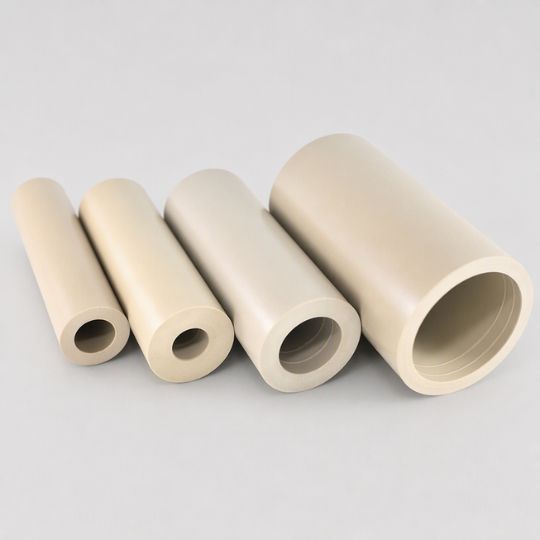
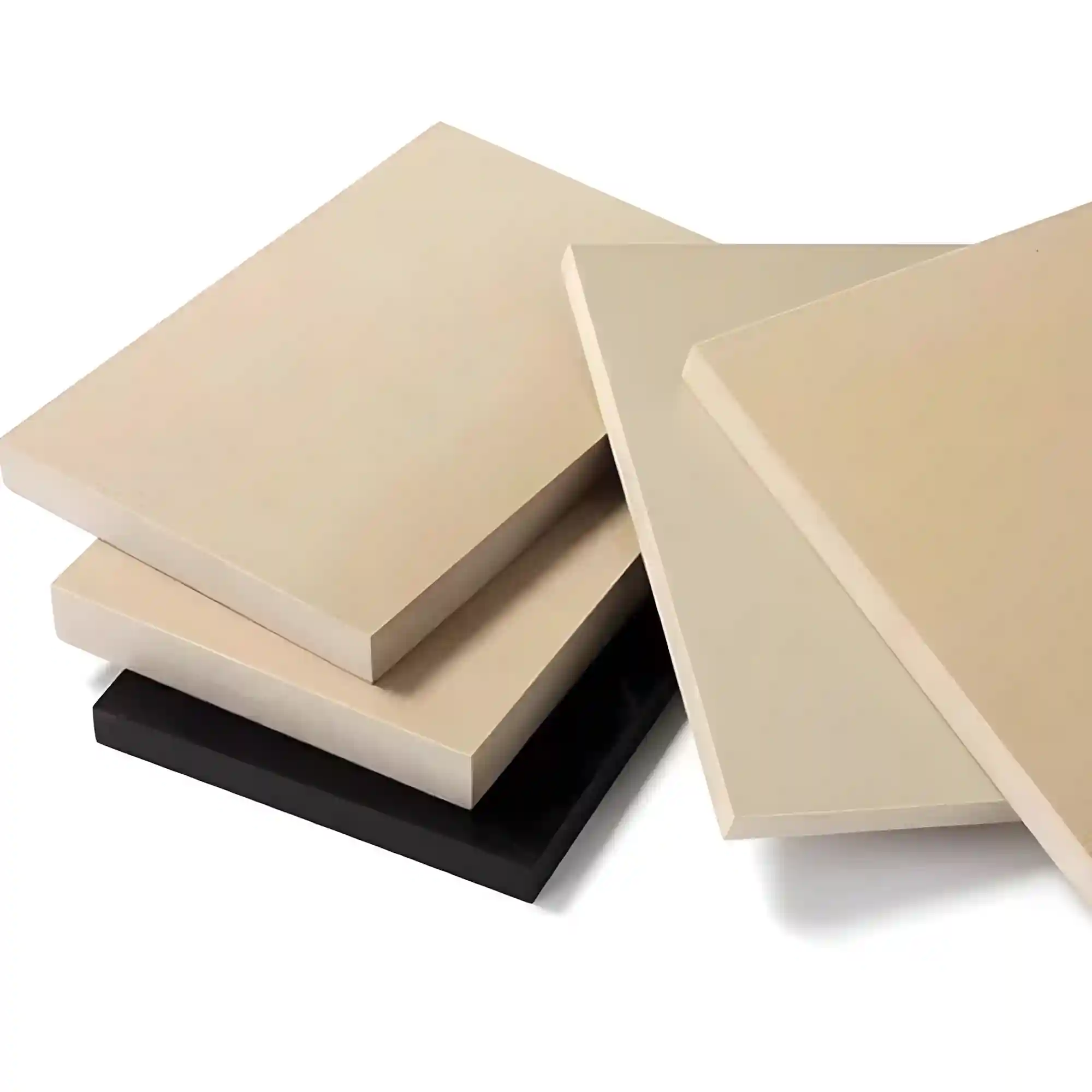
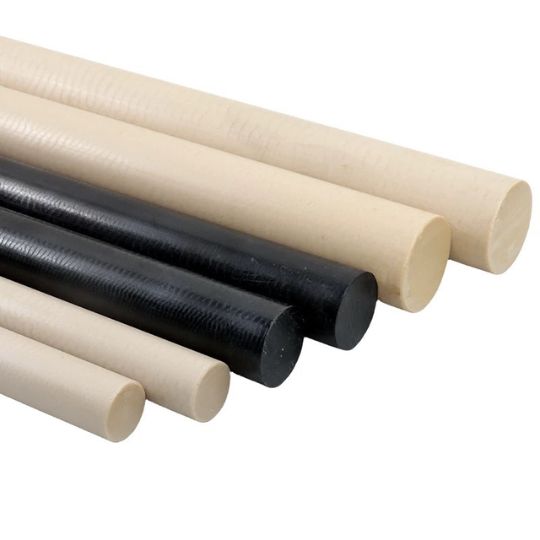
A rod is solid and a tube is hollow. If you are making a ring, a bushing or a sleeve, a tube gets you to the finished bore with far less material to remove. If you need a solid shaft or a part with no bore, use our PEEK rod instead, or our PEEK sheet if your part is flat rather than round.
Often yes. The table is the standard mould set, and those sizes need no tooling. Anything outside it is a custom run, quoted from 20 kg to 50 kg depending on size and grade, with a lead time confirmed at enquiry.
Frequently. Many moulds run in more than one grade, so the same outside diameter and bore are available in unfilled and filled versions, and you can compare them on price and wear performance without redesigning the part.
Both are 30% filled, and they are not interchangeable. GF30 (glass) gives you stiffness and creep resistance while staying an electrical insulator. CF30 (carbon) gives you the highest strength and stiffness in the range, the lowest thermal expansion and the best sliding wear, and it is antistatic. If your part carries load and must not conduct, order GF30. If it slides, runs hot, or has to hold tight dimensions, order CF30. Tensile strength is 175 MPa for GF30 against 250 MPa for CF30, and the coefficient of friction is 0.38 to 0.46 for GF30 against 0.15 to 0.25 for CF30.
Unfilled 100% PEEK is offered for food and medical contact, and HANSA supplies it against FDA and RoHS/REACH documentation. Ask for the certificate with your order so it travels with the shipping paperwork. Filled grades are a different answer: the glass, carbon and PTFE additives change the compliance picture, so tell HANSA the application and we will confirm which grade carries the documentation you need.
Other Plastic Products You May Need
PEEK Tube: The Ultimate FAQ Guide
What is a PEEK tube used for?
A PEEK tube is the right starting point whenever the part is annular: it has a bore through it and both surfaces are doing a job. Typical parts are bushings and wear rings, seal carriers, back-up rings, insulating sleeves, bearing cages, valve and pump components, and rollers that run hot without swelling.
HANSA supplies it as a near-net blank, so the bore already exists and you machine one surface instead of turning an entire core into chips. On a resin this expensive, that difference usually outweighs the small premium a tube carries over the equivalent PEEK rod.
Does a PEEK tube absorb moisture, and does it matter?
Far less than nylon, acetal or most other engineering thermoplastics, and in most applications it does not matter. Water uptake is low enough that a PEEK tube will not measurably swell over a normal service life, and its mechanical and electrical properties stay stable in humid conditions where a nylon part would drift.
Two cases are still worth checking: a part held to a very tight tolerance that also sees long immersion, and high-frequency dielectric work, where absorbed moisture shifts loss behaviour. Confirm the figure for your own grade with HANSA rather than borrowing it from another plastic’s data sheet.
What happens if a PEEK tube runs hotter than its grade allows?
Nothing dramatic and nothing immediate, which is exactly what makes it dangerous. PEEK does not soften suddenly or fail the way a metal does at its limit. It loses stiffness and creep resistance progressively as you approach and pass the continuous service temperature in the property table above.
So the part does not break – it stops carrying a load it used to carry. A bushing that held its bore creeps oval; a sleeve that gripped hand-tight hot starts to relax. Faults appear as wear, noise or leakage long before anything looks broken. Give HANSA the actual temperature rather than a rounded one, because intermittent peaks usually decide the answer.
Can a PEEK tube be sterilised, and how does it handle steam?
Yes, and this is one of the properties that separates PEEK from cheaper engineering plastics. It withstands repeated steam sterilisation without the hydrolysis that attacks polycarbonate and eventually embrittles it, which is why the material appears in reusable surgical instruments and in food and pharmaceutical plant that is cleaned in place.
Gamma irradiation and ethylene oxide are also used on PEEK components. The limit to watch is not steam alone but steam plus a chemical cleaning agent plus mechanical load – if your part sees all three, describe the whole regime at enquiry.
Where should I measure a PEEK tube, and how many readings do I need?
More than one, and not all in the same place. A single reading tells you very little, because the material moves with temperature and extrusion can leave a slight variation along the length.
Take outside diameter readings at several positions along the tube and at more than one angle around the circumference, then the same for the bore using a method that suits its size. Let the part reach the temperature of the room you are measuring in, then repeat. A single measurement taken on a warm PEEK tube is the most common cause of a false rejection on this material, and the easiest one to avoid.
Is the bore concentric with the outside diameter?
Not perfectly, and it should not be assumed. Wall thickness on an extruded PEEK tube varies slightly around the circumference, so the bore centre and the outside centre do not coincide exactly.
For most parts this is irrelevant, because you machine both surfaces and the concentricity of the finished component comes from your setup rather than the blank. It matters when you clamp on the outside diameter and expect the bore to run true unmachined, or when an off-centre wall leaves an uneven wall in service. If it matters, put it on the drawing and let HANSA confirm whether it is achievable from stock or should be supplied machined.
How thin a wall can I specify on a PEEK tube?
Thinner than most people expect, because PEEK is stiff for a thermoplastic – but the practical limit is set by your process as much as by the extrusion. A thin wall is harder to hold round, harder to clamp without deforming, and harder to machine without chatter.
It also amplifies everything else: a small variation in wall thickness matters more, thermal movement moves the wall further, and there is less material resisting the stress released by machining. Ask what the part must survive – pressure, wear, or clamping in your own fixture. HANSA sees that question push the wall up far more often than down.
Can I get a PEEK tube held tighter than the published tolerance?
Sometimes, and it is worth asking rather than assuming either way. The published tolerance widens as outside diameter grows because that is what extrusion delivers consistently, not because a tighter figure is forbidden.
On a small diameter the as-extruded tube may already sit inside a tighter band, so you are selecting rather than manufacturing. On a large diameter, holding a tight band can mean extra operations, extra inspection or a smaller usable portion of a run. The cleanest route is to send HANSA the finished part and its tolerance, and let the answer come back as stock selection, extra processing or simply machining to size.
When does roundness matter more than diameter?
When the part has to grip, seal or wear evenly. Diameter tells you how big the tube is; roundness tells you whether it is that size all the way round, and they are separate numbers for a reason.
A liner a fraction out on diameter but perfectly round will usually work, because the fit is uniform. The same part acceptable on diameter but visibly oval grips harder at two points, wears unevenly and leaks where it never touched. If your part is a liner, bushing, wear ring or seal carrier, state roundness on the drawing and ask HANSA to confirm it for your size and wall.
Why does a machined PEEK tube change size after machining?
Because machining releases stress the extrusion left locked in the wall. PEEK is semi-crystalline, and extruding, sizing and cooling a tube freezes a stress pattern through the section. While the tube sits undisturbed, that pattern stays in balance and the dimensions hold.
Cut material from one face, or from the bore more than the outside, and you remove the wall holding that stress in equilibrium. What remains relaxes and the part moves: a bore on size during the cut tightens overnight, a ring round on the machine goes oval a week later.
This is why HANSA runs multi-stage stress-relief annealing before shipping – the anneal lets the polymer relax at the works under controlled conditions instead of inside your fixture after the finish pass. So rough machine with stock left on, let the part stabilise, and finish last.
Can a PEEK tube be welded or bonded?
Machining and mechanical fastening are the normal routes, and they are the right first choice. Where bonding is genuinely necessary, PEEK can be joined with high-temperature adhesives and surface preparation that gives the adhesive something to grip – but a bonded joint is not the mechanical equivalent of a machined one, and the adhesive, not the PEEK, becomes the temperature limit of the assembly.
Welding is used to fabricate PEEK assemblies and needs the right equipment and procedure rather than shop-floor improvisation. If your design can avoid a joint, one machined part or a mechanical seat with an O-ring will be simpler and more reliable.
Can a PEEK tube be bent or heat-formed after extrusion?
Not the way you would bend a metal tube or form a polycarbonate one. PEEK is not thermoformable in the ordinary workshop sense: it has to reach a temperature far above what a fabrication shop oven will produce, and at that point the part needs proper support and controlled cooling or it distorts instead of taking a clean shape.
For most designs the practical answer is to machine the shape rather than form it. If a bent PEEK tube is central to your design, raise it at enquiry rather than planning to form it in-house – the route affects both cost and lead time.
How do I cut a PEEK tube without chipping it?
Use tooling that is sharp and intended for plastics, support the tube on both sides of the cut, and keep the cutting action steady rather than forcing it. PEEK is not brittle the way acrylic is, but it is notch-sensitive, and a cut that grabs the edge leaves a burr or chip that later becomes a crack.
For a clean end on a short length, a fine-tooth blade or an abrasive wheel intended for plastics works better than a general-purpose metal blade. On larger diameters support the tube so the wall cannot deflect into the blade.
Can I order a PEEK tube cut to length?
Yes, and it usually saves money. A tube cut to the length your process needs arrives ready for the first operation, so you avoid the saw time and the offcut that is too small to use but has already been paid for at full material price.
Send a cut list rather than a single figure: outside diameter, length and quantity per line. If a part will be faced after arrival, add that allowance to the ordered length instead of taking it out of the finished part. Where a length falls outside normal stock, tell HANSA early, because cut-to-length from a production run and a custom length are different commercial conversations.
How should I store a PEEK tube before machining?
Flat, supported, out of direct sun, and away from anything that will deform it. A long tube resting on two supports will sag under its own weight over time, and one that has taken a set is a tube you will fight during machining.
Keep it in its packaging or on a padded rack rather than leaning it against a wall or stacking weight on top. Temperature matters less than load, but keep stock in the same environment as the machine that will cut it – a part measured cold and machined warm is a tolerance argument waiting to happen.
What documentation ships with a PEEK tube order?
Whatever you specify up front, which is why it belongs on the enquiry rather than in a later email. Batch certificates, material test reports and compliance declarations travel with the material when they are requested with the order, and they are harder to assemble once it has shipped.
Name the documents you need to file, and if the part goes into a regulated product, name the standard your paperwork has to satisfy rather than describing it in general terms. The process behind those documents is set out on the test documentation page. If you would rather not machine the tube yourself, HANSA’s PEEK parts division will quote the finished component; if you are still weighing PEEK against a fluoropolymer, the PTFE vs PEEK comparison settles that first.
Still have a question that is not answered here? Send it with your drawing and HANSA will answer it against your actual part rather than in general terms. Contact us and you will have both the answer and the price.

 Korean
  English
  Arabic
  Tibetan
  German
  Spanish
  French
  Hindi
Hindi  Indonesian
  Italian
  Japanese
  Dutch
Dutch  Portuguese
  Thai
Thai  Russian
  Swedish
  Chinese