


HDPE and LDPE are both polyethylene. What separates them is density: one is high-density polyethylene, the other low-density polyethylene. Both are used across a very wide range, from supermarket shopping bags at one end to military body armor at the other.
Is your project considering polyethylene as well? The article below will take you through the specific differences between HDPE and LDPE — how they perform, where they are used, the strengths and limitations of each, and how to choose between them based on your operating conditions, with cost kept in view.
Fundamental Difference
The difference between HDPE and LDPE ultimately comes down to their chemical structure. And it all starts with their molecular structure.
HDPE
HDPE has a linear molecular structure, with chains that line up neatly and pack tightly. It has very few branches, so its crystallinity is high, and so is its density.
That molecular arrangement gives HDPE high stiffness and strong resistance to stress cracking(ESCR).
LDPE
LDPE has a highly branched molecular structure. Its molecules are spread out rather than running in a single straight line the way HDPE does. Picture one molecular chain with a branch coming off it, then another branch coming off that branch, extending onward without end.
The more branches there are, the harder it is for the chains to fit into a crystal lattice, so crystallinity drops and density drops with it. That is what gives LDPE its good flexibility.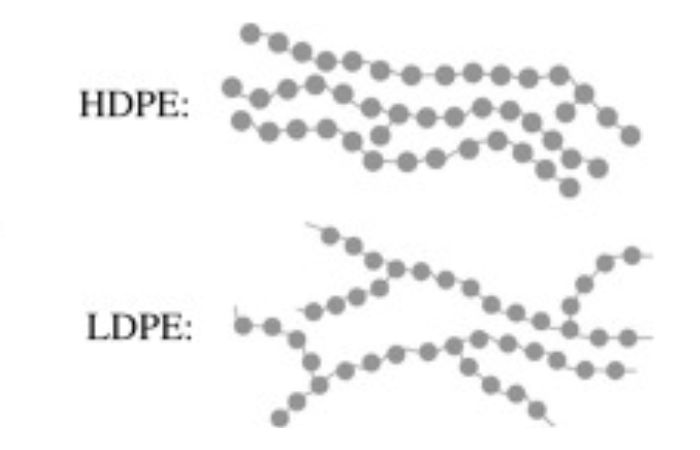
Typical Properties of HDPE and LDPE
Physical Properties
HDPE has a higher density than LDPE — typically 0.93–0.97 g/cm³ — and that density underpins HDPE’s excellent mechanical and chemical performance. HDPE’s long-term working temperature range is -50 to 60 °C, and certain high grades reach 80–100 °C under specific temperatures and load pressures. Its melting point is around 120–136 °C.
LDPE has a density of 0.91–0.94 g/cm³ and a long-term working temperature of 60–80 °C. Its melting point is 105–115 °C, and that lower melting point makes it very well suited to heat sealing.
HDPE and LDPE have very similar resistivity, so both are commonly made into electrical insulating parts. Which of the two you choose depends on the service conditions.
Mechanical Properties
On mechanical properties, HDPE and LDPE each have their own strengths, which is what makes them suited to different service conditions.
Strength
Strength is a material’s ability to resist permanent deformation under an applied force. HDPE’s high crystallinity and high density give it excellent stiffness and tensile strength. That is why HDPE works for structural parts: within a working temperature of 60–80 °C, it can continuously withstand 0.6–1.6 MPa while keeping its mechanical properties stable. LDPE is weaker than HDPE. Too many branches along the chain mean low crystallinity and low density, and its strength simply does not match HDPE’s.
Ductility
Ductility covers elongation at break and reduction of area, among other measures. HDPE has poor ductility: when it is pulled, it elongates only a little, because the material is hard and densely packed and does not stretch easily. LDPE is different. Its molecules are irregular to begin with, so under tension it actually extends better — which is why LDPE shows the higher elongation. During processing, keep in mind that HDPE shrinks more, generally 1.3–5.0%, and carries a high warpage risk. LDPE shrinks 1.5–3.5%, and does so relatively evenly. To reduce severe shrinkage, control the mold temperature and the cooling temperature: keeping the mold cool and cooling the part rapidly will limit shrinkage.
Hardness
Hardness is a material’s ability to resist being pressed into by a harder object. By the same logic as strength, HDPE is harder than LDPE.
Toughness
LDPE’s low crystallinity gives it better toughness and tear resistance than HDPE, while HDPE is harder and less tough. That is why LDPE is commonly used for plastic film, squeeze bottles, and other softer containers, while HDPE goes into rigid water pipes, underground piping, crates, and other rigid containers.
Chemical Properties
Both HDPE and LDPE have excellent chemical resistance and hold up well against acids, alkalis, and salt solutions. The differences between them are subtle, though: LDPE is more readily attacked by strong oxidizing agents than HDPE.
Advantages and Limitations of HDPE and LDPE
Advantages
HDPE
HDPE is recycled at a far higher rate than LDPE, because it is harder and therefore easier to sort and crush. Recycled HDPE also performs almost the same as virgin HDPE. LDPE is somewhat harder to recycle than HDPE: being soft, it can wrap around the machinery during grinding and jam the equipment. HDPE is an excellent fit for projects that put a priority on environmental protection — given its outstanding recyclability and today’s mature recycling systems, its environmental impact is very low.
LDPE
LDPE has a low melting point and processes more easily. It is better suited to heat sealing, and it is also easy to blow mold, extrude, or injection mold, which allows it to be made into containers of complex shapes. LDPE is highly transparent and reflects light well, because its density is low. That is why LDPE is usually made into retail packaging, or used where a product’s appearance needs to be inspected visually.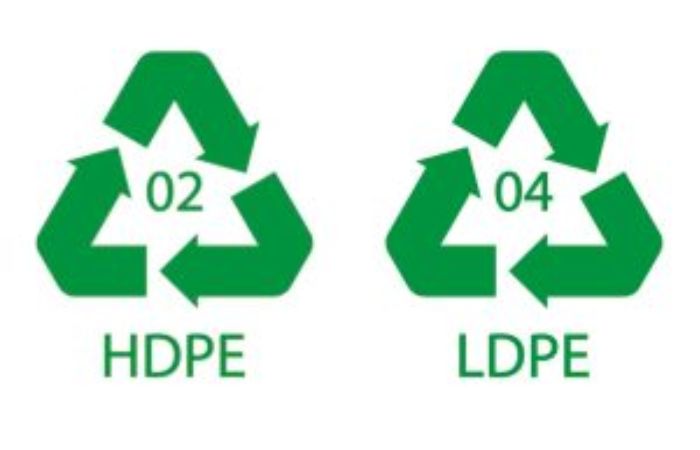
Limitations
HDPE
- Stiff as HDPE is, it will still stress crack under pressures beyond what it can withstand.
- HDPE’s temperature resistance is only average. Once it goes past its melting point (120–136 °C), it softens, deforms, and loses its structural strength.
- HDPE that contains no carbon black or antioxidant has weak UV resistance; long-term outdoor exposure leaves it oxidized and brittle.
LDPE
- Because LDPE has somewhat lower strength, its surface scratches and wears more easily, and its stress cracks more readily than HDPE.
- Its barrier performance is not particularly good — gases such as carbon dioxide still permeate through it to some degree — so it is not suitable for high-barrier pouches.
- It is highly flammable, cannot be used in high-temperature service, and will burn as soon as it meets an open flame.
Common Uses of HDPE and LDPE
Electrical & Electronics
HDPE
HDPE’s high strength and high stiffness mean it is usually used for structural parts or for the housings of electronic products — parts that place high demands on impact resistance. Its chemical resistance and electrical insulation also make it better suited to buried applications. As a protective jacket for underground communication cables, it effectively prevents attack by chemicals in the soil. In the electronics industry, HDPE is also used for ESD trays and electronic totes.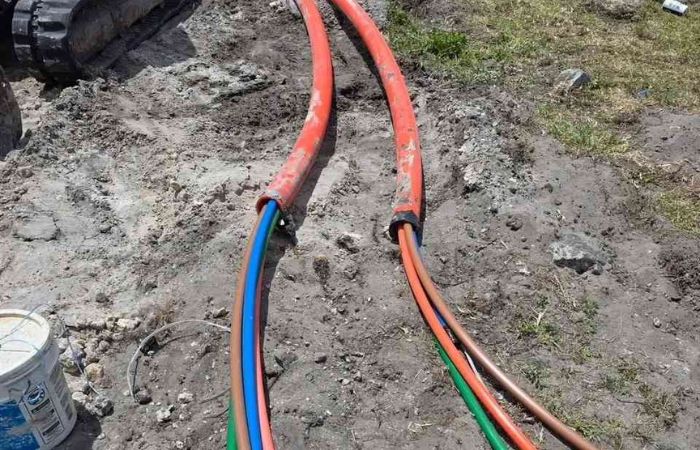
LDPE
LDPE has excellent ductility, flexibility, and high-frequency insulation properties, so it is usually used as the insulation layer on wires and cables, and as anti-static packaging film for electronic products.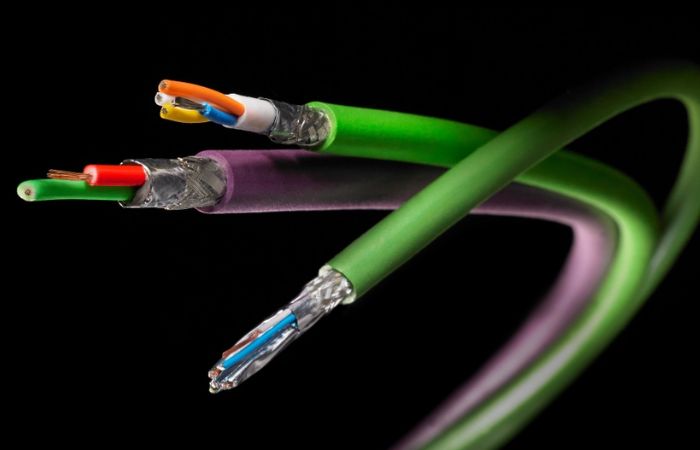
Marine Engineering
HDPE
✔ Dock fender impact panels
HDPE is usually used together with UHMW-PE. Both have high stiffness and impact resistance and a very low coefficient of friction, which effectively disperses the impact when a vessel comes alongside and protects the steel structure.
✔ Drainage and water supply pipes
Sewer lines in some coastal cities are made of HDPE, and so are the intake pipes at seawater desalination plants. HDPE’s low coefficient of friction keeps marine organisms from attaching to it and causing blockages and contamination, and it resists saltwater corrosion, so it does not age easily in long-term service.
✔ Floats
The floats and walkways of floating offshore solar plants are almost all injection-molded or rotomolded HDPE.
LDPE
✔ Subsea communication cable sheathing
LDPE’s high-frequency insulation, seawater corrosion resistance, and near-zero moisture absorption make it suitable as the insulating jacket on submarine cables.
✔ Small floats
Many of the objects you see floating at sea may well be LDPE — the buoys used in coastal aquaculture, small channel marker buoys, and the floats on fishing nets.
✔ Anti-corrosion packaging for marine equipment
This is essentially a LDPE film. Equipment that has to stay at sea for long periods is easily corroded by the highly saline marine atmosphere; wrapping it in LDPE film cuts replacement frequency and the chance of damage.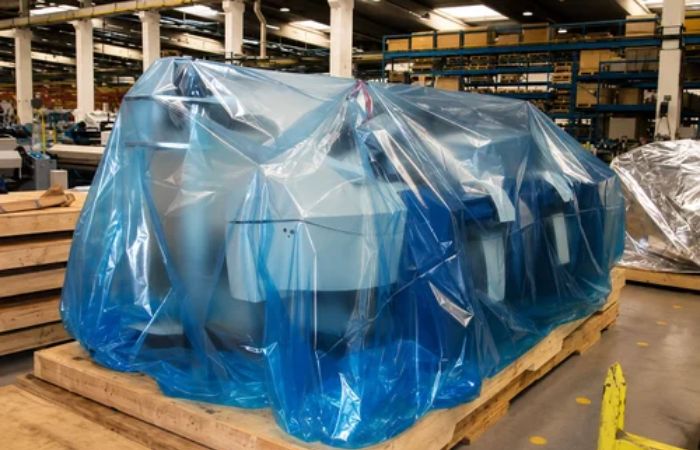
Automotive
HDPE
HDPE’s advantage is excellent processability: blow molding and injection molding can turn out fuel tanks in all kinds of complex shapes. Because the available space is tight, this allows irregular tanks to be designed and made, so space is used to the fullest.
LDPE
LDPE is usually used for body components such as electrical connector covers. Its low density keeps the part light, which helps reduce fuel consumption.
Packaging
HDPE
HDPE has better gas barrier properties and excellent chemical resistance, so it covers everything from household packaging to industrial chemical containers.
LDPE
LDPE’s high transparency and good flexibility suit packaging that needs to be seen — easy to inspect and easy to sell. Its lower melting point also makes it better suited to heat-sealed packaging.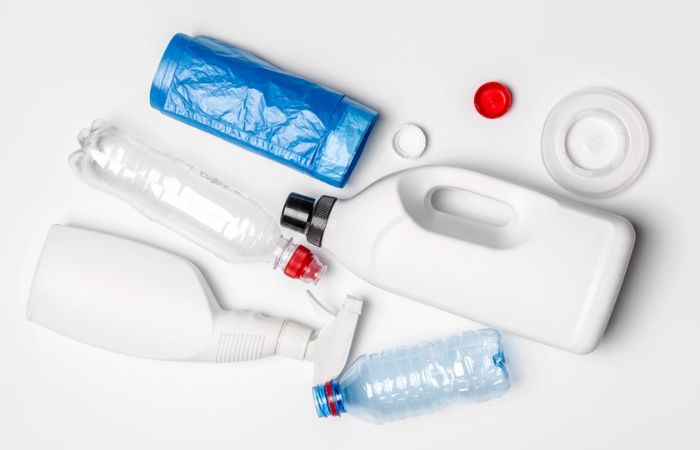
How to Choose Between HDPE and LDPE
When you choose between these two materials, focus on what your project actually needs most — the stiffness required, the flexibility, the heat resistance, and the load the part has to carry.
HDPE: suited to high-load conditions that call for high hardness, strong stiffness, and high temperature resistance. If you are making structural parts, or an application that has to resist repeated friction and impact, put HDPE first.
LDPE: good toughness and strong ductility. Its most common form is LDPE film, followed by shopping bags and packaging bags. Wherever the service conditions call for high flexibility and tear resistance, choose LDPE.
FAQs
1.HDPE or LDPE: Which is better?
If your part must hold its shape under load, choose HDPE: around 38 MPa tensile against 21 MPa for LDPE, and about 73% crystalline against 48%. If it must flex without cracking — a seal, liner or cover — choose LDPE, because more of it is amorphous.
Heat follows the same line: LDPE melts at 105–115 °C, HDPE at 120–136 °C.
One thing people miss: HDPE is welded, not glued, and LDPE welds at lower heat.
Send HANSA the drawing and we quote the same part in both, so you compare like with like.
2.Will HDPE warp in the sun?
Yes, it can — for two reasons that are easy to mix up.
Heat. A panel in direct sun gets much hotter than the air around it. The plastic expands, and if you bolt both ends down tight, the expansion has nowhere to go, so the panel bends.
Sunlight over time. Ordinary HDPE slowly goes chalky and brittle outdoors, then cracks at the edges.
Both are easy to avoid. Use a UV-stabilized grade, which is usually black. Leave the panel some room to move instead of fixing it hard at every point. And avoid long thin panels with nothing supporting them.
Tell HANSA the part will live outdoors when you ask for a quote — that one detail decides which grade we put on it.
3.Are HDPE and LDPE safe for food?
Yes, both are safe for food in their normal form. That is why you see them in storage containers and cutting boards. HDPE is code 2, LDPE is code 4.
4.Can you mix HDPE and LDPE?
You can melt them together, but you probably shouldn’t.
HDPE and LDPE do not co-crystallize, so a blend forms separate phases. You lose the stiffness of HDPE and the consistent flexibility of LDPE, and the weak spots appear later: lower weld strength, worse stress-cracking resistance, uneven shrinkage after machining.
That is why recyclers sort them apart by code, 2 and 4.
5.Why is HDPE so expensive?
Per kilo of resin, HDPE is not much dearer than LDPE. The part gets expensive elsewhere.
Weight: 0.961 against 0.924 g/cm³, so the same volume weighs about 4% more.
Processing: it melts at 120–130 °C against 105–115 °C, needs more energy and a narrower window.
Joining: it cannot be glued reliably, so assemblies go to welding.
Grade and size: a UV-stabilized or food-contact grade, cut to a non-standard size in low volume, costs more than standard stock.
The offset: HDPE is stiffer, so a thinner wall often does the same job. Send HANSA the finished size and price the finished form, not the resin.
Final Thought
HDPE is the harder, stiffer one. LDPE is the softer, more transparent one. Where a part has to hold its shape under load, HDPE carries it; where a part has to give, LDPE does.
They overlap in use, but they are not interchangeable. Picking the one your part actually needs is also the cheapest route — you stop paying for stiffness you never use.
If you are not sure which one fits, or you want to know whether another material would serve you better, send HANSA the drawing and the service conditions. We quote both materials on the same part, so the comparison is real.
We reply with a price and a recommendation.

 English
 Arabic
 Tibetan
 German
 Spanish
 French
 Hindi
 Indonesian
 Italian
 Japanese
 Korean
 Dutch
 Portuguese
 Thai
 Russian
 Swedish
 Chinese