




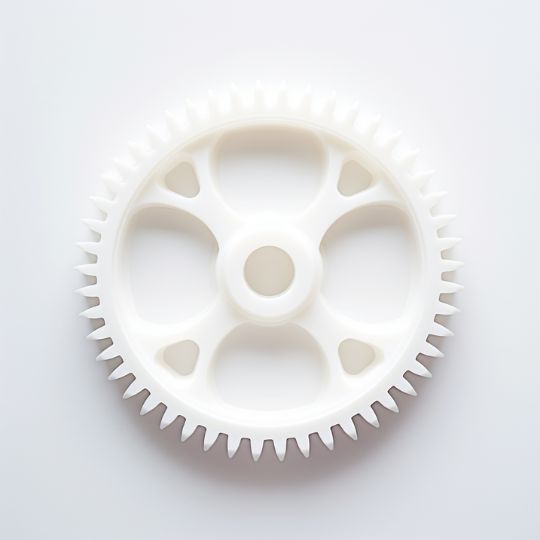

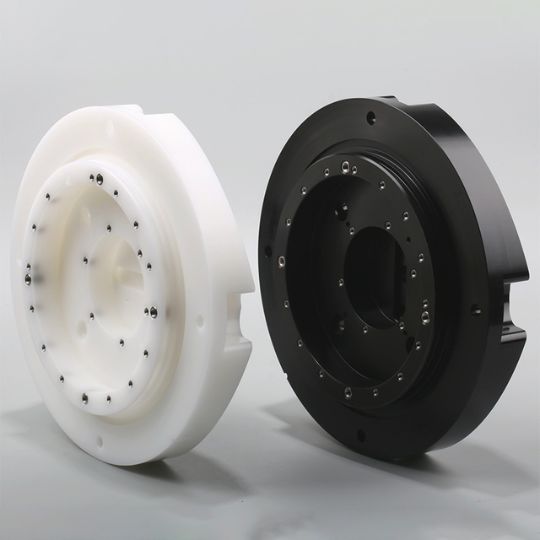
Why do Engineers Buy from HANSA
- In-house production of a full range of POM sheets, rods, and tubes.
- Equipped with advanced CNC machining tools and lathes to provide one-stop machining services.
- Professional technical staff design POM components to prevent issues such as shrinkage, stress concentration, and warping.
- Strict, standardized quality inspection processes and quality control measures.
- Hold relevant compliance certificates and reports, including ISO 9001, SGS, FDA, REACH, and RoHS.
What is POM(Acetal) Parts
POM stands for polyoxymethylene; it is also commonly known by its commercial name, “acetal.” POM is categorized into two series—POM-H and POM-C—which differ primarily in their material properties.
POM-H, better known as Delrin® (a registered trademark of Delrin USA LLC), is characterized by superior rigidity, hardness, and density, as well as a high degree of crystallinity. It is well-suited for structural components that require high mechanical strength, or for wear-resistant sliding parts subject to repetitive motion.
While POM-C is not as hard as POM-H, it offers better chemical resistance; therefore, POM-C should be selected for applications involving exposure to strong chlorinated cleaning agents. Furthermore, POM-C exhibits slightly better thermal performance, making it suitable for environments that involve contact with hot water or require steam sterilization.
POM Parts Made From HANSA
Below are some examples and types of POM (polyoxymethylene) machined parts that you can review to see if they align with your project requirements. Please feel free to contact us; we would be happy to recommend the most suitable material for your specific operating conditions and assist with the machining process.
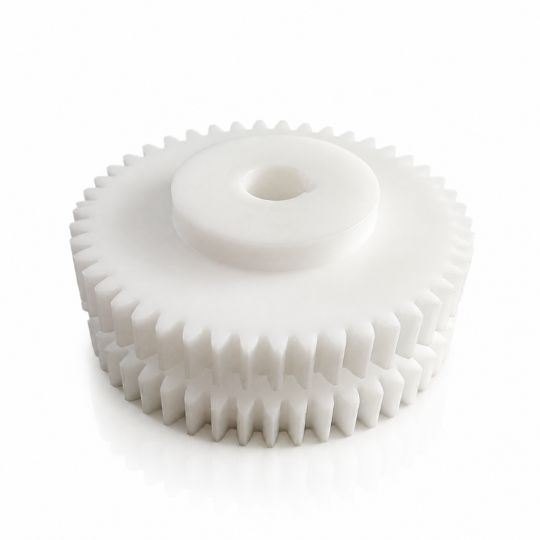
This is a gear with a raised boss, classified as a precision-machined part. Since the client’s own equipment could not meet the necessary machining requirements, we manufactured it for them using a POM sheet.

This is another herringbone-style gear. The client approached us with the technical drawings. HANSA offers OEM and ODM customization services—please feel free to reach out to us with any questions.

Because POM is inherently rigid and hard, it is easy to maintain dimensional stability during machining. For parts made from this material, tolerances can be controlled to within approximately ±0.002. POM sleeves are typically used in applications subject to long-term friction or as structural components requiring load-bearing support.

It is made from food-grade POM material and complies with relevant FDA regulations. A client engaged us for OEM manufacturing, intending to use the component in food-filling equipment.

Their original wear strips for the conveyor belt were prone to bending and deformation, making them unsuitable for long-term use. Drawing on our extensive industry experience and product expertise, we recommended components made of POM; the client has been highly satisfied with the results.The blue color was a custom requirement specified by the client.

POM acetal pin shaft, precision machined to your drawing for guide rollers, idler wheels and hinge assemblies.It runs dry without lubrication, keeping low friction against steel and plastic mating parts and staying free of rust in humid or washdown areas.

POM acetal bushing, precision machined to your ID and OD tolerance and press-fitted into the housing to carry the rotating shaft. It replaces bronze and steel bushings in light-to-medium load positions, running dry with low friction, no greasing and no rust.

HANSA offers a complete set of components, including bearings, bushings, shims, and washers—available in both standard flat configurations and custom, non-standard shapes. Made from POM, these parts are highly resistant to rust, capable of dampening vibrations between metal surfaces, and feature self-lubricating properties that eliminate the need for additional lubricants.

This is a custom-machined POM component, which the client uses as a mold for making cakes. This project also prompted us to upgrade our machining equipment; the initial parts showed visible machining marks, which did not meet the client’s expectations. By upgrading our cutting tools, we were ultimately able to deliver a product that the client was fully satisfied with.
Polyoxymethylene Parts: The Ultimate FAQ Guide
What Is POM Part?
A POM part is a component machined or moulded from polyoxymethylene, the semi-crystalline engineering plastic that most buyers know as acetal. POM is often called metal-like plastic, or synthetic steel, because a well-made POM part can take over from a bronze bushing or a steel guide without giving up much stiffness.
What separates POM parts from other engineering plastic parts is the combination rather than any one figure. The material is stiff, it runs against metal with little friction, and it absorbs almost no moisture, so a part machined to size tends to still be that size when it reaches your line. Plastics usually trade one of those against the others. Nylon is tougher but takes up water. PTFE is slipperier but creeps under load. The balance is the point with POM parts.
HANSA machines POM parts from rod, sheet and tube in both POM-H and POM-C, and holds the same two grades as stock for customers who cut their own.
What Are The Differences Between POM, Acetal, and Delrin?
POM and acetal are not two materials. POM stands for polyoxymethylene, which is the chemical name. Acetal, or polyacetal, is the commercial name, taken from the acetal linkages in the polymer chain. Buyers say acetal, drawings and data sheets say POM, and both cover the same family.
Delrin is a different kind of name altogether. It is a registered trademark of Delrin USA LLC and it refers specifically to the homopolymer grade, POM-H. Asking for Delrin gets you one producer’s homopolymer. Asking for POM or acetal gets you the family, which is why the two questions get different answers.
The distinction that actually matters on a drawing is the grade. POM-H is the denser, harder, stiffer of the two, with a continuous service range of -50 to 90 °C (-58 to 194 °F), and it is what most people mean by Delrin. POM-C is the copolymer: a little softer, better at resisting chemicals, and the one to specify where the part sees hot water, steam or chlorinated cleaning agents, where its range runs to 100 °C (212 °F). On POM parts that live wet, the grade settles more than the trade name does, and POM rod sets the two side by side. HANSA machines POM parts in both.
How Is POM Processed and Molded into Different Products?
POM reaches a plant by three routes: injection moulding, extrusion, and machining from stock.
Moulding carries the high-volume parts, the gears, clips and housings where a tool is paid off across tens of thousands of pieces. POM’s sharp melting point is what governs the process. The melt passes from fluid to solid across a narrow band, so the mould runs hot and the gate position matters; there is less room to drift than a more forgiving plastic allows.
Extrusion produces the POM rod, POM sheet そして POM tube that the machining route starts from. POM cuts cleanly with sharp tooling and positive rake, and the chip clears without a coolant flood, which keeps a machined part dry and free of fluid residue. That is the route HANSA works on: POM parts turned and milled from stock, to a drawing.
Which route a part should take is a volume question before it is a technical one. Below the point where a tool pays for itself, machined POM parts come out cheaper even at a higher piece price, and they can be revised between runs without cutting a new tool.
What Are The Uses of POM Parts?
Functionally, POM parts fall into a handful of jobs, and HANSA machines all of them:
- gears, cams and drive parts that carry load and have to run quietly
- bearings and bushings, usually dry or lightly greased
- wear pads, guides and slide blocks
- rollers, wheels and sprockets
- spacers, washers and shims that set a gap and keep it
- insulators, housings and brackets that need stiffness without much weight
- clips, catches and snap fits that flex and come back
Almost all of them sit at a joint where one surface moves against another, or at a gap that has to stay a gap. That is the ground POM owns. Where the joint is heavily loaded or runs hot, the material is being asked for something it does not have, and the part belongs in a different plastic or back in metal.
What Are The Common Applications of POM in Industry?
In automotive work the familiar POM parts are window regulator gears, lock cams, seat adjuster slides and fuel line clips, chosen for resistance to fuel, oil and grease with quiet running on top. Appliances use moulded gear trains in mixers and blenders, pump impellers and door latches, where the economics of a tool and a cheap pellet both matter.
On industrial equipment you meet POM parts as conveyor rollers, chain guides, sprockets and star wheels, usually in place of something that used to need greasing. Fluid handling takes valve bodies, seats, pump components and fittings. Electrical work takes insulators, switch actuators and terminal blocks, where the part has to insulate and carry load at the same time. Consumer goods are full of them too: buckles, hinges, zipper sliders, tool housings. HANSA ships POM parts into most of these, in machined form rather than moulded.
Two reasons cover nearly the whole list. The part moves and has to keep moving, or it holds a gap and must not move at all.
What Are The Main Properties of Polyoxymethylene(POM)Parts?
Stiffness that survives temperature is the first. POM stays rigid across a working range where softer plastics begin to sag, which is how POM parts hold a tolerance in a machine that runs warm.
Low friction and steady wear against metal is the second. A POM part running on a steel shaft often needs no lubricant feed at all, and where it does, a little goes a long way because the material is not relying on an oil film to stay slippery.
Very little moisture uptake is the third, and it is the one buyers underrate. The part does not swell after machining, so the dimension measured at goods-in is the dimension that arrives at the line.
Fatigue resistance is the fourth. Repeated flexing and repeated tooth loading are what finish most plastic parts; POM tolerates both well enough to carry gears and snap fits through millions of cycles.
The grade sets the ceiling on all four. POM-H runs to 90 °C (194 °F) continuous and POM-C to 100 °C (212 °F), and the figures behind those four properties belong to a specific grade rather than to POM in general, so ask HANSA for the data sheet of the grade being quoted.
What Are The Disadvantages of Acetal Parts?
Creep is the one that catches designers. A POM part under a load that never comes off will relax into it. A preloaded bushing, a washer clamped under a bolt, a clip that stays bent for a year: each loses part of that load, and the loss is invisible until the joint rattles or the seal weeps.
Hot water needs a grade decision rather than a blanket warning. The homopolymer is the weaker of the two in wet heat; POM-C resists hydrolysis and is the one to specify for hot water, steam or chlorinated cleaning agents, and even then the duty has a ceiling.
Strong acids and oxidisers attack the material outright, and no grade rescues it.
Ultraviolet light is a slow failure. Unfilled POM is not UV-stable, which is why outdoor parts are specified black, with carbon black in the compound rather than a coat of paint on top.
Bonding is awkward, as the next answers explain. Adhesive joints on acetal are weak without surface preparation, so most designs end up fastened or welded instead.
Sharp corners concentrate stress, and POM is notch-sensitive enough that a square internal corner becomes the place a part cracks from. A generous radius is cheaper than a redesign.
It also burns. There is no easy flame-retardant version, so a part with a flammability specification is usually a different material.
None of that rules POM parts out of general machinery. It rules them out of specific duties, and those are worth naming before the drawing is fixed. Where a duty sits outside them, HANSA will say so at quotation rather than let the order run.
In Which Fields Are POM Parts Used?
Each field buys POM parts for its own reason, and knowing which reason applies to your customer tells you what to prove on the drawing.
- Automotive takes the material for fuel, oil and grease resistance, and stays for the quiet running in gears and linkages.
- Appliances take it because it moulds cheaply at volume and still holds a gear tooth after a thousand cycles.
- Fluid handling wants dimensional stability in water, which means the copolymer.
- Electrical wants an insulator that also carries mechanical load, a combination most insulators cannot offer.
- Industrial automation wants wear parts that nobody has to lubricate.
- Food equipment wants the FDA-compliant black and white material wherever the part touches product.
Can POM parts be glued?
Barely, and a bonded joint becomes the weak point of the assembly rather than a hidden detail.
POM has a low surface energy, so most adhesives do not wet it properly in the first place. Getting a bond means abrading the surface, cleaning it, and using a primer matched to the adhesive, which is a good deal of preparation for a joint that still will not match the strength of the material either side of it.
Fasten it, snap it, or weld it. Where a bonded joint on POM parts cannot be avoided, a structural acrylic or a cyanoacrylate after surface treatment will carry light loads, provided the joint is designed so the adhesive works in shear instead of peel. Treat it as a maintenance joint, not a structural one, and HANSA will say which of the three routes suits the geometry you have.
Can POM parts be welded?
Yes, and welding is usually the better answer than gluing.
Ultrasonic welding is the common route for small parts, with an energy director machined or moulded into one face to concentrate the melt at the joint line. Hot-plate and vibration welding both work on larger parts, and HANSA can put the energy director on the part as it machines it rather than leaving you to add it later.
Weld strength approaches the parent material where the joint has been designed for the process, which means the joint geometry is part of the design rather than something discovered after the part is proved. Welded POM parts are not a detail to add to a drawing at the end.
What does not work is solvent welding. POM shrugs off the solvents that soften PVC or acrylic, so a joint relying on solvent is a joint waiting to fail.
Are POM parts food-safe?
In the right grade, yes. FDA-compliant POM is supplied in black and white, and those are the two to specify when the part touches food. The black is the same resin with a black masterbatch, so only the colour changes.
Food safety on POM parts is a chain rather than a property. The grade has to be a compliant one, the machining has to leave no residue, and the packing has to suit the application. A certificate naming the grade should travel with the order, and quality certifications and test documentation lists what HANSA can issue alongside FDA, ISO 9001, SGS, REACH and RoHS.
Say at enquiry that the part is for food contact, because the grade is reserved before the blank is cut rather than after the parts are finished and packed.
How does POM compare to other engineering plastics in terms of durability and performance?
All of them are used where metal once was, and none of them substitutes for the other.
Nylon is the tougher of the pair and some grades take heat better, but it absorbs several times more moisture than acetal and grows as it takes that moisture up. On POM parts that have to stay on size, that is usually the deciding difference, which is why a nylon part needs a conditioning step that a POM part does not.
UHMW has the lowest friction of the group and outstanding abrasion resistance at low load. It is also soft and far less stiff, so it creeps under load and will not hold a machined tolerance the way acetal does, and it is stubborn to machine cleanly.
PEEK parts are the answer when the duty is genuinely hot, and the price tells you so. PTFE is the answer when the chemistry is aggressive, with the caveat that it cold-flows under load and will not carry a structural job.
A POM part sits in the middle: more friction than UHMW, less moisture movement than nylon, and the stiffness and machinability that let a part be made once and stay made. When a bore has to stay round or a thread has to stay tight, acetal is the answer. When the duty is pure sliding wear at low load, UHMW wins. When the heat or the impact is beyond acetal, nylon is worth a look.
For general machinery that trade is the right one, which is why POM parts outnumber the high-performance grades on a plant floor, and it is the range HANSA machines most often. Where a duty needs impact strength instead, nylon parts carry it at a similar price.

 Japanese
 English
 Arabic
 Tibetan
 German
 Spanish
 French
 Hindi
 Indonesian
 Italian
 Korean
 Dutch
 Portuguese
 Thai
 Russian
 Swedish
 Chinese