


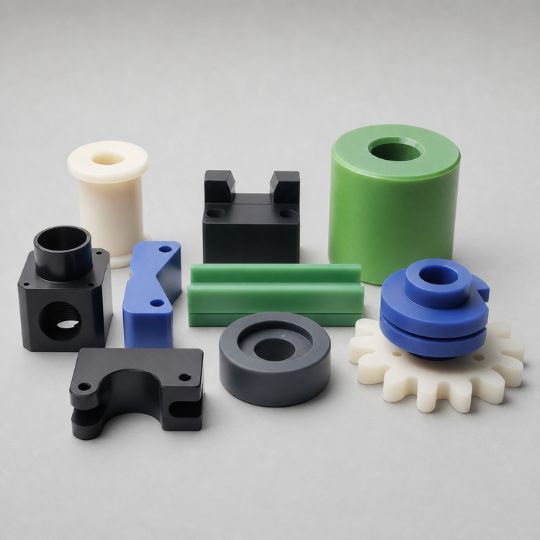
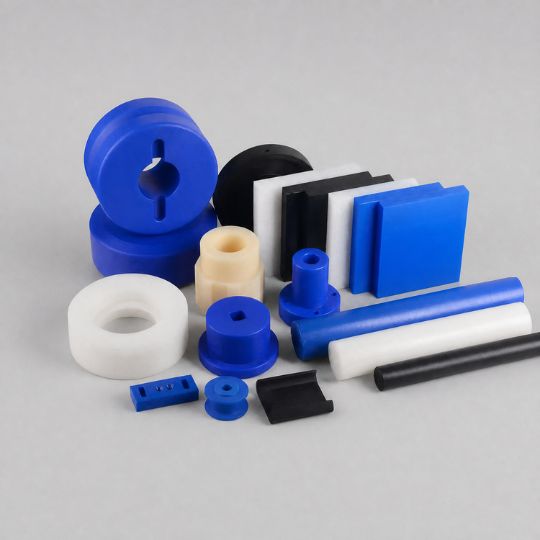
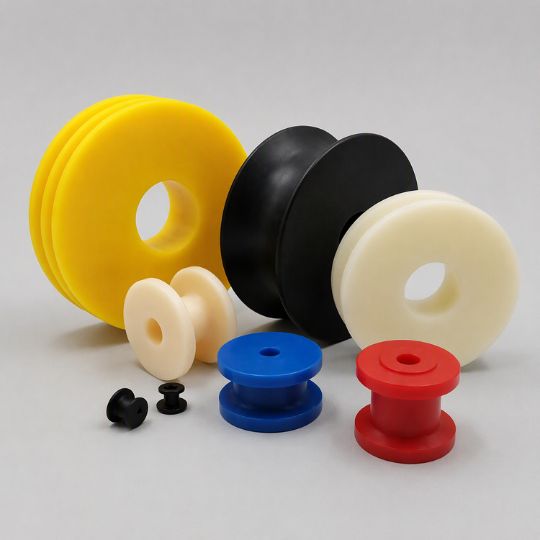
Typical applications
- Industrial machinery and material handling: guide rollers, wear pads, sprockets
- Food and beverage processing: bushings and wear strips for washdown equipment
- Packaging and conveying: rollers, sheaves and guide rails
- Electrical and electronic equipment: insulating spacers, non-conductive mountings
- Automotive and transport: non-marring bushes and trim fasteners
- Laboratory and medical equipment: quiet, corrosion-free moving parts
Custom nylon components machined to your drawing
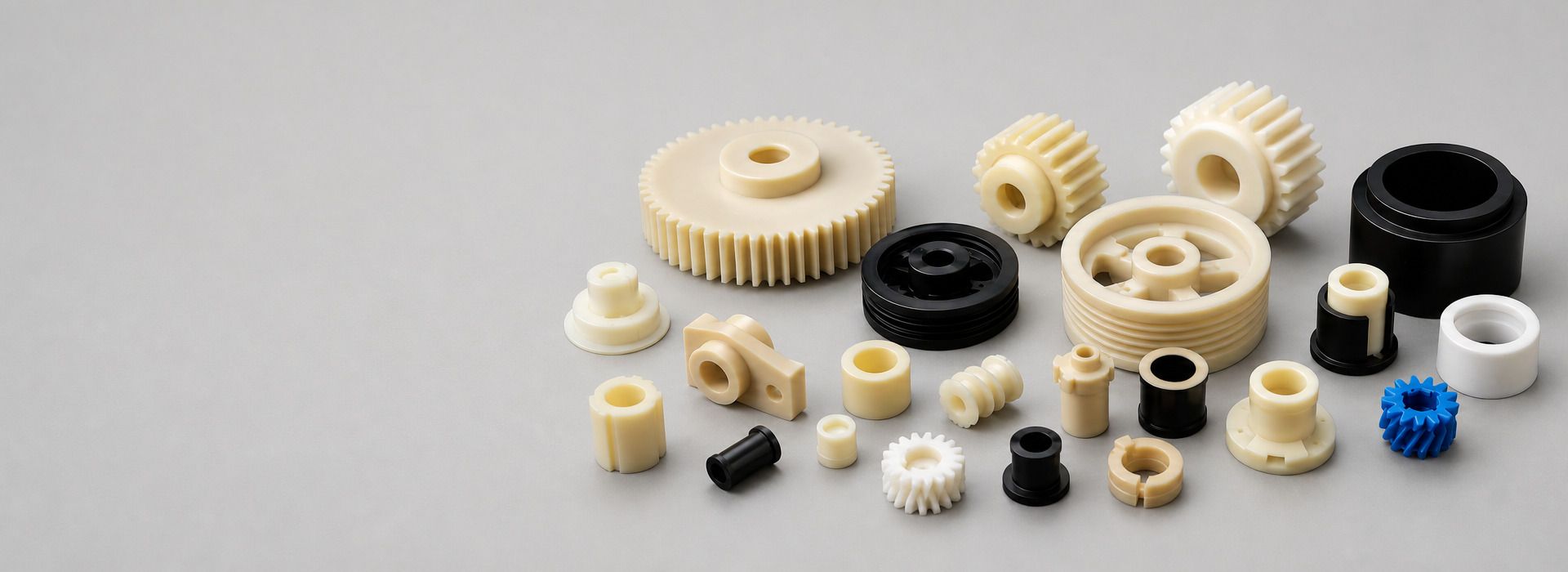
HANSA machines custom nylon parts to your drawing, from a single prototype to a production run. Bushings, gears, rollers, spacers, washers and fasteners make up most of the work, each one machined to the tolerance your assembly needs.
Two questions decide whether nylon is the right material for your part: what it has to survive, and how tightly it has to fit. Both are answered in detail further down this page, and both are worth settling before you release a drawing.
Nylon Parts from HANSA
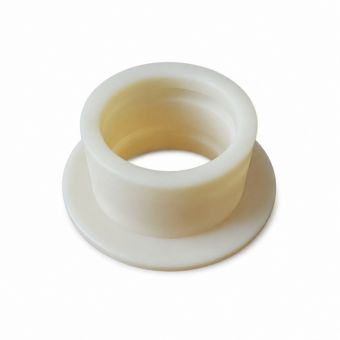
Plain, flanged and sleeve bushings machined by HANSA to your drawing. Self-lubricating in most duties, so you drop the grease point and the maintenance round.
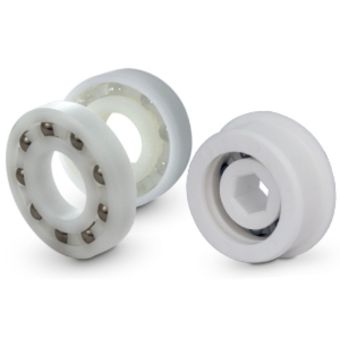
Plain and sleeve nylon bearings machined to your bore and load. HANSA holds the running clearance your shaft needs, batch after batch.
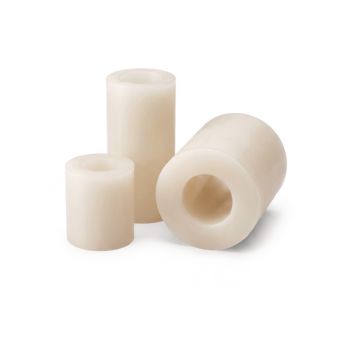
Round, hex and square spacers cut and machined by HANSA. Tell us the gap you need to hold, the tolerance that matters, and the abrasion the spacer sees.
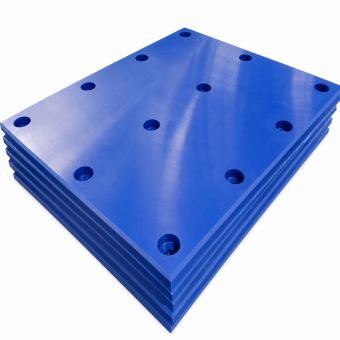
Wear pads machined by HANSA for sliding contact. Send the abrasion, the load and the surface they run against, and you get the profile that lasts.
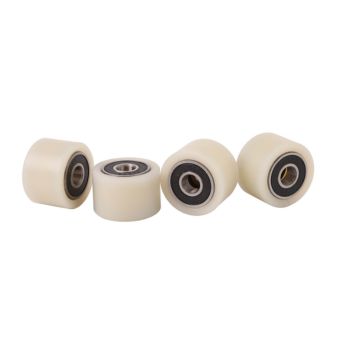
Machined nylon rollers that run quieter than metal and need no lubrication. Send HANSA your bore, width and load and the roller is quoted to suit.
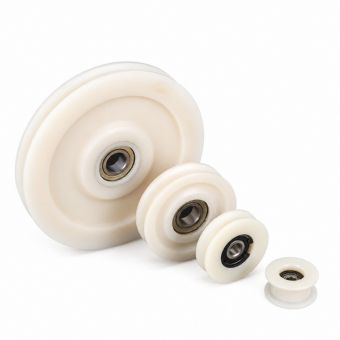
Nylon pulleys machined to your groove profile. HANSA cuts the groove to the rope or belt you actually run, rather than to a stock catalogue shape.
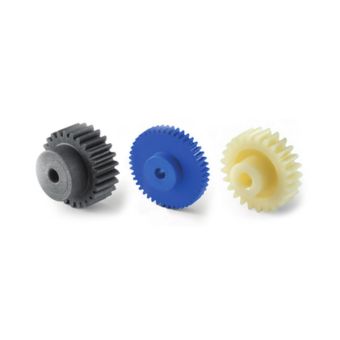
Spur, helical and worm gears machined by HANSA for low-load, low-noise drives. You get the tooth profile you specify, not a catalogue shape.
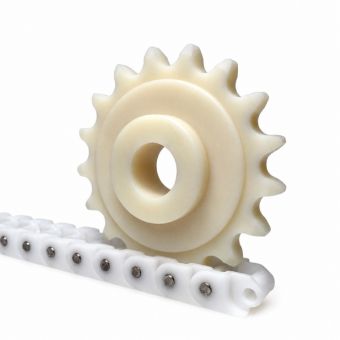
Nylon sprockets cut to your pitch and tooth count. Send HANSA the chain you run and the sprocket is machined to match it.
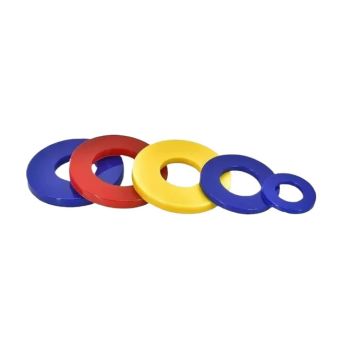
Flat, shoulder and sealing washers machined to your drawing. HANSA holds them to the tolerance your assembly needs, so your joint behaves the same on every batch.
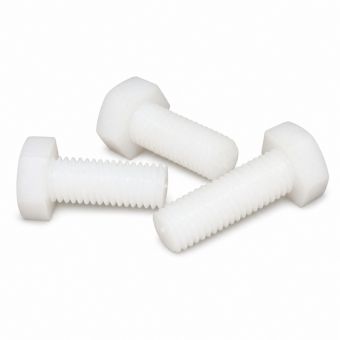
Nylon screws machined by HANSA in the thread, length and head you specify. Tell us the material you are fixing into and the screw is quoted to suit it.
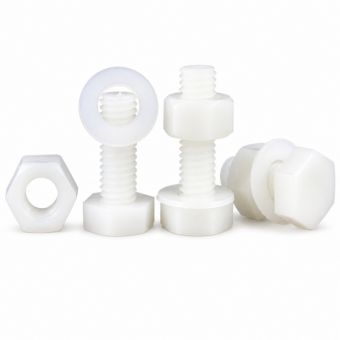
Nylon bolts machined to your drawing, sized for the load your joint carries. HANSA makes them in the thread and length you need.
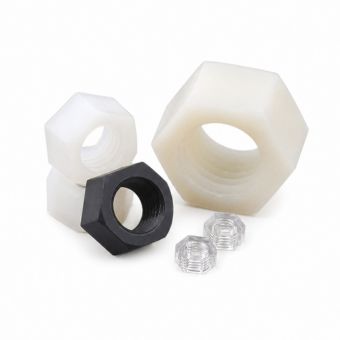
Hex nuts machined from nylon, not metal lock nuts. HANSA makes them in the thread and size you specify.
What HANSA machines: the nylon parts that come through the shop
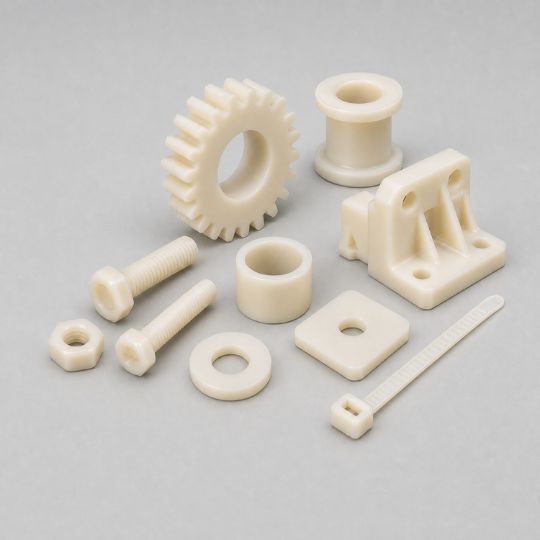
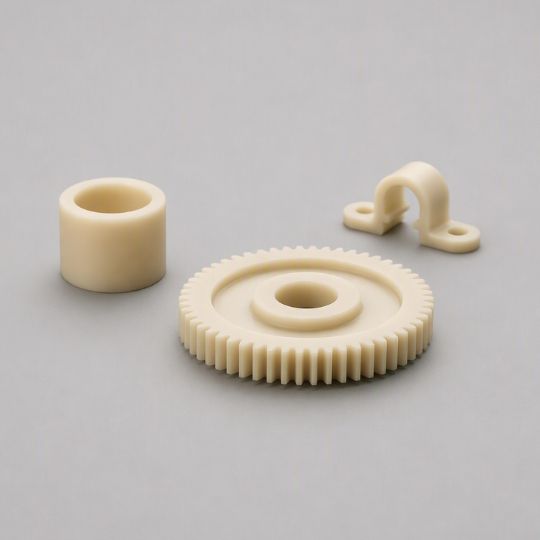
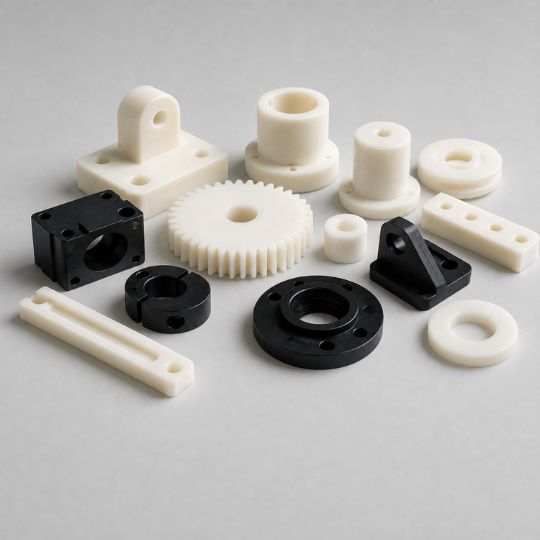
Send HANSA your drawing and you get a part machined from nylon. The nylon parts that arrive most often are bushings and bearings, gears and sprockets, rollers and sheaves, spacers and wear pads, flat and shoulder washers, and nylon screws, bolts and hex nuts.
Nylon is not one material. It behaves differently depending on which member of the family your part needs, and that choice drives your tolerance, your fit and how long the component lasts in service. If you have not settled it yet, start with the guide to polyamide (PA) material and the comparison of nylon 6 and nylon 66. Both are written for people specifying a part, not for chemists.
HANSA also supplies the stock your part is cut from, so one supplier covers both the Nylonstange oder Nylonblatt and the finished component. That single-source arrangement is worth knowing before you split the nylon parts order across two vendors and two delivery dates.
Why your part may belong in nylon rather than metal
Most nylon parts start life as bronze, steel or aluminium. Four reasons come up again and again when a buyer makes the switch.
The component gets lighter – nylon is roughly one seventh the weight of bronze for the same volume, which matters when your part sits on a moving assembly. It runs quieter, which is why you find it in gears and rollers rather than static frames. It does not corrode, so washdown and humid environments stop being a maintenance item. And it needs no external lubrication in most bushing and wear-pad duties, which removes a grease point from your service schedule.
None of those four reasons depends on the part being new. Most nylon parts replace a metal component that already works, and the case for changing is a cost or a maintenance one.
If your decision is still open between polymers rather than between metal and plastic, two short comparisons show where each one stops working on nylon parts: PTFE versus nylon Und nylon versus rubber.
What +/-0.02 mm actually means on a machined part
HANSA machines nylon to a general tolerance of +/-0.02 mm. Put that figure in your enquiry if you want a realistic picture of what will arrive.
It is the band you can expect on ordinary turned diameters and on the straightforward milled features of most nylon parts. It is not a promise that every feature on every nylon part holds it. Tolerance on nylon parts is a function of the geometry in front of the tool, not of the material alone. A short, well-supported diameter is easy. The same dimension on a long slender rod deflects under cutting force and will not hold. Thin walls move. A tight band held across a large span is a different job from the same band held over 10 mm, and you would rather hear that at quotation than discover it at inspection.
So state the band you need for each feature. If two dimensions are critical, say which two and let the rest run to a commercial tolerance. You get a lower price and a faster delivery for a part that still does its job.
Moisture: the one thing that catches out first-time nylon buyers
Nylon takes up moisture from the air, and the nylon parts that measure perfectly in the inspection room will not measure the same three weeks later in a humid plant. Absorbed water changes their dimensions. That is not a defect, and no amount of machining precision removes it – it is what the material does.
The practical consequence is that “in tolerance” means nothing until you say under what condition. Tell HANSA which of these your drawing should specify:
- Dry as machined. Dimensions set immediately after machining, for parts that stay dry or are fitted straight away.
- Conditioned. Dimensions verified after the part has taken up moisture to equilibrium, for parts that live in a normal atmosphere.
- A defined gap. You design the clearance so that moisture growth moves the part in a direction that still works.
Which condition is right for your nylon parts depends on your fit. If you are unsure, describe what the part does and HANSA will tell you which condition to call out.
Parts in damp service also run slightly softer and more dimensionally mobile than parts kept dry. If your assembly depends on a clearance measured from a dry sample, check that assumption before you release the drawing.
Design details that move your price and your date
Two drawings can describe the same function and quote very differently. Four details explain most of the gap.
Wall thickness. Thin walls are where nylon moves under cutting force, so they need lighter passes and more inspection. A wall that is generous enough to stay rigid while it is being cut is cheaper than one that is not.
Corner sharpness. A sharp internal corner concentrates stress and is the first place a loaded part cracks. A small radius costs nothing at the drawing stage and removes a whole class of field failure.
Tolerance stacking. A stack of features each held to a tight band multiplies the cost. Identify the two or three dimensions the assembly actually depends on; a process capability study is worth more on those than a tighter band on everything.
Feature count. Every extra hole, slot and thread adds a setup or a tool change. Consolidating similar features so they can run in one operation often cuts cost without changing the part’s function.
None of this requires you to redesign the component. It requires you to say which features matter on your nylon parts, and to let the rest be machined at the tolerance that keeps the price sensible.
Where nylon parts fail – and how to design around it
Nylon is the right answer for a lot of parts and the wrong answer for some. These four failure modes account for most nylon parts that come back:
- Sustained load. Nylon creeps. A part held under continuous stress deforms slowly over months, even at room temperature. If your load never comes off, design for the deformed shape or choose a different polymer.
- Heat. Nylon has a lower continuous service temperature than PEEK or PTFE. If your part runs hot, check that first rather than last.
- Strong acids and phenols. These attack nylon. If your process involves them, say so early, and the answer is likely a different polymer rather than nylon.
- Outdoor UV. Unstabilised nylon degrades in sunlight. Indoor and enclosed applications are unaffected; long-term outdoor exposure is a specification, not an afterthought.
HANSA would rather lose a quotation than sell a part that fails in the field. If your application sits in one of those four areas, you will hear it plainly before you order.
When another engineering plastic is the better answer
Nylon is one of several polymers HANSA machines, and there are duties where a different one wins outright.
If the part runs hot, or has to survive aggressive chemicals, PTFE parts Und PEEK parts both hold their properties where nylon will not. If the duty is high-load and high-temperature, polyimide parts are built for it. If the problem is sliding abrasion at low load, UHMW parts wear longer than nylon parts and are usually the cheaper answer.
The honest position is that the drawing does not commit you to a material. Describe the load, the temperature, the chemicals and the duty cycle, and HANSA will tell you which of these polymers fits – including when the answer is not nylon. Parts that arrive at our shop as nylon enquiries do not always leave as nylon parts, and that is the point of asking.
What happens after you send a drawing
A quotation is the start of the process, not the end of it.
Your drawing is reviewed against the material and the tolerance you have asked for, and you get back three things: a price, a dated delivery commitment, and a note on any feature that will be difficult to hold. That third item is the one worth reading. It tells you where the risk sits before you commit to a tool or a batch, and it is far cheaper to resolve on paper than at inspection.
From there you approve the quotation, the first part is machined and inspected against your drawing, and you see the measurement results before the rest of the batch runs. The component you approve is the component you get in volume, because nothing about the process changes between the two – and that consistency is what makes repeat nylon parts orders predictable.
If the first article reveals a problem, it is found while it is still one part. That is what the sequence is for. Ask HANSA for a first-article inspection report on any part where a dimension matters, and it is built into the quotation from the start.
Yes. Send a 2D PDF with your tolerances and HANSA can quote from it; a 3D STEP file removes the remaining ambiguity about geometry. Both are sufficient to start – the drawing does not need to be production-released before you ask for a price.
Minimums are quoted per part rather than published as a single catalogue figure, because the economic minimum depends on the geometry, the stock size and the material. Send the drawing together with the quantity you expect across the first year, and the quotation will state the minimum for that part.
Yes. Single parts and small batches run through the same process as volume orders, so the part you approve as a prototype does not change when it moves to production.
Describe what the part has to do – load, moisture, chemicals, heat and whether it touches food – and HANSA will tell you which member of the nylon family fits. The guide to polyamide (PA) material covers the differences in plain language.
Yes, when they are requested. Name the certificates you need on the purchase order; documents are straightforward to issue at order entry and awkward to reconstruct afterwards.
Yes. FDA requirements are met for parts intended to contact food. Tell HANSA the application on the enquiry so the correct material is selected from the start rather than corrected later.

 German
  English
  Arabic
  Tibetan
  Spanish
  French
  Hindi
Hindi  Indonesian
  Italian
  Japanese
  Korean
  Dutch
Dutch  Portuguese
  Thai
Thai  Russian
  Swedish
  Chinese