


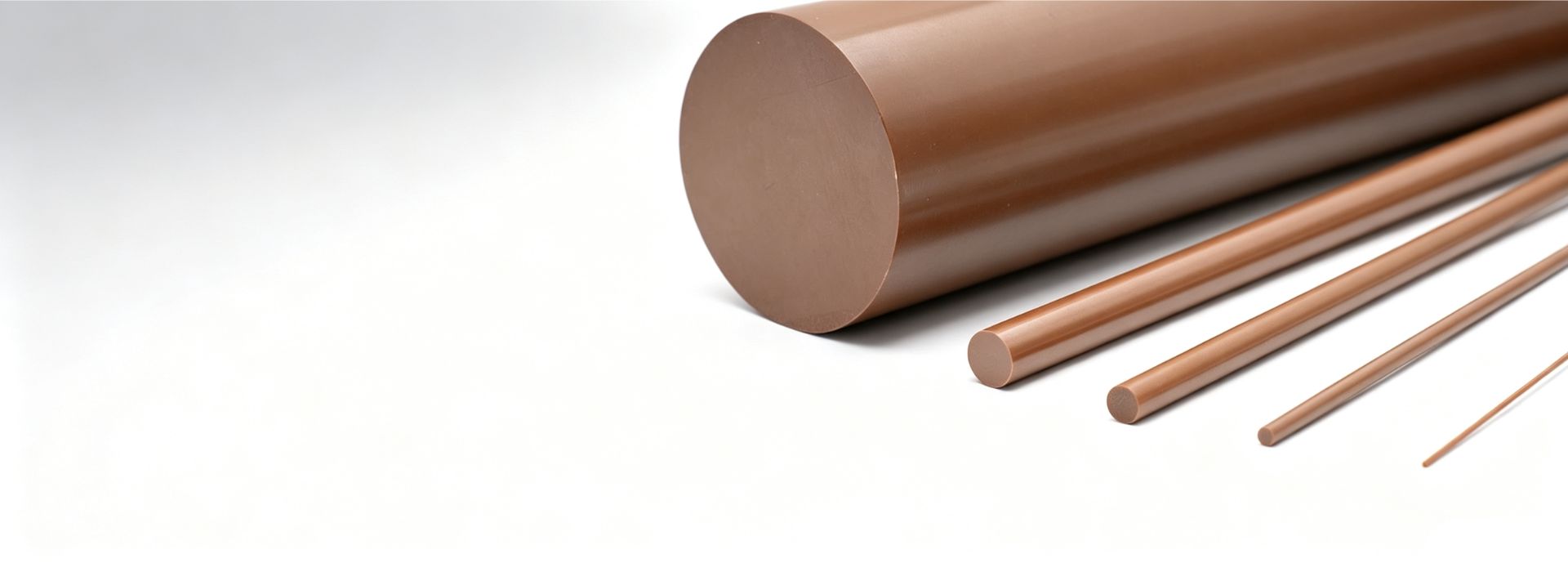
What is Polyimide Rod?
Polyimide rods are solid, round stock shapes made from specialty engineering plastic. They are typically produced from polyimide powder through high-temperature compression molding and sintering. The polyimide rods supplied by HANSA are machined from PI sheets. Their available length corresponds to the sheet length, while the maximum rod diameter is determined by the sheet thickness.
Polyimide rod is available in multiple grades, and the material formulation determines its final performance. Options include, but are not limited to, graphite-filled, PTFE-filled, glass-fiber-reinforced, ceramic-filled, and specialized electrical grades designed to meet different application requirements.
Polyimide Rod Types by Material Modification
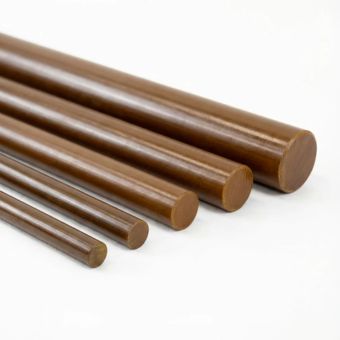
Unfilled PI rod contains no graphite, PTFE, glass fiber, or conductive filler. Start with this category when you need a filler-free composition or electrical insulation.
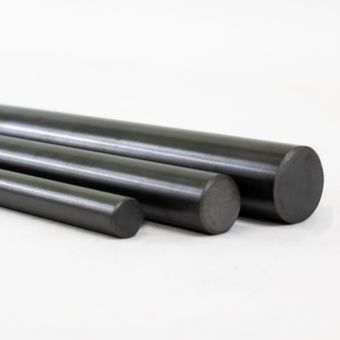
If you are comparing wear-resistant polyimide rod options, HANSA offers grades containing either 15% or 50% graphite. The 15% grades balance modified friction and wear properties with the characteristics of their base resin.
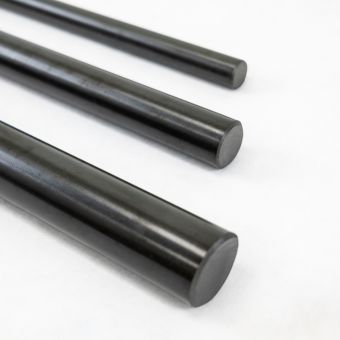
A-PI-211 contains 15% graphite and 10% PTFE. This PTFE-modified polyimide rod provides a lower-friction formulation than graphite-only PI.
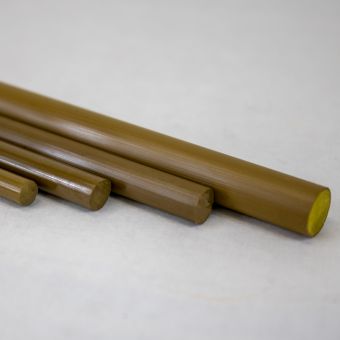
A-PI-6010-GF30 contains 30% glass fiber. The reinforcement increases modulus and makes the material stiffer than the unreinforced base grade.
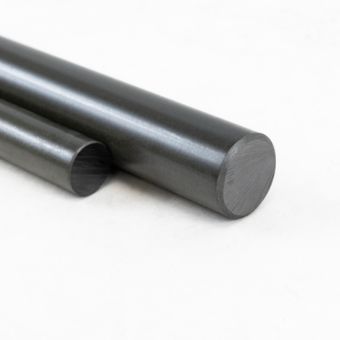
A-PI-F and A-PI-ESD belong to HANSA’s functional electrical PI range. If your specification calls for anti-static or electrostatic-dissipative behavior, define the required resistance range and test conditions before selecting a grade.
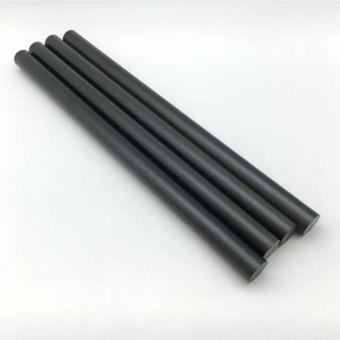
A-PI-D is HANSA’s conductive PI grade and targets lower electrical resistance than A-PI-ESD.
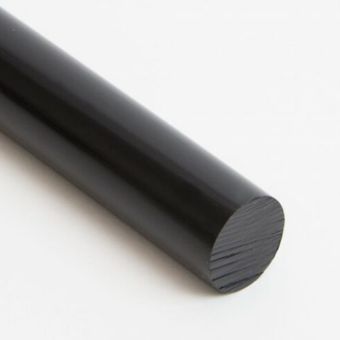
A-PI-MS is HANSA’s vacuum self-lubricating PI grade. Review it when your material specification prioritizes self-lubricating behavior in a high-vacuum environment, then confirm the required vacuum level, temperature, load, motion, and test conditions with HANSA.
HANSA Polyimide Rod Grades
The latest HANSA range covers basic, modified, vacuum self-lubricating, and functional electrical PI grades. Use the tables below to narrow the material family first. Then compare the exact grade data against your thermal, mechanical, friction, electrical, and environmental requirements.
- Basic Polyimide Rod Grades
- Modified Polyimide Rod Grades
- Vacuum Self-Lubricating Grade
- Functional Electrical Polyimide Rod Grades
- Polyimide Rod Sizes
| HANSA PI Grade | Confirmed Grade Family or Focus | How You Can Compare It |
| A-PI-L8 | Basic polyimide resin | Use as a base-grade option and compare its exact thermal, mechanical, and electrical data with the other basic grades |
| A-PI-260S | Basic polyimide resin | Review when you need another balance within the basic PI range; confirm the grade-specific limits before selection |
| A-PI-280 | Basic polyimide resin | Compare temperature performance and moisture response with the other unfilled grades |
| A-PI-330 | Basic PI with good toughness and plasma resistance | Review when toughness and plasma exposure both matter |
| A-PI-350-A | Basic PI with good toughness | Not recommended for high-temperature plasma or ultraviolet environments |
| A-PI-380 | Basic PI with higher-temperature capability and plasma resistance | Compare with A-PI-330 and A-PI-350-A when temperature has higher priority than toughness |
| A-PI-6010 | Basic PI with high hardness and wear resistance | Review when you need wear resistance without a graphite-filled formulation |
| A-PI-5001 | Basic PI with high hardness and modulus | Review when stiffness, toughness, wear resistance, and temperature performance are priorities |
| A-PI-5200 | Basic polyimide resin | Compare its grade-specific property balance with A-PI-5001, A-PI-480H, and A-PI-480W before selection |
| A-PI-480H | Higher-temperature basic PI with improved toughness | Review when you need high-temperature performance with a tougher material balance |
| A-PI-480W | Higher-temperature basic PI with high hardness | Compare hardness, thermal expansion, and temperature data under your required conditions |
| HANSA PI Grade | Confirmed Modification | How You Can Compare It |
| A-PI-350-21 | 15% graphite | The tougher 15% graphite option; compare with A-PI-380-21 when temperature also matters |
| A-PI-380-21 | 15% graphite | Places more emphasis on friction and wear at higher temperatures than A-PI-350-21 |
| A-PI-211 | 15% graphite and 10% PTFE | Review when lower friction matters; compare its electrical, thermal, and mechanical tradeoffs with graphite-only grades |
| A-PI-5050 | 50% graphite | Targets wear performance at elevated temperatures, with lower toughness than the 15% graphite grades |
| A-PI-5051 | Modified polyimide resin | Confirm the targeted modification and grade-specific data before comparing it with A-PI-5050 or the 15% graphite grades |
| A-PI-6010-GF30 | 30% glass fiber | Review when higher modulus and stiffness are priorities, then check toughness, electrical behavior, and thermal response |
| HANSA PI Grade | Confirmed Grade Focus | How You Can Compare It |
| A-PI-MS | Self-lubricating behavior in a vacuum environment | Define the vacuum level, temperature, load, motion, and expected friction and wear behavior before selection |
| HANSA PI Grade | Confirmed Grade Focus | How You Can Compare It |
| A-PI-D | Conductive PI | Define the required resistance range and measurement method, then compare its other thermal and mechanical requirements |
| A-PI-F | Anti-static functional PI | Confirm the target resistance range rather than selecting from the anti-static label alone |
| A-PI-ESD | Electrostatic-dissipative PI | Define the ESD resistance range, conditioning, test voltage, electrode arrangement, and measurement method |
| Length | Diameter |
| 1,000 mm | Ø1–100 mm |
| 510 mm | Ø1–50 mm |
| 210 mm | Ø1–50 mm |
| 360 mm | Ø1–80 mm |
| 320 mm | Ø1–80 mm |
How to Choose Between Polyimide Rod Grades
Choosing a polyimide rod begins with the material grade, not the color or diameter. The base polymer and every added filler change the balance of thermal, mechanical, friction, electrical, moisture, and dimensional properties. A grade selected for lower friction may not meet an insulation target. A grade with higher-temperature capability may not provide the toughness or thermal expansion behavior you need. Use the following process to narrow the HANSA grade range before confirming the rod size.
Rank Your Requirements Before Comparing Grades
Begin by separating essential requirements from preferences. An essential requirement may be electrical insulation, a defined resistance range, lower friction, higher stiffness, reduced moisture absorption, or lower thermal expansion. Temperature also needs context: distinguish continuous service, peak exposure, atmosphere, load, and duration instead of asking only for a “high-temperature polyimide rod.”
Next, rank properties that may compete with one another. Increasing graphite content may improve the targeted friction and wear behavior while reducing toughness. Glass fiber may increase modulus but change surface, electrical, and thermal characteristics. Once HANSA knows which requirements cannot change, the grade comparison becomes more focused and useful.
Start with Unfilled PI When You Do Not Need a Filler
An unfilled grade keeps graphite, PTFE, glass fiber, and conductive filler out of the formulation. It is a logical starting point when you need a filler-free composition or electrical insulation. However, `unfilled` is only a material category, not a complete specification. HANSA’s current basic PI range includes A-PI-L8, A-PI-260S, A-PI-280, A-PI-330, A-PI-350-A, A-PI-380, A-PI-6010, A-PI-5001, A-PI-5200, A-PI-480H, and A-PI-480W.
A-PI-330 emphasizes toughness and plasma resistance. A-PI-350-A combines good toughness with a broad property balance, but it is not intended for high-temperature plasma or ultraviolet exposure. A-PI-380 offers higher-temperature capability and plasma resistance with lower toughness. Other unfilled grades address different combinations of moisture absorption, hardness, modulus, wear resistance, thermal expansion, toughness, and heat resistance.
Choose the unfilled candidates that match your first two priorities, then compare their grade-specific data. This prevents a familiar grade name, color, or single headline property from replacing the full selection criteria.
Compare Graphite and PTFE by the Full Friction Requirement
HANSA offers graphite-filled grades containing 15% or 50% graphite. A-PI-350-21 and A-PI-380-21 both contain 15% graphite, but their base polymers produce different property balances. A-PI-350-21 is the tougher option, while A-PI-380-21 places more emphasis on friction and wear performance at higher temperatures.
A-PI-5050 contains 50% graphite and gives greater emphasis to wear performance at elevated temperatures, with lower toughness. The higher percentage does not make it the automatic choice. Compare load, temperature, motion, lubrication, acceptable wear, electrical behavior, thermal expansion, and surface requirements before selecting the graphite content.
A-PI-211 follows a different formulation strategy by combining 15% graphite with 10% PTFE. Consider it when lower friction is a primary requirement, then compare its electrical, thermal, mechanical, wear, and surface properties with the graphite-only grades. The filler combination matters, but your complete operating requirement still determines the final choice.
Keep Insulating, Anti-Static, ESD, and Conductive Categories Separate
Electrical insulation, anti-static behavior, electrostatic dissipation, and conductivity describe different targets. An unfilled PI grade may support electrical insulation. A-PI-F and A-PI-ESD address controlled-resistance requirements, while A-PI-D targets lower electrical resistance and conductive behavior. Color alone cannot establish which category a rod meets.
Define the required resistance range before choosing between these grades. If electrical acceptance is critical, also state the test voltage, electrode arrangement, conditioning environment, specimen geometry, temperature, and measurement method. The same formulation can produce different reported values when the specimen and test conditions change.
Use Glass Fiber or a Vacuum Grade for a Defined Reason
A-PI-6010-GF30 contains 30% glass fiber and increases modulus. Review it when stiffness is a primary requirement, then check how the reinforcement affects toughness, surface behavior, electrical properties, and thermal response. Do not select it from glass-fiber content alone.
A-PI-MS follows a separate selection path because it targets self-lubricating behavior in a vacuum environment. Define the vacuum level, temperature, load, motion, and expected friction and wear behavior before comparing it with general basic or modified PI grades.
Compare Numerical Data on the Same Basis
Technical values only support a fair comparison when their test basis is comparable. Before comparing two grades, check the standard, specimen, temperature, humidity or conditioning, loading direction, and units. Continuous service temperature, peak exposure, glass-transition temperature, and short-term exposure are not interchangeable measures.
Apply the same discipline to strength, modulus, hardness, moisture absorption, electrical resistance, friction, wear, and thermal expansion. A larger value is not always better. The useful value is the one measured under conditions that represent your requirement and help distinguish the remaining candidate grades.
Confirm the Grade Before You Select a Custom Rod Size
HANSA cuts its polyimide rod from PI plate stock, so the selected grade and applicable plate must support the requested dimensions. First narrow the material grade, then provide the diameter, length, and quantity. HANSA can check your request against the confirmed ranges or review another specification.
Do not choose a diameter first and assume that every PI formulation is available across the same size range. Special fillers, electrical formulations, and higher-temperature polymer systems may require different plate stock. Stating the grade and dimensions together gives HANSA a clear basis for confirming availability.
This order keeps the material identity clear and avoids selecting by color or diameter alone. If you do not know the grade, send HANSA your ranked thermal, mechanical, friction, electrical, moisture, and dimensional requirements with the requested rod size.
HANSA offers basic PI, graphite-filled, graphite- and PTFE-modified, glass-fiber-reinforced, vacuum self-lubricating, anti-static, ESD, and conductive rod grades. Each type has a distinct balance of thermal, mechanical, friction, electrical, moisture, and dimensional properties.
All three are unfilled PI grades. A-PI-330 emphasizes toughness and plasma resistance. A-PI-350-A emphasizes good toughness but is not recommended for high-temperature plasma or ultraviolet exposure. A-PI-380 provides higher-temperature capability and plasma resistance with lower toughness.
A-PI-350-21 and A-PI-380-21 contain 15% graphite. A-PI-5050 contains 50% graphite and places greater emphasis on wear at elevated temperatures, with lower toughness. Compare friction, wear, toughness, electrical behavior, thermal expansion, temperature, and surface requirements instead of selecting from graphite percentage alone.
Graphite-only grades use graphite to modify friction, wear, thermal, and electrical behavior. A-PI-211 combines 15% graphite with 10% PTFE for lower friction. Compare the full property balance because PTFE also affects characteristics beyond friction.
Review A-PI-6010-GF30 when higher modulus and stiffness are priorities. Review A-PI-MS when self-lubricating behavior in a vacuum environment is the primary requirement. Compare the exact grade data and operating conditions rather than selecting from the grade name alone.
An insulating grade is intended to resist electrical current. A-PI-F and A-PI-ESD address controlled-resistance requirements, while A-PI-D targets conductive behavior at lower resistance. Define the electrical target and measurement conditions before choosing among unfilled PI and these three functional grades.
Color can help you distinguish grades, but it does not fully define the material. Brownish red, yellow, dark green, black, brown, or white may indicate a base polymer or modification, yet different grades can share a similar color. Use the HANSA grade number and applicable data as the specification.
HANSA offers confirmed rod lengths of 210, 320, 360, 510, and 1,000 mm, with diameter ranges up to Ø100 mm. The available diameter range depends on the selected length, grade, and PI plate stock. See the size table above for each confirmed combination.
Not necessarily. The available range depends on the selected grade and corresponding PI plate stock. Provide the grade, diameter, length, and quantity, and HANSA will confirm whether the listed or custom specification is available.
Identify the properties that matter most and rank any competing priorities. Useful details include continuous and peak temperature, atmosphere, load, friction or wear requirements, electrical target, moisture exposure, thermal expansion, stiffness, toughness, and required product information. HANSA can then narrow the relevant grade options.

 Tibetan
  English
  Arabic
  German
  Spanish
  French
  Hindi
Hindi  Indonesian
  Italian
  Japanese
  Korean
  Dutch
Dutch  Portuguese
  Thai
Thai  Russian
  Swedish
  Chinese