


PTFE and PEEK are both high-performance thermoplastics, but they offer different strengths, which means each one excels in different applications. Choosing between them comes down to finding the right balance between performance and cost. Both materials perform well in key areas like temperature resistance, chemical resistance, mechanical strength, and dielectric strength.
Advantages of PTFE
PTFE offers outstanding chemical resistance and reacts with almost no chemicals. It has an extremely low coefficient of friction—around 0.04 under dry conditions—and provides natural self-lubrication. PTFE is also inherently non-stick and has good dielectric (electrical insulation) properties.
Advantages of PEEK
PEEK’s biggest advantage is its exceptionally high mechanical strength and excellent creep resistance. It can operate continuously at temperatures up to 260°C (500°F), with short-term use reaching as high as 300°C (572°F). Because of this, PEEK is well suited for high-load applications in high-temperature environments.
Chemical Structural
The molecular structures of PTFE and PEEK are what fundamentally set them apart.
PTFE is made up of only carbon and fluorine. The carbon–fluorine bond is extremely strong, which makes PTFE highly resistant to almost all chemicals. Its molecular structure is linear and has no side groups, resulting in weak intermolecular forces—this is why PTFE has relatively low mechanical strength.
PEEK, on the other hand, has a much more complex molecular structure. This gives it high mechanical strength and excellent creep resistance, but its chemical resistance is not as strong as PTFE.
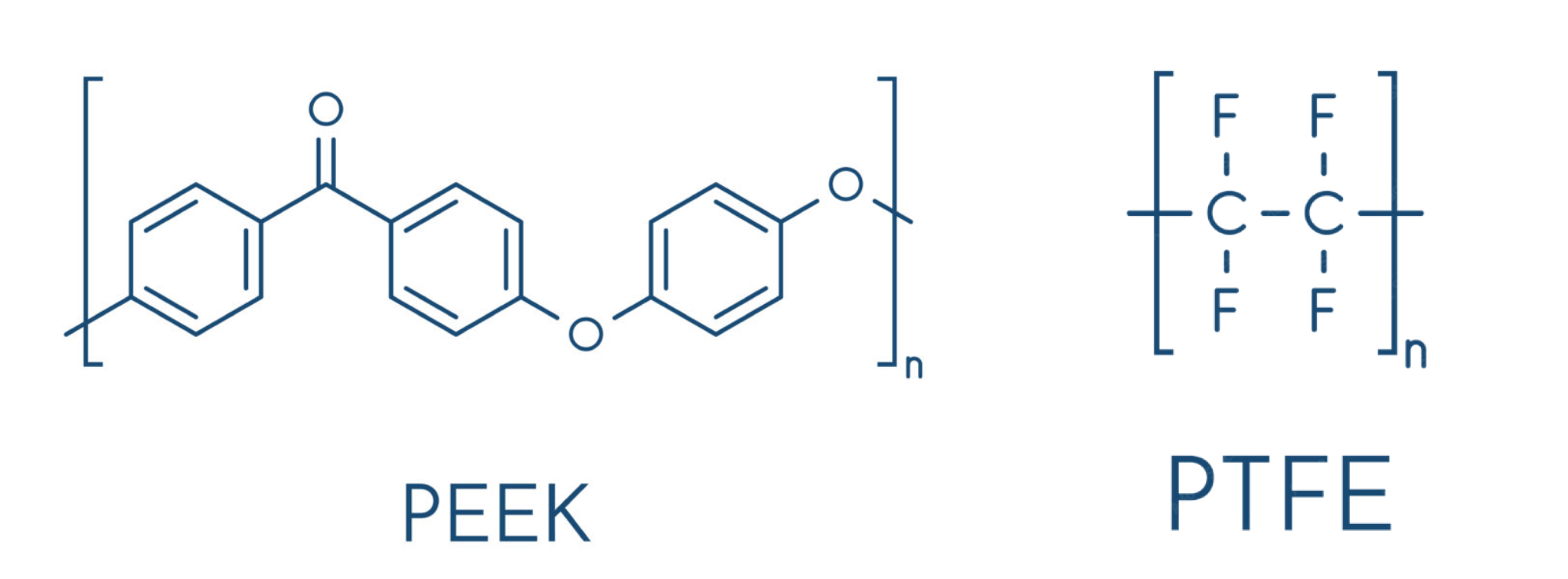
Properties Comparison
| Item | Standard | Eenheid | KIJKJE | PTFE |
| Treksterkte | ISO 527 | MPa | 95 | 20-35 |
| Bending Strength | ISO 178 | MPa | 155 | 10-20 |
| Smeltpunt | ISO 11357 | ℃ | 343 | 327 |
| Coefficient of Thermal Expansion | ASTM D696 | ppm K-1 | 45 | 100-200 |
| Dielectric Constant | IEC 62631 | – | 3.0 | 2.0 |
| Water Absorbation Rate | ISO 62-1 | % | 0.07 | <0.01 |
| Wrijvingscoëfficiënt | ASTM D3702 | 100N-120rpm | 0.30-0.38 | 0.04 |
Chemische bestendigheid
PTFE is widely known as the “king of plastics,” and it is more commonly recognized under the brand name “Teflon.” It has the best chemical resistance of any plastic, and it is almost completely inert to most chemicals. It can withstand strong acids, strong bases, and most organic solvents without reacting. If your application is in the chemical industry and requires high corrosion resistance, PTFE is usually the best choice.
PEEK also offers good chemical resistance, but it has some limitations. It can resist most organic and aqueous media, but it is not resistant to concentrated sulfuric acid, certain halogens, or halogenated compounds at high temperatures, where it can be degraded or attacked.
High Temperature Resistance
PTFE has a long-term service temperature range of about -200°C to 260°C (-328°F to 500°F). This means it performs well not only at high temperatures but also in extremely low-temperature environments.However, even though PTFE can operate at 260°C, it tends to deform under load or pressure at high temperatures.
PEEK, on the other hand, can withstand higher temperatures, typically around 300–325°C (572–617°F), and it maintains its shape and mechanical strength during long-term use. Therefore, if your application involves extreme high-temperature conditions, PEEK is usually the better choice.
Thermal Property
PTFE has a melting point of 327°C (620.6°F). Its coefficient of thermal expansion is about 100–200 ×10⁻⁶ /°C, which is relatively high among engineering plastics. This means its dimensions can change significantly with temperature fluctuations, and its rigidity is relatively low. If your application requires tight tolerances, PTFE should be selected with caution.
PEEK has a higher melting point of around 400°C (752°F). Its coefficient of thermal expansion is about 40–60 ×10⁻⁶ /°C, much lower than PTFE. Compared to PTFE, PEEK offers higher stiffness and much better dimensional stability under temperature changes, making it suitable for applications that require high strength and minimal deformation.
Mechanische sterkte
PTFE has a tensile strength of about 20–35 MPa, while PEEK can reach up to around 95 MPa. This clearly shows that PEEK has significantly higher mechanical strength than PTFE, making it more suitable for high-load and wear-resistant applications.
In addition, PEEK can be processed using machining methods similar to metals. It combines metal-like strength with much lower weight, which allows it to replace metal in certain applications where stiffness is required but metal is not suitable. A typical example is in aerospace, where lightweight and high-strength materials are critical.
Elektrische isolatie
PTFE has an extremely low dielectric constant of around 2.0, and it is not affected by humidity. This makes it ideal for extreme conditions such as high-frequency and high-voltage applications, including cable insulation and microwave communication components.
PEEK has a slightly higher dielectric constant of about 3.0. However, due to its overall performance advantages, it is well-suited for high-temperature and mechanically demanding environments. It also maintains excellent dimensional stability under load.
How PTFE and PEEK solve different engineering problems
Industrie
- PTFE: Due to its extremely low friction coefficient, PTFE is commonly used in sliding bearings and guide rails. Its chemical inertness also makes it ideal for low-friction linings.
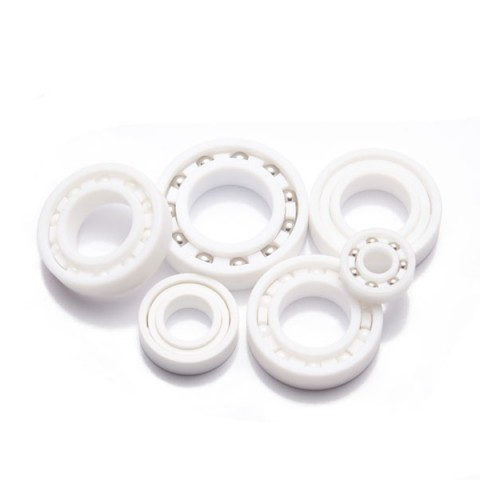
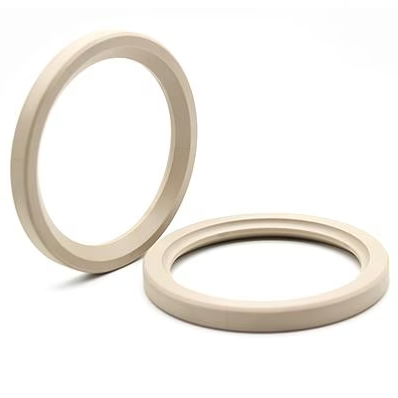
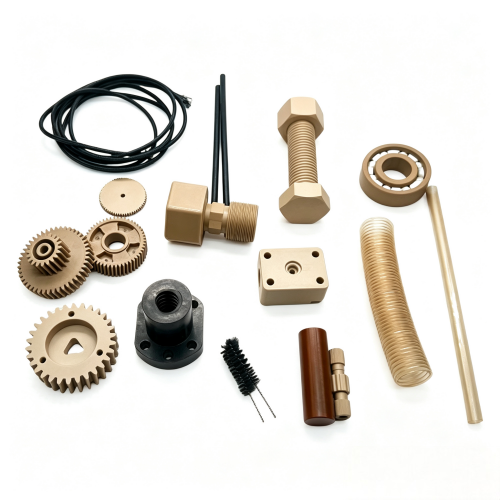
- PEEK: With its high rigidity and excellent dimensional stability, PEEK is used for pump components, load-bearing parts, and wear rings.
Lucht- en ruimtevaart
- PTFE: Because of its excellent electrical insulation properties, PTFE is often used in insulation systems and low-friction bearings.
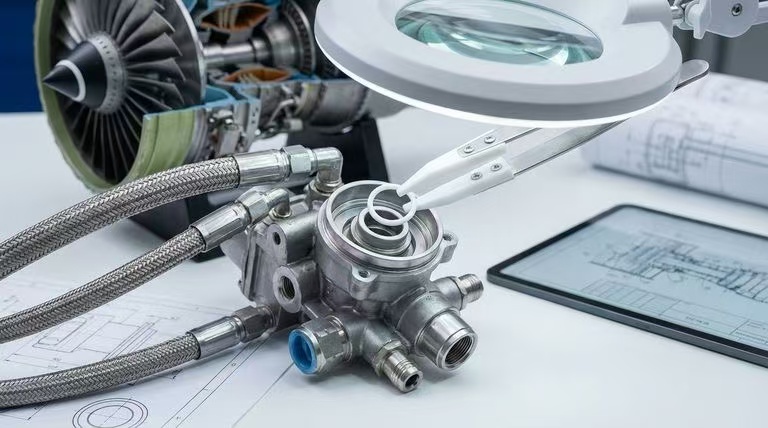
- PEEK: Thanks to its high mechanical strength and lightweight nature, PEEK is used for lightweight structural brackets and in applications where metal cannot be used.
Olie en gas
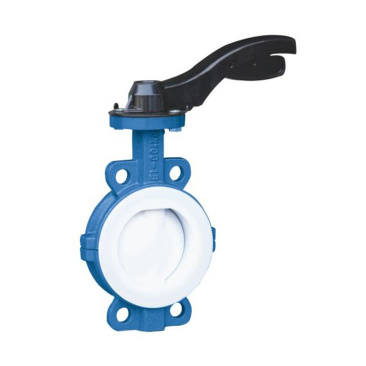
- PTFE: Similar to chemical processing environments, PTFE is widely used for corrosion-resistant valve seats, seals, and gaskets.
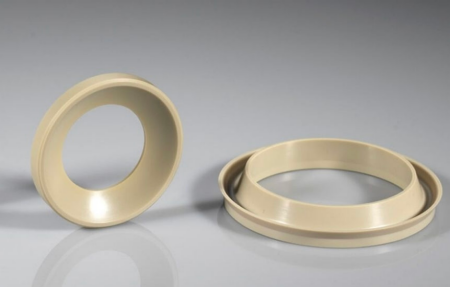
- PEEK: Due to its strong creep resistance, PEEK is commonly used for anti-extrusion rings, support rings, and high-pressure structural components.
Semiconductor
- PTFE: Used in ultra-pure chemical processing and low-contamination environments. Its chemical inertness prevents corrosion and contamination of process fluids, while its non-stick surface resists particle adhesion, ensuring high cleanliness.
- PEEK: Commonly used in wafer handling components that require repeated gripping and high stability. It provides high mechanical strength, low deformation, and also meets high cleanliness requirements.

Hydrogen energy and renewable energy
- PTFE: Offers excellent chemical resistance, low permeability, and outstanding sealing performance. It is widely used in seals for renewable energy systems exposed to aggressive chemicals, solving critical challenges in chemical resistance and sealing reliability.
- PEEK: Used in hydrogen compressors, high-pressure valve components, and structural parts. It addresses requirements for high strength, high temperature resistance, and long-term mechanical stability under demanding conditions.
Scenarios where PTFE cannot replace PEEK
Simply put, PTFE cannot replace PEEK because it cannot provide strong load-bearing performance at high temperatures. In applications that require both heat resistance and dimensional stability, PTFE is not sufficient.
-
Structural load-bearing
For components like high-load bearings, industrial gears, and transmission parts, PTFE falls short. Its low mechanical strength and poor creep resistance mean it can deform under long-term stress.If the machine stops operating, it will reduce your production efficiency and increase costs.
-
High temperature + load conditions
PTFE can withstand temperatures up to 260°C, but under load at high temperatures, it tends to deform. This makes it unsuitable for structural parts exposed to both heat and pressure, such as components near engines, aerospace supports, or high-temperature pump parts. In these cases, PEEK is the better long-term solution.
-
Precision dimensional control
In applications like wafer handling, where purity and dimensional stability are critical, PTFE is not ideal. Its high thermal expansion can lead to deformation, which may cause instability and even damage sensitive components like wafers.
-
Repeated mechanical motion
For dynamic, friction-based components, long-term wear is a concern. While PTFE has good wear resistance, it lacks resistance to mechanical fatigue. Continuous motion can accelerate wear, leading to deformation and higher maintenance costs.
Conclusie
In summary, no single material is perfect for every application. The better choice between PTFE and PEEK depends on your specific project requirements.
If your application prioritizes chemical resistance and low friction, PTFE is the right choice. If you need high load-bearing capacity, excellent dimensional stability, and resistance to extreme high temperatures, then PEEK is the better option.
Tell us your working conditions (temperature, load, chemical exposure), and our engineers will recommend the most cost-effective material for you.
Veelgestelde vragen
Why is PEEK more expensive than PTFE?
PEEK has a complex molecular structure, which makes its raw material cost relatively high. It is also more difficult to process and requires advanced equipment. In addition, PEEK offers superior performance and is considered a structural material that can replace metal in some applications. Its production volume is relatively low, and market supply is more limited.
How do I choose between PTFE and PEEK?
The choice should be based on your specific application. Key factors include temperature resistance, chemical resistance, required mechanical strength, and expected service life.
If your application involves extreme conditions—such as high temperature combined with heavy loads—PEEK is the better choice. If you need corrosion resistance, low-temperature performance, and low friction, then PTFE is more suitable.
Is PTFE stronger than PEEK?
PEEK is significantly stronger than PTFE in terms of mechanical performance. PTFE has a tensile strength of about 20–35 MPa, while PEEK reaches around 90–100 MPa. This makes PTFE a much softer material that is more prone to deformation under load or pressure.
Is PTFE more chemically resistant than PEEK?
Yes, PTFE is chemically inert. PEEK also has good chemical resistance, but it can be attacked by strong oxidizing acids at high temperatures, such as concentrated sulfuric acid.
Can PTFE and PEEK both operate at 250°C?
Yes, but PTFE cannot withstand pressure at high temperatures like 250°C. Under load, it deforms easily because of its very low mechanical strength.
In contrast, PEEK can maintain excellent dimensional stability at around 250°C and still retain high mechanical strength, making it suitable for high-temperature structural applications under load.

 Dutch
Dutch  English
  Arabic
  Tibetan
  German
  Spanish
  French
  Hindi
Hindi  Indonesian
  Italian
  Japanese
  Korean
  Portuguese
  Thai
Thai  Russian
  Swedish
  Chinese