


A PVC sheet is made from PVC resin, and it has a density of 1.40 – 1.45 g/cm³. Rigid PVC, expanded PVC, and flexible PVC are its three main types. You can process these sheets using wood and metalworking tools. The most common applications of these sheets include construction, furniture, signage, and interior design.
What is a PVC Sheet?
Definition and Composition
First, you need to know that PVC stands for Polyvinyl Chloride — a man-made plastic polymer. A PVC sheet is a flat board produced from PVC resin mixed with additives like:
- Stabilizers: Protect the plastic from heat damage and burning
- Plasticizers: Control flexibility; more makes it soft like rubber, less makes it rigid.
- Fillers: Make the sheet stronger and heavier without increasing the cost.
- Colorants: Add the final color and protect the sheet from fading in the sun.
These additives are what control whether the final sheet comes out rigid, flexible, or somewhere in between.
Also Read: What is PTFE Material?
This section is repetitive. You only need to mark the different functions of each additive after them. For example, stabilizer: reduce damage during processing. Plasticizer: control flexibility.
Types of PVC Sheets
Rigid PVC Sheets
First, rigid PVC — also called RPVC or unplasticized PVC — contains no plasticizers. This makes it one of the stiffest polymers at normal temperatures. You should generally use rigid PVC sheets when you need high impact resistance, chemical resistance, and structural strength.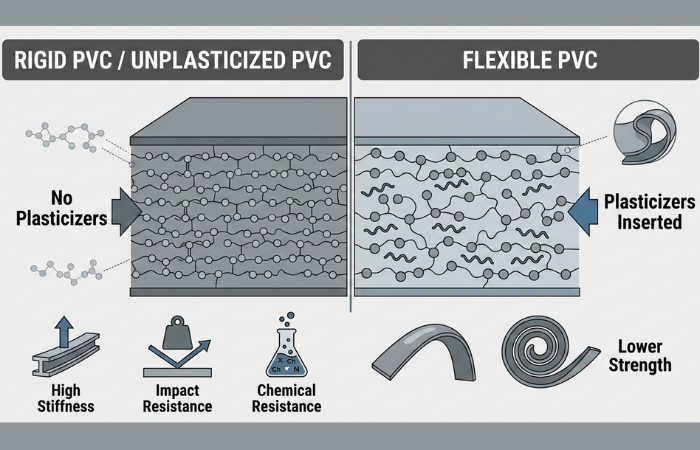
Note that you always verify the UL 94 V-0 flame rating on rigid PVC if you are using it in electrical or industrial enclosures. This rating means the material is self-extinguishing — it stops burning once the flame source is removed.
Rigid PVC sheets are available in standard sizes of 48″ x 96″ and thicknesses from 0.062″ up to 3″, so you have a wide range to work with depending on your load requirements.
Flexible PVC Sheets
Next, flexible PVC sheets use added plasticizers — measured in parts per hundred resin, or phr — to soften the material. You can go from a stiffness close to fabric at 55 phr down to a semi-rigid feel at 10 phr. 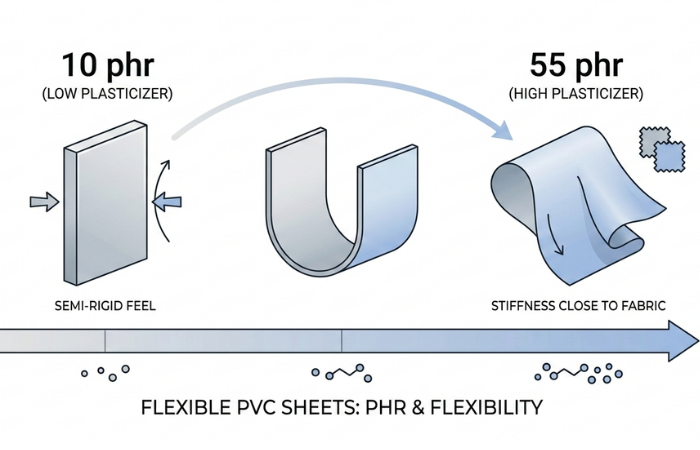
This can be a useful question to ask your supplier: What is the plasticizer content? Because the last thing you want to do is order flexible PVC for a structural panel application and end up with a sheet that bends under load.
Flexible PVC at 26–55 phr is good for waterproof garments, bags, curtains, and soft partitions.
Semi-Rigid PVC Sheets
Then, semi-rigid PVC comes between rigid and flexible, which generally comes in the 10–25 phr plasticizer range. It is good to use semi-rigid PVC when you need a sheet that bends without cracking but still holds its shape under moderate load.
Transparent PVC Sheets
After that, transparent PVC sheets are rigid or semi-rigid sheets processed with high clarity. These sheets allow light transmission close to glass. You can use them anywhere you need visual transparency. Some of the common examples are protective screens, display covers, curtain walls, and point-of-sale signage.
PVC Foam Sheets
Furthermore, PVC foam sheets — also called free foam boards — are made by adding a foaming agent to the PVC compound during extrusion. This creates a closed-cell internal structure that is lightweight but rigid on the surface. The result is a board you can cut, route, print on, and paint without the weight of solid PVC.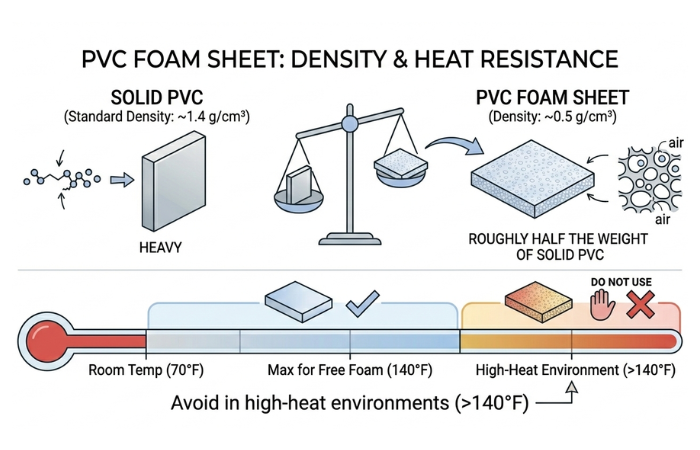
The standard density is around 0.5 g/cm³, which is roughly half the weight of solid PVC. Free foam boards can generally face temperatures up to 140°F, so you should generally avoid them in high-heat environments.
Celuka PVC Sheets
Moreover, Celuka PVC sheets are a specific type of foam board made through a controlled extrusion process. Here is what the experts found to be the key difference: during production, the surface of the Celuka board is rapidly cooled the moment it exits the die, forming a hard, dense outer skin of 0.3–0.5 mm. The core underneath remains foamed and lightweight.
This often just means that Celuka sheets give you the weight savings of foam with a surface that is smooth, hard, and scratch-resistant enough for cabinet making, wall cladding, and outdoor panels. Celuka boards also handle temperatures up to 160°F— that is 20°F higher than standard free foam. You can also CNC routing engrave Celuka sheets cleanly because the hard skin holds fine detail without tearing.
Same as always, the trade-off is cost — Celuka typically runs 15–25% more than standard free foam boards. Just make sure the application justifies it before specifying Celuka over standard foam.
PVC Marble Sheets
Finally, PVC marble sheets are not a separate polymer type. You should understand them as a laminated product — a PVC foam or Celuka base board with a thin marble-finish film bonded to the surface using PUR hot melt adhesive. The marble surface layer is either PVC film at 0.14–0.25 mm thickness or PETG film at 0.35 mm for a more durable, higher-gloss result.
Now that all of this is stated, the reason PVC marble sheets have grown popular in interior design is straightforward: you get the visual effect of natural stone at a fraction of the weight, cost, and installation time. Projects using PVC marble panels finish approximately 30% faster than equivalent natural stone jobs.
Properties of PVC Sheets
PVC sheets offer a hard-headed solution for anyone tired of wood rot or heavy metal costs. You will find that these plastic panels are not just cheap fillers but engineered assets. They perform where organic materials fail because they do not react to the environment in the same way.
Durability and Strength
First, you need to understand that PVC is tougher than it looks. It does not dent easily like thin aluminum. You will see that the impact resistance stays high even in cold weather. This often just means you can bash a cart into a warehouse wall and the PVC will bounce back. It is a helpful trait for your high-traffic zones.
Water and Moisture Resistance
Water is the enemy of most building materials. Not here. PVC does not absorb a single drop. You will need this in places like laundry rooms. So, why? The reason is that the cellular structure is completely closed. This can be a useful question to ask: why use wood that swells when you can use plastic that stays the same size forever?
Resistenza chimica
In terms of chemical contact, PVC wins. It handles acids and alkalis without melting or staining. You should generally avoid harsh thinners, but for soap and industrial cleaners, it is fine. This often just saves you from replacing panels in labs or kitchens.
Fire Retardancy
Fire safety is non-negotiable. Most PVC sheets contain chlorine, which makes them self-extinguishing. If you pull the flame away, the burning stops. Note that you always want a Class A- often tested under the ASTM E84 fire rating if you are installing these in public hallways.
Lightweight Nature
Weight matters for your back and your budget. PVC is light. You can carry a full sheet by yourself. Then, you should realize this lowers your shipping costs significantly. It just means you spend less on labor because one person does the work of two.
Thermal and UV Resistance
Sunlight kills most plastics. High-quality PVC has UV stabilizers. Without them, the sheet turns yellow and cracks after a few months. Same as always, cheap imports fail here. On the other hand, good sheets reflect heat and keep the interior cool.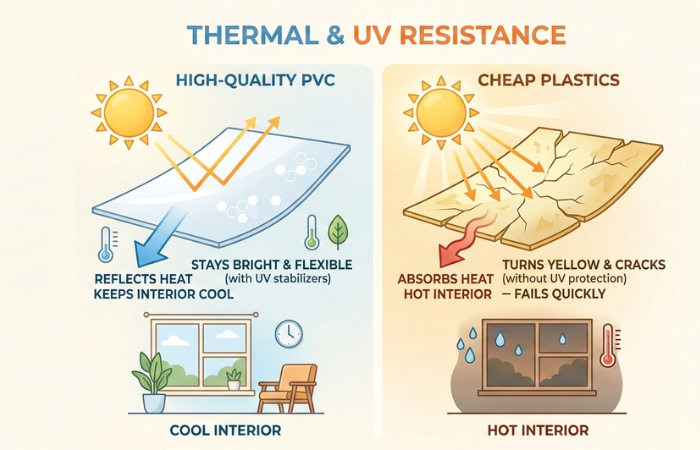
Surface Finishes and Clarity
You have many choices here. You can get a matte finish or a high-gloss shine. Clear PVC is a helpful substitute for glass. It is not quite as clear as acrylic, but it is much harder to break. You should be able to see through it clearly enough for industrial shields.
How PVC Sheets Are Manufactured
Making these sheets is a messy, high-heat business. It is not just melting plastic. It is about the chemistry of your mix.
Raw Materials Used
First, of course, you start with resin. You add plasticizers for flexibility or keep it rigid for construction. Then, you add heat stabilizers. If you skip the stabilizers, the plastic burns inside the machine. Not so great for the final product.
Extrusion Process for PVC Sheets
The extrusion process is the best way to do this for long, continuous sheets. You shove the raw mix through a heated barrel. A giant screw pushes it through a flat die. This will happen at high pressure to ensure the density is even across the board.
Calendering Process for PVC Sheets
If you want thin film or very precise thickness, you use calendering. This involves giant heated rollers. The plastic squeezed between them becomes a flat sheet. You can then use these for laminates or credit cards. It is a bit more expensive than extrusion.
Foaming and Celuka Techniques
Foam board is different. You add a blowing agent. The Celuka process cools the outer surface quickly. This creates a hard, shiny skin while the inside stays light and airy. It is my preferred method for signage because it is stiff but weighs nothing.
Cooling, Cutting, and Finishing
After the sheet leaves the die, it goes through cooling rollers. If it cools too fast, it warps. You need a slow, steady temperature drop. Finally, make sure to use automated saws for clean edges. Rough edges look amateur.
Common Applications of PVC Sheets
You see PVC everywhere, but probably do not notice it. It hides in plain sight because it mimics other materials so well.
Construction and Wall Cladding
This is the big one. You use it to cover ugly brick or damp drywall. It is the best way to do this because it is fast. You do not need to paint it. You just glue it up and walk away.
Signage and Advertising
Print shops love foam PVC. It holds ink better than most plastics. Also, you can cut it into letters with a simple knife. It is the standard for trade show booths and grocery store displays.
Interior Design and Furniture
Note that you want to always check the density for furniture. You can build cabinets out of PVC. It will never warp in a damp kitchen. Sure, it feels a bit like plastic, but once it is laminated, no one can tell the difference.
Packaging and Protection
Clear PVC is used for those annoying blister packs that are hard to open. It is also used for floor protection during renovations. After a few days of boots walking on it, the floor underneath stays perfect.
Bathroom and Wet Area Use
Stop using tiles. Grout gets moldy and gross. PVC sheets for bathrooms have no seams for mold to grow in. Why? The reason is that the surface is non-porous. This can be a useful question: why scrub grout for hours? Just wipe the plastic.
Industrial and Medical Uses
In hospitals, you need surfaces that do not harbor germs. PVC is non-porous. It handles bleach every day without losing its color. In factories, it acts as a splash guard for machines.
Remove the installation instructions and add industrial applications.
Industrial Applications of PVC Sheets
Waste Water Treatment
Thick PVC sheets line the inside of large tanks that process sewage. These sheets stop liquids from leaking out and protect the concrete from eroding. Since the plastic does not react to harsh chemicals, the tanks stay solid for a long time. This material is used because it does not rust or rot when wet.
Cold Storage Room Curtains
Freezer warehouses use clear, flexible PVC strips to hang in doorways. These strips keep the cold air inside while allowing workers to move through. The specific mix of additives keeps the plastic soft so it does not crack at low temperatures. This setup helps reduce the amount of electricity needed to keep the room cold.
Marine Boat Parts
Boat builders use high-density PVC sheets to make internal walls and floors. This material is closed-cell, which means it does not absorb any water. It is much lighter than wood or metal, helping the boat stay buoyant and save fuel. The sheets remain strong even after years of being in salt water.
Semiconductor Cleanrooms
Walls in microchip factories use “antistatic” PVC sheets. These boards prevent static electricity from building up and damaging small electronic parts. The surface is very flat and smooth, so dust cannot stick to it. This keeps the air inside the factory very clean for manufacturing computer chips.
PVC Sheets vs Other Materials
I have a strong preference for PVC in wet areas, but here is how it stacks up against the rest.
PVC Sheets vs Wood
Wood looks better but fails faster. Wood rots, attracts bugs, and needs paint. PVC does none of that. Originally, people hated the “plastic look,” but now the textures are very realistic.
PVC Sheets vs Acrylic
Acrylic is prettier and clearer. On the other hand, it is brittle. If you drop an acrylic sheet, it shatters. PVC is tougher. It is a bit messier to cut compared to acrylic, but it survives much more abuse.
PVC Sheets vs Gypsum or Plasterboard
Gypsum is heavy and dies when it gets wet. PVC is the opposite. In terms of price, gypsum is cheaper, but you spend more on paint and repairs. I would rather pay more upfront for PVC.
PVC Sheets vs Aluminum Composite Panels
Aluminum is stiffer and better for big outdoor signs. But it is expensive. For indoor use, aluminum is overkill. PVC gives you 90% of the benefit for 50% of the cost.
Conclusione
PVC sheets have four important elements: chlorine, carbon, stabilizers, and plasticizers. This is a perfect mix that solves common issues like rot, rust, and regular maintenance. PVC sheets are waterproof and fire resistant materials with a very good life. These sheets provide you with the best and most affordable way to maintain surfaces.
FAQs
Is PVC Sheet Waterproof?
It is entirely non-porous. You can submerge it in water for years, and it will not change shape or rot. This is why it is the top choice for bathrooms.
Are PVC Sheets Fire-Resistant?
Most are. They usually have a Class B1 or Class A rating. They will not start a fire. They melt and char but do not carry a flame.
Can PVC Sheets Be Painted?
You can, but you need a primer made for plastics. If you use regular wall paint, it will peel off in sheets. It is better to just buy the color you want.
How Long Do PVC Sheets Last?
Inside, they last for decades. Outside, they last about 10 to 15 years, depending on the sun. They are much more durable than most people realize.
Are PVC Sheets Eco-Friendly?
Not really. They are plastic. However, they are recyclable. Because they last so long, you do not replace them often, which reduces waste in the long run.

 Italian
  English
  Arabic
  Tibetan
  German
  Spanish
  French
  Hindi
Hindi  Indonesian
  Japanese
  Korean
  Dutch
Dutch  Portuguese
  Thai
Thai  Russian
  Swedish
  Chinese