


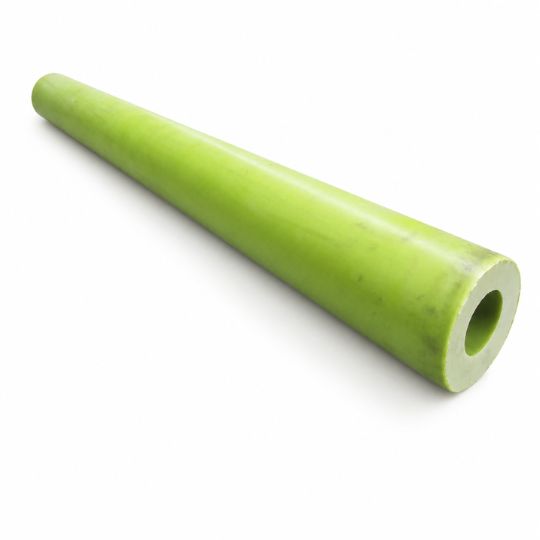
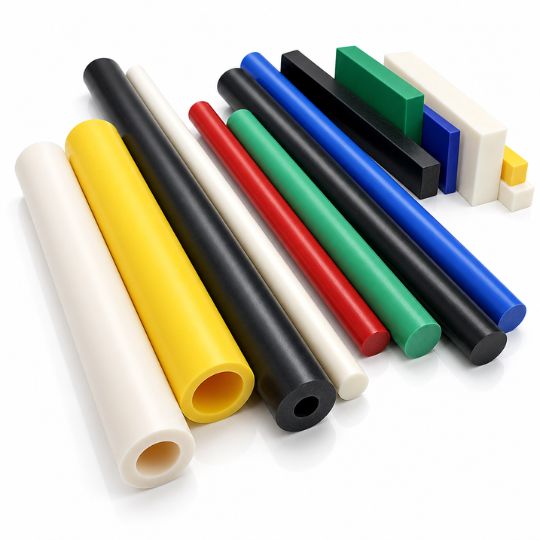
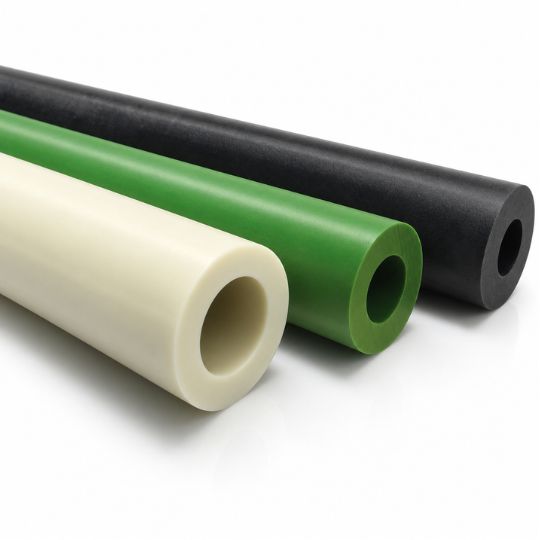
Why You Choose HANSA
- Cast in our own moulds, in our own plant
- A standard mould set that reaches 500 mm outside diameter
- Beyond the standard set: 1000 mm and 1800 mm outside diameter
- A machining centre behind every blank
- Material that runs dry, and keeps running
- Records and process knowledge from the plant that casts it
Nylon Tube Material: Polyamide, Cast or Extruded
The nylon tube material HANSA supplies is a polyamide — the same family behind the nylon 6 and nylon 66 grades you already specify, and the same material we supply as rod, sheet and machined parts. We make it by both routes, so the choice is about your part rather than our capability.
The process is the half that changes the numbers. Extrusion pushes melted pellets through a die; casting polymerises the monomer in a mould made for the size you want. The cast route produces the higher molecular weight, and molecular weight is where wear resistance and impact toughness come from. That is why the largest nylon tube diameters are cast and the thinnest sections are extruded — and why a part that has to survive dry, abrasive service usually starts from cast.
Two properties come with the material rather than the process. It does not rust, so it makes no galvanic couple with the steel shaft it runs on. And it handles oils, greases and dilute alkalis well — though strong acids and phenols attack it, which matters if your part sees aggressive washdown chemicals.
Grades and fillers. The polyamide family is broad, and the suffix on the grade is frequently the whole reason a part succeeds. Nylon 6 (PA6) is the general-purpose grade; nylon 66 (PA66) is the stiffer, higher-melting relative; PA12 and PA11 are the low-moisture members of the family. Fillers change the surface behaviour: oil-filled and molybdenum-disulphide grades are specified where the part has to run without an external lubricant, and glass-filled grades where stiffness and creep resistance matter more than impact. Which of these HANSA casts as tube, and in which colours, is confirmed against your drawing — tell us the grade and we will tell you what we can run.
Nylon Tube Grades and Forms from HANSA
Grades, fillers and both routes — most of them quoted against your drawing, and the extruded sizes ready to order off the list.
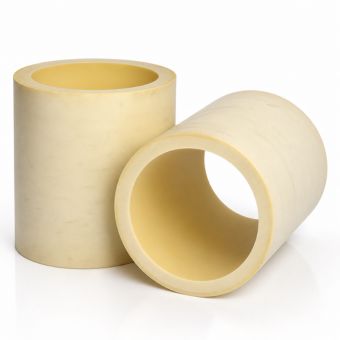
Standing moulds reach 500 mm (19.7 in) outside diameter, with no tooling charge and every size quoted against your drawing. HANSA casts it for sleeves, liners and wear rings.
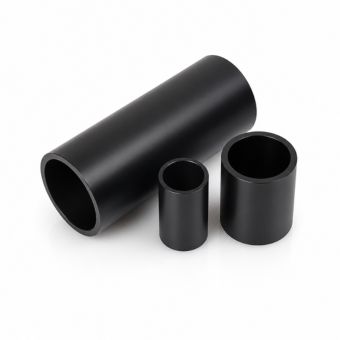
Past a standing mould, a new mould is cut for your size. HANSA casts 1000 and 1800 mm (39.4 and 70.9 in) today, tooling quoted with the tube.
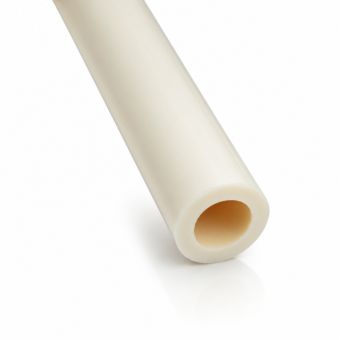
PA6 is the workhorse grade, and HANSA casts nylon 6 tube as a solid-wall blank you machine straight into bushings and wear rings. Bores from 40 mm (1.6 in).
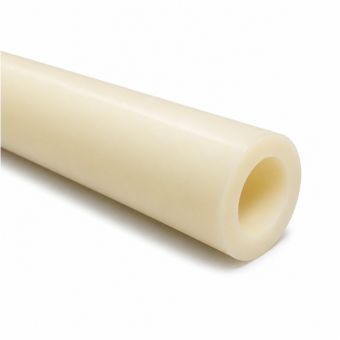
More rigidity than PA6 gives you, at the same bore range: HANSA casts nylon 66 tube for machined sleeves and liners that have to hold their shape.
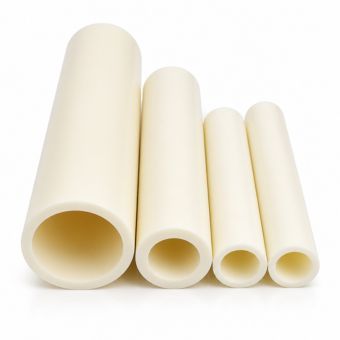
Where you cannot reach a grease point, HANSA’s oil-filled nylon tube carries its own lubricant — cast into the material, not applied. Your bushings run without a schedule.
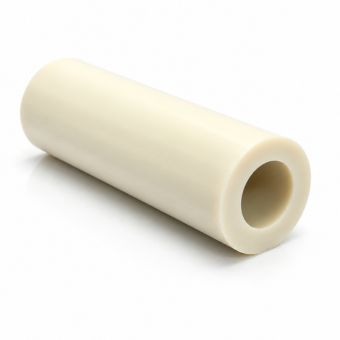
Stiffer and less prone to creep than unfilled nylon — what you want for structural sleeves and load-bearing rings. HANSA casts glass-filled nylon tube from 40 mm (1.6 in) bores.
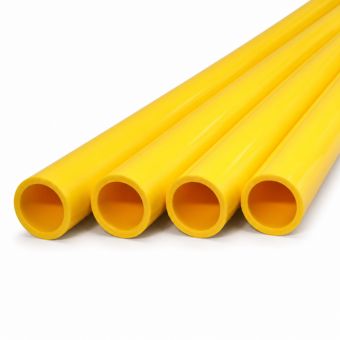
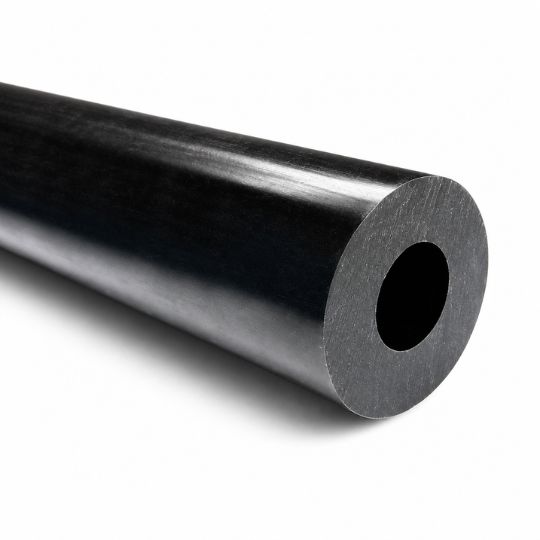
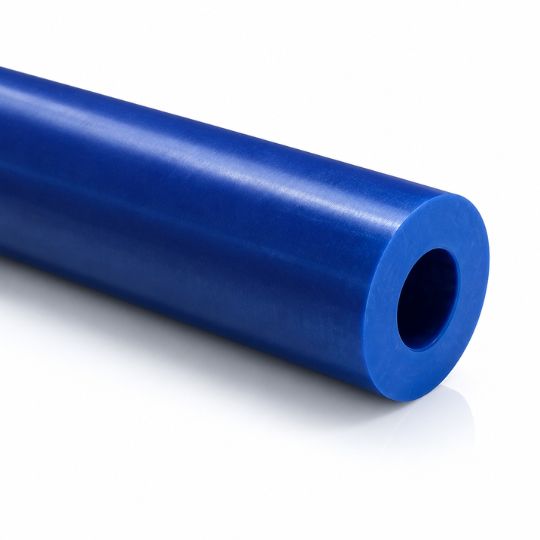
HANSA holds 22 extruded nylon tube sizes, 10 mm to 25 mm (0.4-0.98 in), in natural, black and white. Choose yours.
What a cast nylon tube is – and where it stops being one
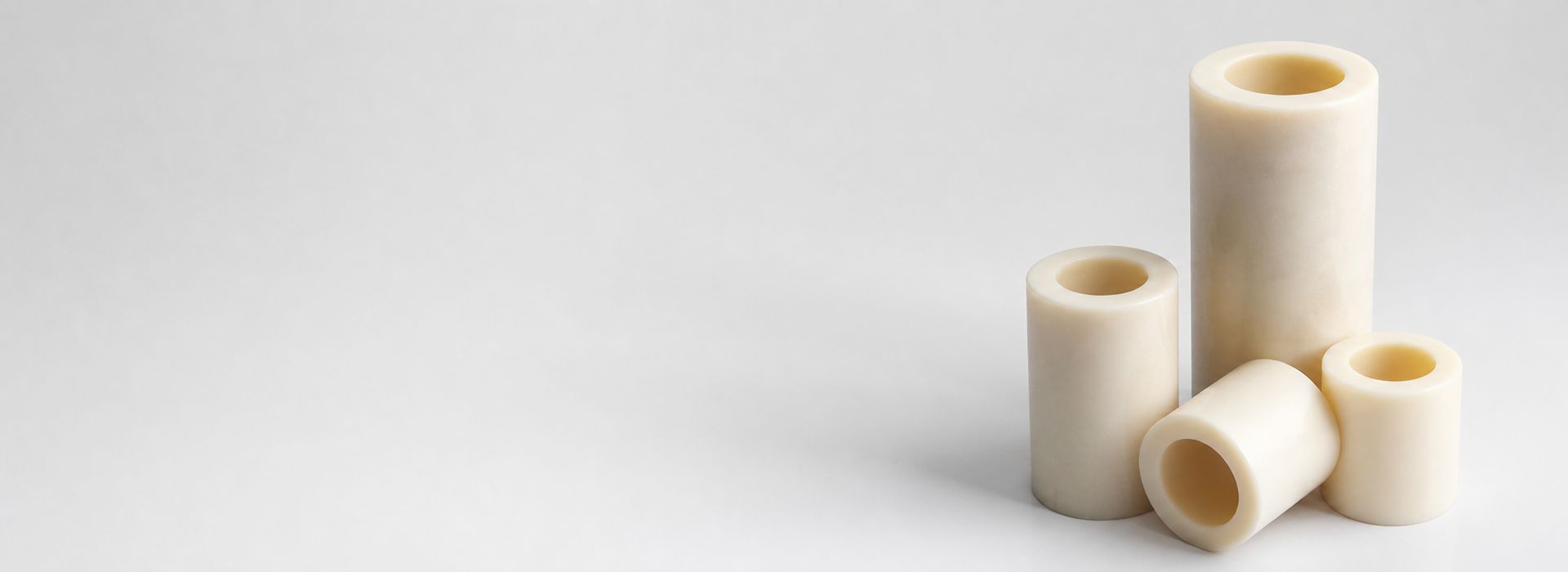
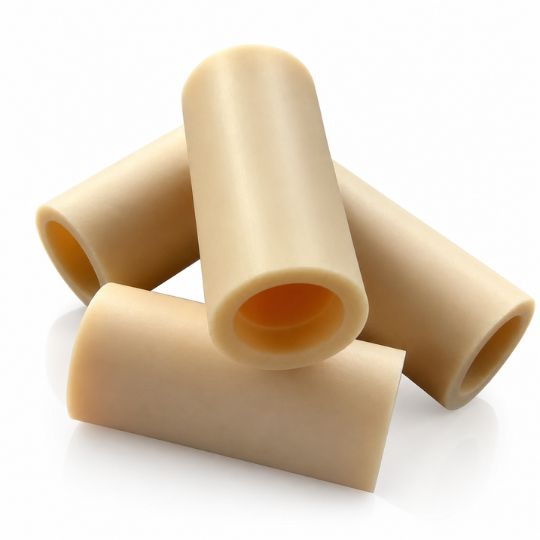
A cast nylon tube from HANSA is a semi-finished hollow blank: monomer-cast (MC) nylon, supplied with a bore through the centre, ready for you to machine into a bushing, sleeve, liner or wear ring.
HANSA makes nylon tube both ways, so this guide covers both. It leads with the cast route, because that is where the size range and the engineering questions sit – the large diameters, the bore-and-wall rule and the moisture behaviour are all cast questions. Extrusion covers the small end, from 10 mm (0.4 in) to 25 mm (0.98 in) outside diameter, and the choice between the two routes has its own section further down.
It is a stock shape. It is not a finished part, and it is not a flexible line to carry anything. The distinction that matters commercially is the one between a tube and a rod, because as the wall thickens a cast tube and a cast rod become the same object. For HANSA’s cast range, we treat a minimum bore of 40 mm (1.6 in) as the practical dividing line between the two – below it the cast nylon rod is the better buy, and we will tell you so rather than quote you a nylon tube you cannot use.
Why the largest diameters are cast, not extruded
Casting and extrusion make the same polyamide by different routes, and each route has a size range where it is the sensible choice.
Extrusion pushes melted pellets through a die. It is continuous, fast, and economical at small diameters and thin walls.
Casting polymerises the monomer directly in a mould, and the mould is made for the size you want. That is why casting is what you reach for when the section is thick or the diameter is large – and why a cast tube in a diameter nobody has tooled yet carries tooling with it.
That is the practical rule on this page. HANSA casts, and every diameter below is a cast diameter.
How large a nylon tube can you order?
Two numbers set the bounds of HANSA’s standard cast range, and one subtraction connects them.
The bore starts at 40 mm (1.6 in). For our cast range, we treat that as the practical dividing line between tube and rod – below it, a bored rod serves you better, because you would be paying casting prices for a machining job.
The wall starts at 10 mm (0.4 in). That is the minimum wall we cast in the standard range, and it thickens from there; take it to solid and the shape is a rod rather than a tube. It is a limit of our mould set rather than a property of nylon – which is why the extruded line, at the small end of the size range, runs walls down to 1.75 mm (0.07 in).
Everything else follows from those two numbers, and the size table on this page works the arithmetic out diameter by diameter. The wall floor sits where it does because a thin cast section is harder to hold as it takes up moisture, and below that thickness extrusion is the better route.
Past the standard range the constraint changes shape rather than disappearing. A cast nylon tube in a diameter nobody has tooled yet carries a mould with it, and a mould is made for one size. That is why an unusual outside diameter is a conversation about your part and your quantity rather than an entry you can pick off a list, and why HANSA quotes the tooling alongside the tube.
It is worth knowing what that range is compared against. US distributors stock cast nylon tube up to roughly 190 mm (7.5 in), and the largest single-piece cast tube listed by a US distributor in our own survey was 292 mm (11.5 in). Our standard moulds run to 500 mm (19.7 in). The same plant supplies other plastic tube materials if your part calls for one of them.
Moisture, and how a wall thickness tolerance is set
This is the part of the page worth reading twice.
Nylon is hygroscopic. It takes up and releases moisture with its surroundings, and it changes dimension as it does. That is a property of the material rather than a fault in the tube.
It does not follow that a cast nylon tube cannot be held to a manufacturing tolerance – it can, and we agree one. What it does mean is that a dimensional figure only holds for a stated condition: variation depends on how the material has been conditioned and the environment it is measured in, so finished dimensions and tolerances are agreed with reference to the supplied condition and the machining process you intend to run.
That is why HANSA works from your finished size instead of publishing a blanket figure. A number on a page would be measured by you on arrival, in your workshop air, against whatever the material had absorbed on the way to you – and when the reading did not match, the printed number rather than the material would have been the problem.
Agreeing it up front costs a conversation. Discovering it at the machine costs a run.
What moisture movement means at your machine
Three things follow every time you machine a cast nylon tube, and all three sit on your side of the fence.
Tell us the finished size you need rather than the size you expect to receive. If your part finishes at a bore of 60 mm (2.4 in), specify 60 mm, and the material will arrive with enough left on the wall for you to take it there.
Decide when you measure. A cast nylon tube measured the day it lands and the same tube measured a fortnight later in a different workshop are two different readings off one piece.
Build the allowance into your process, not into the order. Cutting a thick cast section takes away material that was restraining the piece, and it can move again after the cut. If the fit is tight, leave yourself a finishing pass.
Why a cast nylon tube replaces a bronze bushing
The substitution most buyers are actually making is bronze to a cast nylon tube, and it holds up for four reasons that compound.
The first is friction. A cast nylon tube runs against a steel shaft with a low coefficient of friction and needs no external lubricant, so the grease nipple, the oil line and the maintenance route all come off the drawing.
The second is what happens in a dirty plant. Nylon is softer than the steel it runs on, so abrasive grit can press into the nylon surface and stay there instead of being dragged around the clearance and wearing the shaft. In some contaminated, low-speed applications that is an advantage over a metal bearing – but it is not a general rule. Bearing performance also turns on load, speed, shaft hardness and finish, the nature of the contamination and the running temperature, and a bronze bearing specified for a contaminated duty can be the better answer.
The third is shock. Cast nylon has lower stiffness and good impact resistance, so it absorbs and damps shock loads that a metal bearing would transmit more directly. On a star wheel or a sprocket that takes a jam every shift, that difference shows up in service life.
The fourth is weight and noise. A cast nylon tube weighs a fraction of the bronze it replaces, and it damps vibration where metal rings.
Where the substitution fails is temperature and dimension rather than load. If the part runs hot, or if your design depends on a clearance that survives a change of season, bronze is still the answer, and HANSA will say so rather than take the order.
Where a nylon tube earns its place, and where it does not
A cast nylon tube is the right starting point when several of these are true: you need a large-diameter hollow section, you want toughness rather than stiffness, you are replacing bronze or steel and would rather not lubricate, you are running low speed against high load, and you would prefer to machine the part from one piece of stock instead of assembling it. If your part is flat rather than hollow, cast nylon sheet is the same material in a different form.
It is the wrong starting point in three situations, and it is cheaper to hear them from HANSA now.
You cannot hold a metal-tolerance fit on an as-cast surface. The cut surface machines well; the cast skin is not a bearing face.
You cannot treat it as dimensionally stable. If your design assumes a fixed clearance that survives a change of season or a move to a different plant, choose a material that is.
It is not the right choice for high-temperature applications. Cast nylon has no place where the operating temperature is high, but the allowable operating temperature depends on the grade, the load, the speed and the service conditions – so it is a selection question rather than a single figure. We would rather say that than sell you the tube. Nylon’s thermal behaviour is worth understanding before you specify it anywhere near heat.
Choosing between cast and extruded
| Cast (MC) nylon tube | Extruded nylon tube | |
| How it is made | monomer polymerised in a mould | melted pellets pushed through a die |
| Best suited to | large diameters, thick walls | 10-25 mm outside diameter, walls of 1.75-5.75 mm |
| Molecular weight | higher, which is where the wear and impact resistance comes from | lower |
| Changing the size | needs a mould made for the size | die-based, cheaper to change |
| Dimensional behaviour | moves with moisture | moves with moisture |
| Typical use | bushings, liners, large sleeves, wear rings | small-bore sections and long lengths |
Both routes are HANSA’s own. Cast nylon tube covers the large diameters this page is built around. Extruded nylon tube covers the small end: outside diameters from 10 mm (0.4 in) to 25 mm (0.98 in), walls from 1.75 mm (0.07 in) to 5.75 mm (0.23 in), in natural, black and white. Extruded also has the practical advantage of a stocked list: those 22 combinations are held as sizes you can order against directly, where a cast diameter above the standing mould set begins with tooling. Which route suits your part depends on the diameter and the wall, so send us the size you need and we will tell you which one it runs on – rather than answering with a catalogue entry.
Which grade you end up with matters more than most buyers expect, and nylon 6 and nylon 66 do not behave the same way under load or in heat.
What HANSA needs from you to quote
Quoting a nylon tube takes less back-and-forth than most buyers expect. Four things, and you will get a number rather than a range: the outside diameter, the bore, the length you want, and the quantity.
If the outside diameter is above 500 mm (19.7 in), say so in the first line. That tells us the tooling conversation has to happen, and you will get the mould cost quoted with the tube instead of separately three emails later.
Send us your drawing, or those four numbers, and you will have your quote.

 Indonesian
  English
  Arabic
  Tibetan
  German
  Spanish
  French
  Hindi
Hindi  Italian
  Japanese
  Korean
  Dutch
Dutch  Portuguese
  Thai
Thai  Russian
  Swedish
  Chinese