


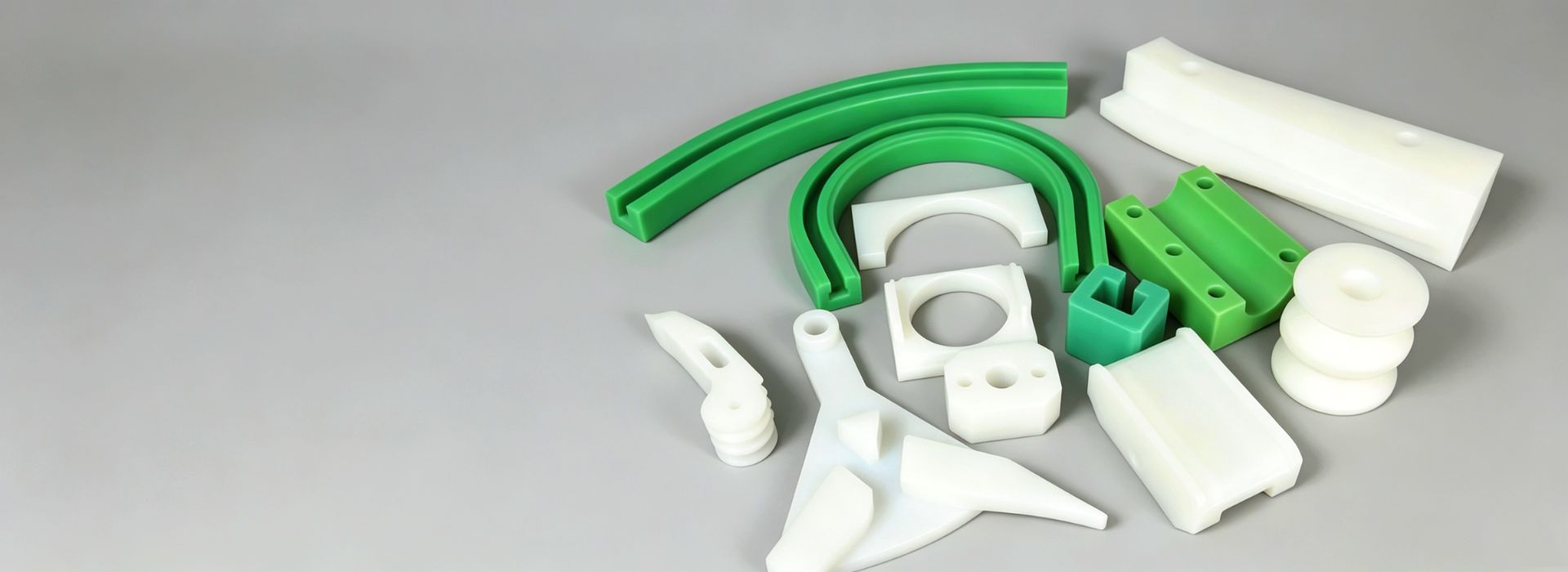
What is UHMW PE Parts
UHMW-PE (ultra-high-molecular-weight polyethylene) is a high-performance engineering plastic known for its excellent wear resistance and impact strength. It is commonly machined into wear components, mechanical parts, and other industrial components.
HANSA supplies UHMW-PE parts for a wide range of industries. Whether you operate in petrochemical processing, marine engineering, food processing, or equipment manufacturing, we have experience working with long-term customers in these sectors. Our UHMW-PE components include bearings, guide rails, wear strips, impact pads, and more.
HANSA has a dedicated workshop for machining UHMW-PE and other engineering plastic components, supported by experienced technicians. This enables us to provide end-to-end support for your project, from technical drawing preparation to component production and machining.
Custom UHMW Parts Manufactured by HANSA
As a UHMW parts manufacturer, HANSA produces custom UHMW conveyor parts and other components for guiding, rotating, supporting, and wear-protection functions. You can order these UHMWPE parts to match an existing assembly or a new equipment design, with machining details developed around your drawings and application.
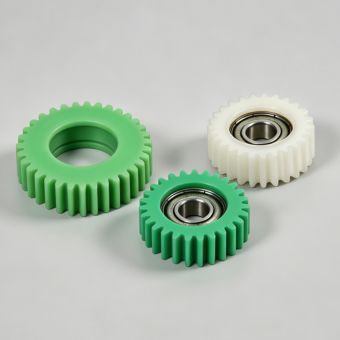
UHMW gears combine wear resistance, impact tolerance, low sliding friction, and quieter tooth engagement than comparable metal components. They are used in conveyors, packaging machinery, food-processing equipment, and other light- to moderate-duty transmission systems. HANSA machines custom tooth profiles, hubs, bores, keyways, and mounting features so the finished gear fits your shaft and surrounding assembly.
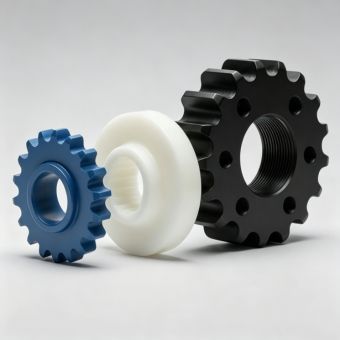
UHMW sprockets engage and guide chains while helping reduce contact noise, corrosion, and wear on mating components. Their low weight and resistance to moisture make them useful in conveyor lines, material-handling equipment, packaging systems, and wet processing environments. HANSA can produce custom teeth, bores, keyways, hubs, and mounting holes from your sprocket drawing or matching sample.
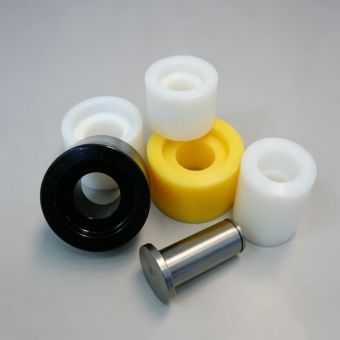
UHMW rollers support, move, or guide products with a wear-resistant surface that absorbs impact and runs with less noise than metal-to-metal contact. They are widely used in conveyor systems, packaging lines, food-processing machinery, marine equipment, and general industrial handling. HANSA can machine straight or profiled rollers with custom outside diameters, bores, grooves, flanges, shoulders, and shaft interfaces.
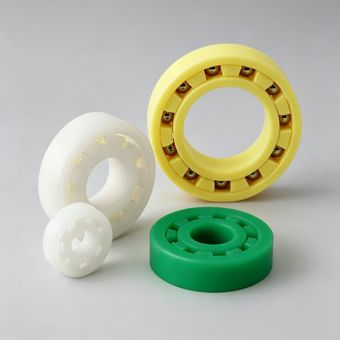
UHMW bearings provide a low-friction interface for shafts and moving assemblies while resisting moisture and many industrial chemicals. In suitable applications, they can reduce lubrication demand and protect metal mating surfaces from direct contact. You can use them in conveyors, food-processing machinery, marine equipment, and general industrial systems. HANSA machines custom bearing geometries, bores, flanges, grooves, and mounting features.
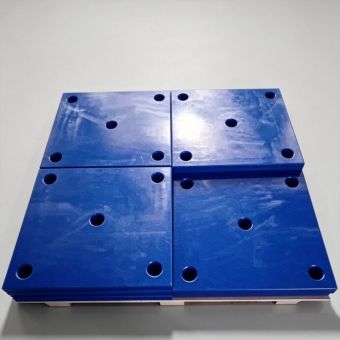
UHMW wear plates create a replaceable surface between moving material and the equipment structure. Their abrasion resistance, impact tolerance, low friction, and resistance to moisture help protect metal surfaces and promote smoother material flow. Typical uses include chutes, hoppers, conveyor transfer points, loading systems, and bulk-material equipment. HANSA supplies custom-cut and machined plates with holes, slots, recesses, and installation features.
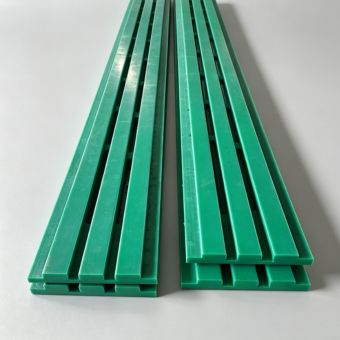
UHMW wear strips provide a low-friction running surface for chains, belts, sliding assemblies, and conveyed products. They help reduce drag, operating noise, and direct wear on the equipment frame or mating component. These strips are common in conveyor, packaging, bottling, food-processing, and automated handling systems. HANSA can machine flat, grooved, stepped, beveled, or custom-profile strips to suit your installation.
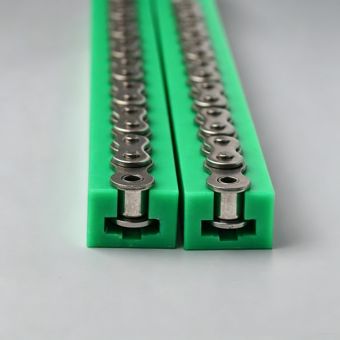
UHMW guide rails control the path of chains, containers, packages, and other products as they move through conveying or processing equipment. Their smooth, wear-resistant contact surface helps limit misalignment, impact, scuffing, and unnecessary resistance. HANSA produces straight, curved, channel-shaped, and custom-profile rails for packaging lines, food and beverage equipment, logistics systems, and industrial conveyors.
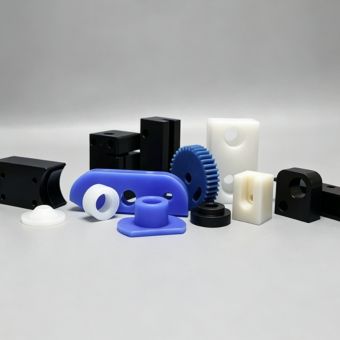
Custom UHMW structural components include support blocks, spacers, guards, mounting blocks, isolation pieces, impact elements, and complex nonmetallic shapes. They bring low weight, corrosion resistance, impact tolerance, and design flexibility to industrial assemblies. HANSA combines CNC milling, turning, drilling, cutting, and thermoplastic welding to manufacture individual components or fabricated structures around your drawings and installation needs.
In-House Machining for Custom UHMW Parts
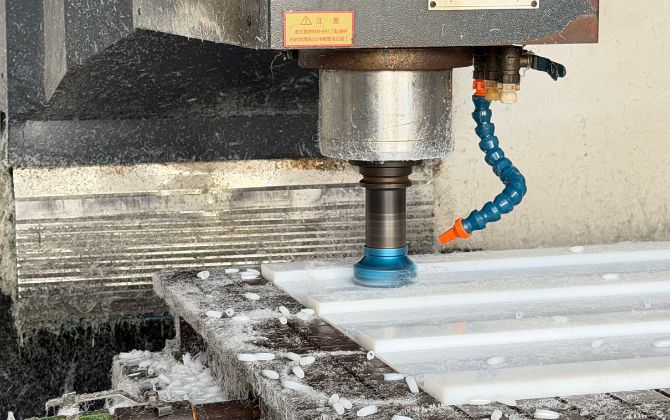
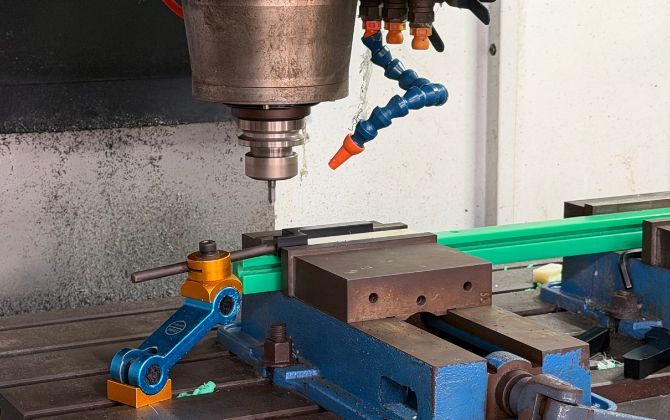
HANSA operates a dedicated engineering plastics machining workshop, enabling you to source UHMW material and finished components through one coordinated production process. Our capabilities include cutting, CNC milling, drilling, slotting, profiling, turning, and other machining operations. Whether you require wear plates, guide rails, rollers, gears, or custom structural components, HANSA can manufacture your UHMW parts according to your drawings and assembly requirements.
How to Specify Custom UHMW Parts for Reliable Industrial Service
Choosing UHMW-PE is only the first step in developing a reliable component. Two parts made from the same general material can perform very differently when their functions, loads, mating surfaces, temperatures, and installation methods are different. If you define those conditions before production, HANSA can manufacture custom UHMW parts that fit the equipment and address the actual wear, motion, or impact problem.
UHMW-PE is widely selected for its combination of abrasion resistance, impact strength, low friction, moisture resistance, and chemical resistance. These characteristics make it useful for wear strips, guide rails, rollers, bearings, gears, sprockets, liners, and protective components. However, the material name alone does not define the correct grade, dimensions, tolerances, or manufacturing method for your part.
Start with the Job the Part Must Perform
Begin by describing what the component does inside the equipment. A wear plate protects the machine structure from moving bulk material. A guide rail controls the path of a chain or package. A roller supports or redirects a moving product. A gear or sprocket transfers motion, while a bearing creates a sliding interface around a shaft.
This functional description gives HANSA a better basis for reviewing your custom UHMW-PE parts than a drawing alone. It identifies which surfaces matter most, where contact occurs, and whether the priority is wear life, smooth movement, impact absorption, product protection, noise reduction, corrosion resistance, or low maintenance. When several requirements apply, rank the ones that have the greatest effect on equipment performance.
Treat Wear as a Complete System
Wear resistance is not a fixed service-life promise. The result depends on the entire contact system: pressure, sliding speed, type of motion, mating material, surface condition, abrasive particles, temperature, alignment, and operating cycle. A UHMW wear strip running beneath a clean conveyor chain faces a different wear mechanism from a liner exposed to sharp bulk solids or a bearing operating around a rotating shaft.
For rotating UHMW machined parts, consider how the load and speed generate heat at the contact surface. For gears and sprockets, tooth engagement, alignment, pitch accuracy, and the mating component affect how the load is distributed. For guide rails and wear plates, the direction of movement, mounting method, and condition of the contacting surface can influence both wear and product flow. Looking at the complete system helps you avoid selecting a material from one property in isolation.
Account for Stiffness, UHMW Creep, and Thermal Expansion
UHMW-PE is tough and impact tolerant, but it is more flexible than metals and many rigid engineering plastics. Under a sustained load, the material can deform gradually through creep. This does not prevent UHMW plastic parts from serving as supports, spacers, mounting blocks, or protective structures, but the geometry and load path need to suit the material.
If a component must hold precise alignment under continuous structural loading, its section thickness, support points, fastening method, and allowable movement become important. A broad, well-supported wear surface behaves differently from a thin projecting feature carrying the same force. For applications in which rigidity and close positional control dominate the design, another engineering plastic may need to be compared with UHMW-PE.
Temperature also affects dimensions and operating clearance. UHMW-PE typically undergoes greater thermal expansion than common metals, so a part that fits at inspection temperature may behave differently after the equipment heats or cools. You can reduce assembly problems by identifying the operating temperature range, critical clearances, mating materials, and dimensions that control movement or alignment.
Choose the Material Grade for the Environment
The term `UHMW` covers more than one material option. Good UHMW material selection starts with the environment and the function of the finished part. The choice between virgin UHMW and reprocessed UHMW can affect consistency, appearance, performance, documentation, and cost. Your project may also call for a particular color or a modified grade for static control, outdoor exposure, lubrication, detectability, or another specialized requirement.
A project that specifies food-contact UHMW, antistatic UHMW, or UV-resistant UHMW needs the exact grade and supporting information connected to that requirement. These options can change mechanical, electrical, surface, and regulatory characteristics, so the grade should follow the application rather than the product color alone.
Food-contact requirements deserve particular care. A general statement that UHMW-PE is used in food equipment does not prove that every resin, color, additive package, stock shape, or finished component meets the same requirement. If your UHMW parts will contact food, specify the market, contact conditions, temperature, cleaning process, and documentation you need. HANSA can then match the quotation and material documentation to the applicable product rather than relying on a blanket claim.
Chemical exposure should also be described by the actual substance, concentration, temperature, contact duration, and cleaning cycle. UHMW-PE is resistant to many industrial chemicals, but compatibility should be evaluated under the conditions in which your component will operate. Outdoor equipment may additionally require attention to ultraviolet exposure and weathering.
Design the Part for UHMW Machining and Assembly
A drawing created for a metal component is not always ready to use for UHMW machining. Unnecessarily tight tolerances, thin unsupported walls, sharp internal corners, large changes in section thickness, and highly constrained press fits can make the component less stable or add machining cost without improving its function.
Focus UHMW machining tolerances on the features that control assembly or performance. These may include a bearing bore, gear center distance, sprocket tooth profile, roller shaft interface, guide-rail mounting surface, or the position of holes in a replacement wear plate. Other dimensions can often use practical manufacturing tolerances. Smooth transitions and suitable radii can also reduce stress concentration and make complex UHMW components easier to produce consistently.
The mounting method should allow the plastic component to respond to temperature and load without buckling or becoming overconstrained. Bolted wear plates and guide rails may need suitable hole geometry and edge distance. Rotating components require an appropriate relationship between the bore, shaft, running clearance, and retention method. Welded UHMW assemblies need joint access and enough material around the connection to support fabrication.
Match the Manufacturing Process to the Geometry
HANSA uses cutting, CNC milling, turning, drilling, and welding to produce different forms of custom machined UHMW parts. Turning is suitable for rotational components such as rollers and bearings. Milling creates gear and sprocket features, guide profiles, wear plates, pockets, slots, and complex three-dimensional surfaces. Drilling and secondary machining add mounting holes, counterbores, recesses, and other assembly details.
Cutting can prepare simple wear surfaces or blanks efficiently, while thermoplastic welding can join larger fabricated structures that would be impractical to machine from one thick block. A component may use several processes before final inspection. Selecting the process from the geometry, quantity, critical features, and installation requirements helps control material use and avoids adding operations that do not improve the finished part.
Define the Information That Changes the Result
To prepare a useful quotation, provide a drawing or model, required quantity, material or grade requirement, and the operating conditions that affect performance. Identify the dimensions that control fit, motion, alignment, or replacement interchangeability. If a compliance document is required, state the exact requirement at the quotation stage so it can be connected to the proposed material.
For a replacement component, you can also explain how the existing part wears, deforms, cracks, becomes noisy, or damages the mating surface. That information may reveal whether the main issue comes from the material, geometry, mounting method, or operating environment. It gives HANSA more context when reviewing the manufacturability of your UHMW-PE component.
Build the Part Around Its Real Operating Conditions
The best custom UHMW parts are not defined by a long list of general material advantages. They are defined by how well the selected grade, geometry, tolerances, and manufacturing method work together in the actual equipment. When you share the part function and operating conditions along with your drawing, HANSA can give you a more focused manufacturing proposal.
If your project also requires plate stock or cut blanks, you can review HANSA’s UHMWPE sheet options alongside the finished component requirements.
Send HANSA your drawing, quantity, and application details to discuss custom UHMW gears, sprockets, rollers, bearings, wear plates, wear strips, guide rails, or other UHMW wear parts for your project.

 Hindi
Hindi  English
  Arabic
  Tibetan
  German
  Spanish
  French
  Indonesian
  Italian
  Japanese
  Korean
  Dutch
Dutch  Portuguese
  Thai
Thai  Russian
  Swedish
  Chinese